

Chemistry
Get insights from 6.9k questions on Chemistry, answered by students, alumni, and experts. You may also ask and answer any question you like about Chemistry
Follow Ask QuestionQuestions
Discussions
Active Users
Followers
New answer posted
12 months agoContributor-Level 10
q = 0 as adiabatic process is given
W = 0 as paxt = 0
q + W = DU
q = 0
W = 0
Þ DU = 0
New answer posted
12 months agoContributor-Level 10
PF5, PCl5, PBr5, Fe (CO)5 Þ Trigonal bipyramidal
BrF5 Þ Square pyramidal
[PtCl4]2– Þ Square planar
SF6 Þ Octahedral
New answer posted
12 months agoContributor-Level 10
Order of reactivity towards electrophile
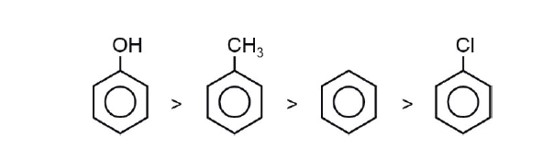
Strength of +M/+R : –OH > –CH3 > –Cl
In case of halogens, their –I effect dominates over
+M hence –Cl is deactivating and is lesser reactive than for incoming electrophile.
New answer posted
12 months agoContributor-Level 10
CuSO4 acts as catalyst in Kjeldahl's method of estimation of nitrogen.
New answer posted
a year agoContributor-Level 10
This is an example of chromyl chloride test
K2Cr2O7 + 4KCl + 6H2SO4? 6KHSO4 + 2CrO2Cl2 + 3H2O
Oxidation state of Cr is +6.
New answer posted
a year agoContributor-Level 10
The balanced reaction is as follows
2 mole react with 16 mole H+
1 mole will react with 8 mole H+
New answer posted
a year agoContributor-Level 10
A, D, E, K vitamins are fat soluble vitamins, are stored in liver and adipose tissue.
While vitamin B and vitamin C are water soluble and must be supplied regularly in diet (not stored) (except vitamin B12)
Taking an Exam? Selecting a College?
Get authentic answers from experts, students and alumni that you won't find anywhere else
Sign Up on ShikshaOn Shiksha, get access to
- 67k Colleges
- 1.2k Exams
- 716k Reviews
- 1850k Answers