

Class 11th
Get insights from 8k questions on Class 11th, answered by students, alumni, and experts. You may also ask and answer any question you like about Class 11th
Follow Ask QuestionQuestions
Discussions
Active Users
Followers
New answer posted
a year agoContributor-Level 10
The reaction is Fe (s) + 2HCl (aq) → FeCl? (aq) + H? (g). 50 g of Fe corresponds to 0.89 moles, which produces 0.89 moles of H? (g). The work done by the gas is calculated using W = -Δn_gasRT. The work done by the gas is the positive value, 2218 J.
Answer: 2218 J
New answer posted
a year agoContributor-Level 10
The partial pressure of dry N? is 758 - 14 = 744 mm Hg. Using the ideal gas law (PV=nRT), the moles of N? are calculated to be 1.25 * 10? ³ mol. This corresponds to 0.035 g of N? The percentage of nitrogen in the sample is (0.035 g / 0.1840 g) * 100, which is 18.96%.
Answer: 19 (Rounded)
New answer posted
a year agoContributor-Level 10
This problem involves the stoichiometry of acid-base neutralization.
o For the reaction with H? PO? (a dibasic acid), 100 mL of NaOH is required.
o For the reaction with H? PO? (a monobasic acid), 200 mL of NaOH is required.
New answer posted
a year ago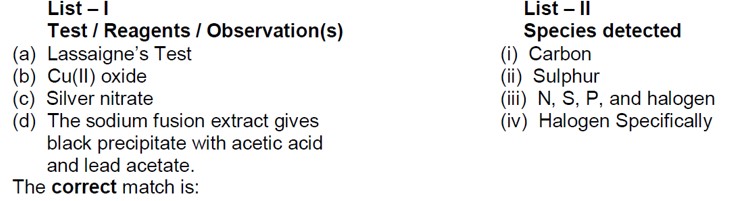
Contributor-Level 10
The Lassaign's test is a qualitative analysis method used to detect nitrogen, sulfur, phosphorus, and halogens in an organic compound. Copper (II) oxide is used to detect carbon. In the sodium fusion extract, halides (X? ) precipitate with AgNO? , and sulfide (S²? ) precipitates as black PbS.
New answer posted
a year agoContributor-Level 9
ΔG° = + 25.2 kJ / mol
Using ΔG° = -2.3 RT log Kp
25.2 * 10³ = - 2.3 * 8.3 * 400 log Kp
o 3.3 = log Kp
log (1 / 2*10³) = log Kp
Kp = 1 / (2*10³)
Using; Kp = Kc (RT)
1 / (2*10³) = Kc (0.083 * 400)? ¹
New answer posted
a year agoContributor-Level 9
V (Na? CO? ) = 10 mL
Volume of HCl used will be 5 mL (average of titre values)
Meq of HCl = meq of Na? CO?
(M * n-factor * V)HCl = (M * n-factor * V)Na? CO?
0.2 * 1 * 5 = M * 2*10
M= 0.05 M
M= 50 mM
Taking an Exam? Selecting a College?
Get authentic answers from experts, students and alumni that you won't find anywhere else
Sign Up on ShikshaOn Shiksha, get access to
- 67k Colleges
- 1.2k Exams
- 716k Reviews
- 1850k Answers