

Class 12th
Get insights from 12k questions on Class 12th, answered by students, alumni, and experts. You may also ask and answer any question you like about Class 12th
Follow Ask QuestionQuestions
Discussions
Active Users
Followers
New answer posted
a year agoContributor-Level 10
The VFX Institute has not given a specific aggregate to be eligible for admission in the certificate courses. However, since 60% is a decent score candidates can get admission in the institute. Fill the application form online and move ahead with the admission process.
New answer posted
a year agoContributor-Level 10
You can identify whether a medium has higher or lower refractive index through the three ways. The first step is to observe the direction of bending. In this case, if the light is bending towards the normal, the second medium has higher refractive index. If the light bends away from normal, first medium has higher index of refraction.
In the second method, you can use Snell's law. If the second angle is smaller than the first one, second medium has higher refractive index. In case the first angle is smaller than second one, first medium has higher index of refraction. The third method is critical angle method where, if the light u
New answer posted
a year agoContributor-Level 10
When these two media are compared, then, it is evident that rarer medium has lower refracted index as compared to denser medium. Denser media like glass and water have higher refractive index whereas rarer medium like air and vacuum have lower refractive index. Due to this, the light will bend towards the normal when it travels from rarer to denser medium. On the other hand, light will bend away from normal when it travels from denser to a rarer medium.
New answer posted
a year agoContributor-Level 10
Whenever a light ray travels from a rarer medium to a denser medium through a spherical surface, relationship between object distance (u), image distance (v), radius of curvature (R) and refractive index ( and ) is given by refraction formula for spherical surfaces as follows.
- is the refractive index of medium that contains the object (on the left side)
- is refractive index of medium that will contain the image (on the right side)
New answer posted
a year ago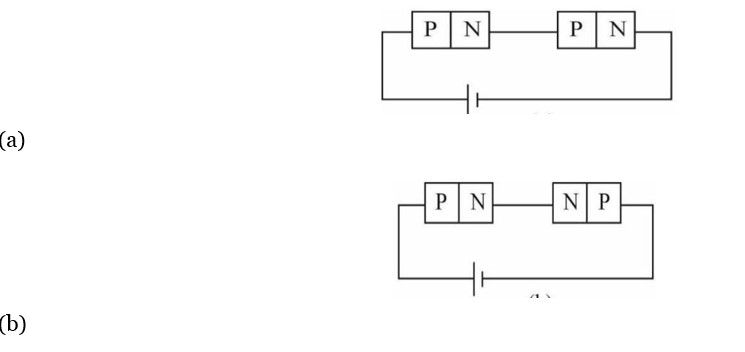
Contributor-Level 9
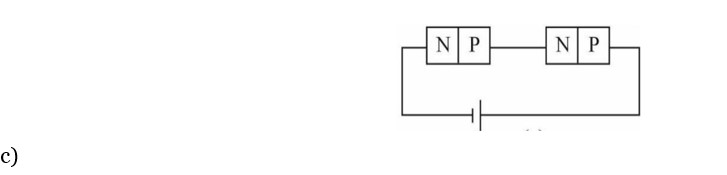
In (a) & (c) circuits, both the junctions are in same biasing conditions so offers equal resistances.
New answer posted
a year agoContributor-Level 10
Capacitive reactance (say) on decreasing the operating frequency reduces
As is inversely proportional to the value of increase
As
increases, therefore displacement current Id decreases.
Taking an Exam? Selecting a College?
Get authentic answers from experts, students and alumni that you won't find anywhere else
Sign Up on ShikshaOn Shiksha, get access to
- 67k Colleges
- 1.2k Exams
- 716k Reviews
- 1850k Answers