Introduction to Three Dimensional Geometry

Get insights from 93 questions on Introduction to Three Dimensional Geometry, answered by students, alumni, and experts. You may also ask and answer any question you like about Introduction to Three Dimensional Geometry

Follow Ask Question
93

Questions

0

Discussions

0

Active Users

0

Followers

New question posted

a year ago

0 Follower

New answer posted

a year ago

0 Follower 5 Views

P
Payal Gupta

Contributor-Level 10

This is a short answer type question as classified in NCERT Exemplar
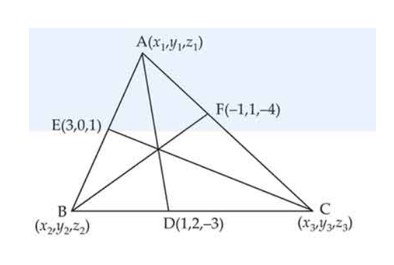
Let  the  coordinates  of  the  vertices  of  ΔABC  beA(x1,y1,z1),  B(x2,y2,z2)  and  C(x3,y3,z3)Mid point of  BC=(1,2,−3)∴        1=x2+x32       ⇒x2+x3=2                                   …(i)           2=y2+y32       ⇒y2+y3=4                                …(ii)and   −3=z2+z32       ⇒z2+z3=−6                            …(iii)Mid  point of  AB=(3,0,1)∴        3=x1+x22       ⇒x1+x2=6                                    …(iv)           0=y1+y22       ⇒y1+y2=0                                    …(v)and   1=z1+z22       ⇒z1+z2=2                                       …(vi)Similarly,  Mid point of  AC=(−1,1,−4)∴         −1=x1+x32       ⇒x1+x3=−2                              …(vii)                1=y1+y32       ⇒y1+y3=2                                …(viii)and  −4=z1+z32       ⇒z1+z3=−8                                   …(ix)Adding  eq.(i),(iv)  and  (vii)  we  get,     2x1+2x2+2x3=2+6−2=6⇒        x1+x2+x3=3⇒                   6+x3=3          ⇒x3=−3      [?From  eq.(iv)]⇒                   x1+2=3          ⇒x1=1          [?From  eq.(i)]⇒                   x2−2=3          ⇒x2=5          [?From  eq.(vii)]So,  x1=1,  x2=5  and  x3=−3Similarly,  Adding  eq.(ii),(v)  and  (viii)  we  get,     2(y1+y2+y3)=4+0+2=6⇒       y1+y2+y3=3

⇒                   y1+4=3          ⇒y1=−1⇒                   0+y3=3          ⇒y3=3⇒                   y2+2=3          ⇒y2=1So,  y1=−1,  y2=1  and  y3=3Adding  eq.(iii),(vi)  and  (ix)  we  get,     2(z1+z2+z3)=−6+2−8=−12⇒       z1+z2+z3=−6⇒                   z1−6=−6          ⇒z1=0         [?From  eq.(iii)]⇒                   2+z3=−6          ⇒z3=−8      [?From  eq.(vi)]⇒                   z2−8=−6          ⇒z2=2So,  z1=1,  z2=1  and  z3=−8.So,  the  points  are  A(1,−1,0),  B(5,1,2)  and  C(−3,3,−8).∴  Centroid  of  the  triangle           G=(1+5−33,−1+1+33,0+2−83)=(1,1,−2)Hence,  the  required  c<<

New answer posted

a year ago

0 Follower 6 Views

P
Payal Gupta

Contributor-Level 10

This is a short answer type question as classified in NCERT Exemplar
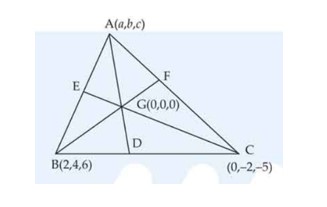
Let  the  coordinates  of  the  third  vertex  i.e.,  A  be  (a,b,c)  Since the  centroid  is  at  origin  i.e,(0,0,0)∴        0=a+2+02       ⇒a=−2           0=b+4−22       ⇒b=−2and   0=c+6−52       ⇒c=−1Hence,  the  required  coordinates  are  (−2,−2,−1).

New answer posted

a year ago

0 Follower 5 Views

P
Payal Gupta

Contributor-Level 10

This is a short answer type question as classified in NCERT Exemplar
G i v e n     v e r t i c e s     a r e     A ( 0 , 4 , 1 ) , B ( 2 , 3 , − 1 )     a n d     C ( 4 , 5 , 0 )               A B = ( 2 − 0 ) 2 + ( 3 − 4 ) 2 + ( − 1 − 1 ) 2 = 4 + 1 + 4 = 9 = 3               B C = ( 4 − 2 ) 2 + ( 5 − 3 ) 2 + ( 0 + 1 ) 2 = 4 + 4 + 1 = 9 = 3               A C = ( 4 − 0 ) 2 + ( 5 − 4 ) 2 + ( 0 − 1 ) 2 = 1 6 + 1 + 1 = 1 8 ?     ( 3 ) 2 + ( 3 ) 2 = ( 1 8 ) 2 S o ,     A B 2 + B C 2 = A C 2 . H e n c e ,     Δ A B C     i s     a     r i g h t     a n g l e d     t r i a n g l e .

New answer posted

a year ago

0 Follower 10 Views

P
Payal Gupta

Contributor-Level 10

This is a short answer type question as classified in NCERT Exemplar

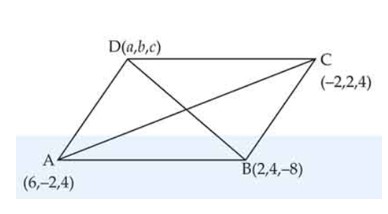
Let  the  coordinates  of  the  fourth  vertex  be  (a,b,c)We  know  that  the  diagonals  of  a    parallelogram bisect  each  other.∴  Midpoint  of  diagonal  AC=(6−22,−2+22,4+42)=(2,0,4)and  the  midpoint  of  diagonal  BD=(a+22,b+42,c−82)∴        a+22=2     ⇒a=2           b+42=0     ⇒b=−4           c−82=4     ⇒c=16Hence,  the  required  coordinates  are  (2,−4,16).

New answer posted

a year ago

0 Follower 10 Views

P
Payal Gupta

Contributor-Level 10

This is a short answer type question as classified in NCERT Exemplar

Given  points  are  A(1,−1,3),B(2,−4,5)  and  C(5,−13,11)       AB=(2−1)2+(−4+1)2+(5−3)2=1+9+4=14       BC=(5−2)2+(−13+4)2+(11−5)2=9+81+36=126=314       AC=(5−1)2+(−13+1)2+(11−3)2=16+144+64=224=414Here,  we  observe  that  14+314=414So,  AB+BC=AC.Hence,  the  given   points are  collinear.

New answer posted

a year ago

0 Follower 4 Views

P
Payal Gupta

Contributor-Level 10

This is a short answer type question as classified in NCERT Exemplar

Given    is  (x,y,1−x2−y2)∴  Distance between  the  origin  and  the   point is=(x−0)2+(y−0)2+(1−x2−y2−0)2                                                                                                     =1=1Hence  proved.

New answer posted

a year ago

0 Follower 3 Views

P
Payal Gupta

Contributor-Level 10

This is a short answer type question as classified in NCERT Exemplar

Coordinates  of  the  origin  are  (0,0,0)∴  Distance from  (0,0,0)  to  (6,6,7)=(6−0)2+(6−0)2+(7−0)2                                                                           =36+36+49=121=11 units.Hence,  the  required  =11.

New answer posted

a year ago

0 Follower 6 Views

P
Payal Gupta

Contributor-Level 10

This is a short answer type question as classified in NCERT Exemplar

Given  points  are   (2, 0, 0),   and   (−3, 0, 0)∴  Distance between  the  given  = (2+3)2+ (0−0)2+ (0−0)2=25=5Hence,   the  required  =5.

New answer posted

a year ago

0 Follower 6 Views

P
Payal Gupta

Contributor-Level 10

This is a short answer type question as classified in NCERT Exemplar

T h e     c o o r d i n a t e s     o f     A ,     B     a n d     C     a r e ( i ) A ( 3 , 4 , 0 ) ,     B ( 0 , 4 , 5 )     a n d     C ( 3 , 0 , 5 ) ( i i ) A ( − 5 , 3 , 0 ) ,     B ( 0 , 3 , 7 )     a n d     C ( − 5 , 0 , 7 ) ( i i i ) A ( 4 , − 3 , 0 ) ,     B ( 0 , − 3 , − 5 )     a n d     C ( 4 , 0 , − 5 )

Get authentic answers from experts, students and alumni that you won't find anywhere else

Sign Up on Shiksha

On Shiksha, get access to

  • 67k Colleges
  • 1.2k Exams
  • 717k Reviews
  • 1850k Answers

Share Your College Life Experience

×
×

This website uses Cookies and related technologies for the site to function correctly and securely, improve & personalise your browsing experience, analyse traffic, and support our marketing efforts and serve the Core Purpose. By continuing to browse the site, you agree to Privacy Policy and Cookie Policy.