Maths

Get insights from 6.5k questions on Maths, answered by students, alumni, and experts. You may also ask and answer any question you like about Maths

Follow Ask Question
6.5k

Questions

0

Discussions

18

Active Users

0

Followers

New answer posted

a year ago

0 Follower 18 Views

P
Payal Gupta

Contributor-Level 10

System of equation is

(23−1111−1|λ|) (xyz)= [−244λ−4]

R1 – 2 R2, R3 – R2

(01−3110−2|λ|−1) (xyz)= (−10    44λ−8)

System of equation will have no solution for λ = 7.

New answer posted

a year ago

0 Follower 13 Views

P
Payal Gupta

Contributor-Level 10

 f (x)= [2nn=2, 4, 6....n−1n=3, 7, 11, 15....n+12n=1, 5, 9, 13....

for n = 2, 4, 6 ……

f (n) = 4, 8, 12, ….4 (n) form

for n = 3, 7, 11, 15, ….

f (n) = 1, 3, 5, 7, …. (4n + 1) or, (4n + 3) from

∴ f is one and onto.

New answer posted

a year ago

0 Follower 2 Views

P
Payal Gupta

Contributor-Level 10

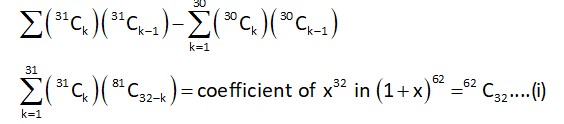
∴α (60!) (30!) (31!)=62!32!30!−60!31!29!

= (1411)60! (31!) (30!)16

∴16α=1411

New answer posted

a year ago

0 Follower 25 Views

V
Vishal Baghel

Contributor-Level 10

(x−1)2+(y−3)2=10−α

x−y=−1x+y=a+b}→m(a+b−12,a+b+12)

A' = 2m – A = (b – 1, a + 1)

C2:x2+y2+2gx+2fy+385=0

r  g 2 + f 2 − c

= 4 + 4 − 3 8 5 = 2 5

C 1 : 2 5 = 1 + 9 − α = 1 0 − α

α + 6 r 2 = 4 8 5 + 6 ( 2 5 ) = 6 0 5 = 1 2

New answer posted

a year ago

0 Follower 49 Views

V
Vishal Baghel

Contributor-Level 10

T = {9, 10, 11, 12, …., 1000}

S = {4, 6, 9}

A =  {a1+a2+....+ak:k∈N, ai∈S}

Let 4 appear x no. of times

6 appear y no. of times

9 appear z no. of times

10 then set A has n element 4x + 6y + 9z

Concept : Let a and b are co-prime numbers, then members from (a - ) (b – 1) and more can be expressed in the form ax + by where x, y ∈  {0, 1, 2, …}

So, all the number of the form

2y + 3z are (2 1). (3 – 1), ….

i.e., 6, 7, 8, 9, 10, 11, ….

form : 2 + t, t = 0, 1, 2, 3, ….

So, 6y + 9z = 3 (2y + 3z) = 3 (2 + t) = 6 + 3t, t = 0, 1, 2, 3, …

sum of element of T – A is 11

New answer posted

a year ago

0 Follower 2 Views

V
Vishal Baghel

Contributor-Level 10

 tn=1 (n+1) (n+2) (n+3), n=1, 2, 3, ...., 99

=12 (1 (n+1) (n+2)−1 (n+2) (n+3))=Vn−Vn+1

=112 (1716101*17)=143101*17=k101⇒k=14317

34 k = 286

New answer posted

a year ago

0 Follower 12 Views

V
Vishal Baghel

Contributor-Level 10

Δ=p!(p+1)!(p+2)!Δ1=2p!(p+1);(p+2)!=2(p!)3.(p+1)2.(p+2)1→α+β=3+1=4

Δ1=|1p+1(p+2)(p+1)1p+2(p+3)(p+2)1p+3(p+4)(p+3)|=|0−1(p+2)(−2)0−1(p+3)(−2)1p+3(p+4)(p+3)|

= 2(p + 3) – 2 (p + 2) = 2

New answer posted

a year ago

0 Follower 4 Views

V
Vishal Baghel

Contributor-Level 10

 A= [a1a2a3b1b2b3c1c2c3], a2, b2, c2∈ {0, 1}

S = a1+a2+a3+b1+b2+b3+c1+c2+c3 is prime

0≤s≤9

Prime value = 2,3, 5, 7

For  S=2, 1+1+0+0+0+0+0+0+0→9!2!7!=36

Total number of matrices

= 36 + 84 + 126 + 36 = 282

New answer posted

a year ago

0 Follower 5 Views

V
Vishal Baghel

Contributor-Level 10

 T5=nC4 (214)n−4. ( (13)14)4=nC4.2n−44.13

T6=9C5 (212)4. ( (13)14)5=9C5.2.135/4=23.1314.9*8*7*64*3*2*1

New answer posted

a year ago

0 Follower 14 Views

V
Vishal Baghel

Contributor-Level 10

 ∑r=1∞a+ (r−1)d2r=4, 4 (a+d)=?

⇒a∑r=1∞ (12)r+d∑r=1∞ (r−1) (12)r=4

= (12)2∑k=0∞k (12)k−1

=14.1 (1−12)2

= 1

a + d = 4

4 (a + d) = 16

Get authentic answers from experts, students and alumni that you won't find anywhere else

Sign Up on Shiksha

On Shiksha, get access to

  • 67k Colleges
  • 1.2k Exams
  • 718k Reviews
  • 1850k Answers

Share Your College Life Experience

×

This website uses Cookies and related technologies for the site to function correctly and securely, improve & personalise your browsing experience, analyse traffic, and support our marketing efforts and serve the Core Purpose. By continuing to browse the site, you agree to Privacy Policy and Cookie Policy.