
Ncert Solutions Chemistry Class 11th
Get insights from 2k questions on Ncert Solutions Chemistry Class 11th, answered by students, alumni, and experts. You may also ask and answer any question you like about Ncert Solutions Chemistry Class 11th
- 2k
Questions
- 0
Discussions
- 0
Active Users
- 29
Followers
Have a question about Ncert Solutions Chemistry Class 11th? Ask our experts
Keep it short & simple. Type complete word. Avoid abusive language.
(A) HOCl + H2O2 -> H3O+ + Cl- + O2
(B) <!-- [if gte mso 9]><xml>
Choose the correct option.
(A) HOCl + H2O2 -> H3O+ + Cl- + O2
(B) <!-- [if gte mso 9]><xml>
Choose the correct option.
In both reactions H2O2 act as reducing agent
In reaction (A) HOCl – O.A
H2O2 – R.A
In reaction (B) I2 – O.A
H2O2 – R.A
 Upvote

When 400 mL of 0.2 M H₂SO₄ solution is mixed with 600 mL of of 0.1 M NaOH solution the increase in temperature of the final solution is _____ ×10⁻² K. (Round off to the Nearest Integer).
[Use : H⁺(aq) + OH⁻(aq) → H₂O : ΔₙH = –57.1kJmol⁻¹
Specific heat of H₂O = 4.18JK⁻¹g⁻¹
Density of H₂O = 1.0gcm⁻³
Assume no change in volume of solution on mixing]
H? SO? + 2NaOH → Na? SO? + 2H? O
Milli mole: 80 60 (limiting reagent)
H? + OH? → H? O
Milli mole: 160 60
Milli mole: 160-60 0 60
Total heat produced = (60/1000) x 57.1 x 1000 = 3426 J
Total heat absorbed = msΔT
ΔT = Totalheat / (m x s)
= 3426J / (1000 x 4.18) = 0.819K
= 81.9 x 10? ² K
Ans. = 82 (the nearest)
Upvote Given that ∆c H° (combustion enthalpy) for Diamond is -834.8 kJ mole and ∆c H° for graphite is -832.8 kJ/mole, the value of ∆f H°(Diamond) i.e. [C(graphite) → C(diamond)] [in kJ/mole] is:
Given that ∆c H° (combustion enthalpy) for Diamond is -834.8 kJ mole and ∆c H° for graphite is -832.8 kJ/mole, the value of ∆f H°(Diamond) i.e. [C(graphite) → C(diamond)] [in kJ/mole] is:
C (graphite) → C (diamond)
ΔH? = Δ? H° (graphite) - Δ? H° (Diamond) = -832.8 - [-834.8] = 2kJ/mole
Upvote 10.30 mg of O2 is dissolved in 1L of sea water of density 1.03 g/mL. The concentration of O2 in ppm is _______.
10.30 mg of O2 is dissolved in 1L of sea water of density 1.03 g/mL. The concentration of O2 in ppm is _______.
ppm of O? = (wt. of O? ) / (wt. of H? O) × 10?
= (10.3 mg) / (1.03 × 10? mg) × 10?
= 10ppm
Upvote 
Kindly consider the following
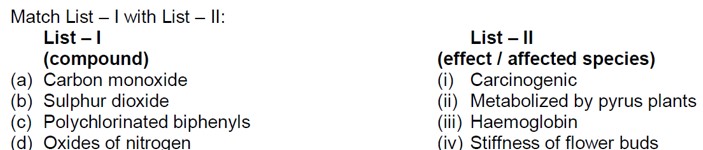
Kindly consider the following
(A) Carbon monoxide – Haemoglobin
(B) Sulphur dioxide – Stiffness of flower buds
(C) Polychlorinated biphenyls – Carcinogenic
(D) Oxides of nitrogen – Metabolized by pyrus plants
Upvote The following acids have been arranged in the decreasing order of their acid strength. Identify the correct order.
I. ClOH
II. BrOH
III. IOH
<!-- [if !supportLineBreakNewLine]-->
<!--[endif]-->
The following acids have been arranged in the decreasing order of their acid strength. Identify the correct order.
I. ClOH
II. BrOH
III. IOH
<!-- [if !supportLineBreakNewLine]-->
<!--[endif]-->
Due to I, ClO? > BrO? > IO? (stability)
Upvote