
Ncert Solutions Chemistry Class 11th
Get insights from 2k questions on Ncert Solutions Chemistry Class 11th, answered by students, alumni, and experts. You may also ask and answer any question you like about Ncert Solutions Chemistry Class 11th
- 2k
Questions
- 0
Discussions
- 0
Active Users
- 29
Followers
Have a question about Ncert Solutions Chemistry Class 11th? Ask our experts
Keep it short & simple. Type complete word. Avoid abusive language.
Which of the following reactions is the metal displacement reaction? Choose the right option.
<!-- [if !supportLineBreakNewLine]-->
<!--[endif]-->
Which of the following reactions is the metal displacement reaction? Choose the right option.
<!-- [if !supportLineBreakNewLine]-->
<!--[endif]-->
Aluminium is more electropositive than Cr, so it displaced chromium from Cr? O?
Cr? O? + Al - (Δ)-> Al? O? + Cr
 Upvote

Which one of the following methods can be used to obtain highly pure metal which is liquid at room temperature?
<!-- [if !supportLineBreakNewLine]-->
<!--[endif]-->
Which one of the following methods can be used to obtain highly pure metal which is liquid at room temperature?
<!-- [if !supportLineBreakNewLine]-->
<!--[endif]-->
At room temperature Hg is liquid and it is purified by 'Distillation method'.
Upvote The structures of beryllium chloride in solid state and vapour phase, are :
<!-- [if !supportLineBreakNewLine]-->
<!--[endif]-->
The structures of beryllium chloride in solid state and vapour phase, are :
<!-- [if !supportLineBreakNewLine]-->
<!--[endif]-->
BeCl? in solid state exist in a polymeric form & in a vapour state in exist in a dimeric form.
chain polymeric structure
Vapour state exist in a dimeric form
Upvote Statement I : Acid strength increases in the order given as HF << HCl << HBr << HI
Statement II : As the size of the elements F, Cl Br, I increases down the group, the bond strength of HF, HCl, HBr and HI decreases and so the acid strength increases.
In the light of the above statements, choose the correct answer from the options given below.
<!-- [if !supportLineBreakNewLine]-->
<!--[endif]-->
Statement I : Acid strength increases in the order given as HF << HCl << HBr << HI
Statement II : As the size of the elements F, Cl Br, I increases down the group, the bond strength of HF, HCl, HBr and HI decreases and so the acid strength increases.
In the light of the above statements, choose the correct answer from the options given below.
<!-- [if !supportLineBreakNewLine]-->
<!--[endif]-->
| H – F | H – Cl | H – Br | H – I |
| :- | :- | :- | :- |
| 1s – 2p | 1s – 3p | 1s – 4p | 1s – 5p |
Down the group size increases
Overlapping decreases
Acidic strength increases
Upvote Among the following alkaline earth metal halides, one which is covalent and soluble in organic solvents is :
<!-- [if !supportLineBreakNewLine]-->
<!--[endif]-->
Among the following alkaline earth metal halides, one which is covalent and soluble in organic solvents is :
<!-- [if !supportLineBreakNewLine]-->
<!--[endif]-->
BeCl? is covalent and soluble in a organic solvent
Upvote Which one among the following is the correct option for right relationship between Cₚ and Cᵥ for one mole of ideal gas?
Which one among the following is the correct option for right relationship between Cₚ and Cᵥ for one mole of ideal gas?
For one mole of an ideal gas
C? – C? = R
Upvote The correct sequence of bond enthalpy of ' C – X ' bond is :
<!-- [if !supportLineBreakNewLine]-->
<!--[endif]-->
The correct sequence of bond enthalpy of ' C – X ' bond is :
<!-- [if !supportLineBreakNewLine]-->
<!--[endif]-->
Correct sequence of bond enthalpy of C – X bond is
CH? – F > CH? – Cl > CH? – Br > CH? – I
Upvote The maximum temperature that can be achieved in blast furnace is :
<!-- [if !supportLineBreakNewLine]-->
<!--[endif]-->
The maximum temperature that can be achieved in blast furnace is :
<!-- [if !supportLineBreakNewLine]-->
<!--[endif]-->
The maximum temperature that can be achieved in blast furnace is upto  .
Upvote Tritium, a radioactive isotope of hydrogen, emits which of the following particles?
<!-- [if !supportLineBreakNewLine]-->
<!--[endif]-->
Tritium, a radioactive isotope of hydrogen, emits which of the following particles?
<!-- [if !supportLineBreakNewLine]-->
<!--[endif]-->
Tritium is radioactive and emits low energy β? particles (? e? )
Upvote For a reaction A → B, enthalpy of reaction is −4.2 kJ mol¯¹ and enthalpy of activation is 9.6 kJ mol¯¹. The correct potential energy profile for the reaction is shown in option.
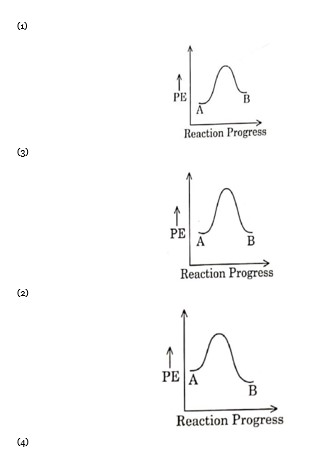
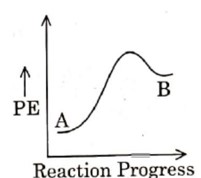
For a reaction A → B, enthalpy of reaction is −4.2 kJ mol¯¹ and enthalpy of activation is 9.6 kJ mol¯¹. The correct potential energy profile for the reaction is shown in option.
For a given reaction? H is negative. Hence, potential energy profile is of an exothermic reaction.
Upvote