
Ncert Solutions Chemistry Class 11th
Get insights from 2k questions on Ncert Solutions Chemistry Class 11th, answered by students, alumni, and experts. You may also ask and answer any question you like about Ncert Solutions Chemistry Class 11th
- 2k
Questions
- 0
Discussions
- 0
Active Users
- 29
Followers
Have a question about Ncert Solutions Chemistry Class 11th? Ask our experts
Keep it short & simple. Type complete word. Avoid abusive language.
The green house gas/es is (are) :
(A) Carbon dioxide
(B) Oxygen
(C) Water vapour
(D) Methane
Choose the most appropriate answer from the options given below:
<!-- [if !supportLineBreakNewLine]-->
<!--[endif]-->
The green house gas/es is (are) :
(A) Carbon dioxide
(B) Oxygen
(C) Water vapour
(D) Methane
Choose the most appropriate answer from the options given below:
<!-- [if !supportLineBreakNewLine]-->
<!--[endif]-->
Oxygen gas (O? ) is not considered a greenhouse gas.
 Upvote
Statement I: Sodium hydride can be used as an oxidizing agent.
Statement II: The lone pair of electrons on nitrogen in pyridine makes it basic.
Choose the CORRECT answer from the options given below:
<!-- [if !supportLineBreakNewLine]-->
<!--[endif]-->
Statement I: Sodium hydride can be used as an oxidizing agent.
Statement II: The lone pair of electrons on nitrogen in pyridine makes it basic.
Choose the CORRECT answer from the options given below:
<!-- [if !supportLineBreakNewLine]-->
<!--[endif]-->
In sodium hydride (NaH), hydrogen has an oxidation state of -1. In this state, it can only act as a reducing agent.
Upvote The oxidation states of nitrogen in NO, NO?, N?O and NO? are in the order of:
The oxidation states of nitrogen in NO, NO?, N?O and NO? are in the order of:
Oxidation state of N
| NO | +2 |
|-|-|
| NO? | +4 |
| N? O | +1 |
| NO? | +5 |
So, order of oxidation state is
NO? > NO? > NO > N? O
Upvote Mn? O? is mixed oxide which contains MnO and Mn? O? , so Mn is in +2 and +3 oxidation state respectively. Both Mn? ² & Mn³? has unpaired electrons so Mn? O? will show magnetic property. While all other oxides have no unpaired electrons either on cation or on anion.
Upvote Match List – I with List – II:
| List – I | List – II |
| :--- | :--- |
| (a) Be | (i) Treatment of cancer |
| (b) Mg | (ii) Extraction of metals |
| (c) Ca | (iii) Incendiary bombs and signals |
| (d) Ra | (iv) Windows of X-ray tubes |
| | (v) Bearings for motor engines. |
Choose the most appropriate answer from the option given below:
<!-- [if !supportLineBreakNewLine]-->
<!--[endif]-->
Match List – I with List – II:
| List – I | List – II |
| :--- | :--- |
| (a) Be | (i) Treatment of cancer |
| (b) Mg | (ii) Extraction of metals |
| (c) Ca | (iii) Incendiary bombs and signals |
| (d) Ra | (iv) Windows of X-ray tubes |
| | (v) Bearings for motor engines. |
Choose the most appropriate answer from the option given below:
<!-- [if !supportLineBreakNewLine]-->
<!--[endif]-->
Be is used in X ray tube windows.
Mg is used in incendiary bombs & signals.
Compounds of Ca i.e CaCO? is used in extraction of metals like Fe.
Radium (Ra) is used in treatment of cancer in radiotherapy.
Upvote _____ grams of 3-Hydroxy propanal (MW = 74) must be dehydrated to produce 7.8g of acrolein (MW = 56) (C?H?O) if the percentage yield is 64. (Round off to the nearest integer).
[Given: Atomic masses: C: 12.0u, H:1.0u, O:16.0u]
_____ grams of 3-Hydroxy propanal (MW = 74) must be dehydrated to produce 7.8g of acrolein (MW = 56) (C?H?O) if the percentage yield is 64. (Round off to the nearest integer).
[Given: Atomic masses: C: 12.0u, H:1.0u, O:16.0u]
3-Hydroxy propanal
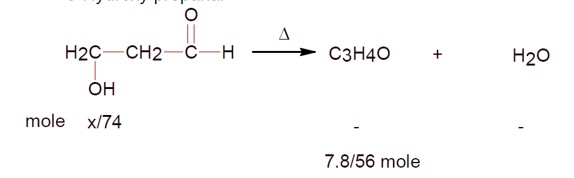
If 7.8g of C? H? O (molar mass 56 g/mol ) is formed, calculate the initial weight of 3-hydroxy propanal (molar mass 74 g/mol ).
Weight = (7.8/56) × 74 × (100/64) [Assuming 64% yield, though the number seems out of place].
Ans ≈ 16 g.
Upvote AX is a covalent diatomic molecule where A and X are second row elements of periodic table. Based on molecular orbital theory, the bond order of AX is 2.5. The total number of electrons in AX is _____. (Round off to the nearest integer).
AX is a covalent diatomic molecule where A and X are second row elements of periodic table. Based on molecular orbital theory, the bond order of AX is 2.5. The total number of electrons in AX is _____. (Round off to the nearest integer).
AX is a diatomic molecule with a bond order of 2.5.
The compound is NO. The total number of electrons = 15 (7+8).
Upvote 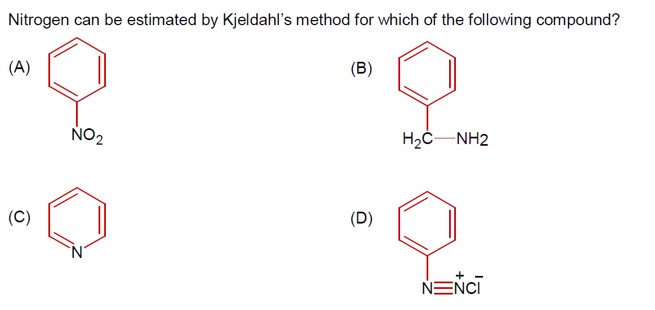
The Kjeldahl method is not applicable for nitrogen estimation in:
Compounds containing nitrogen in a nitro group.
Compounds containing an Azo group.
Pyridine.
Upvote
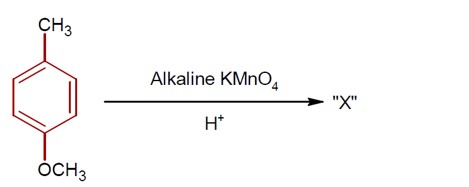
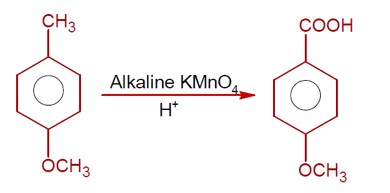
Considering the above chemical reaction, identify the product "X":
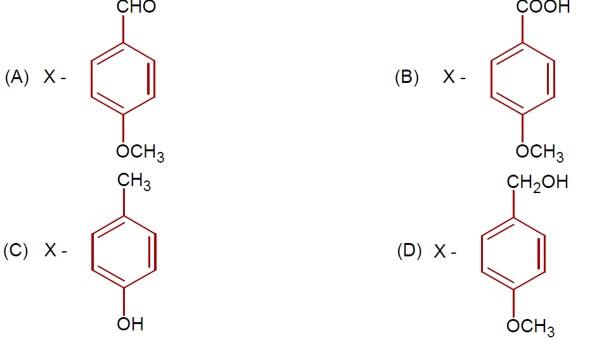
Considering the above chemical reaction, identify the product "X":
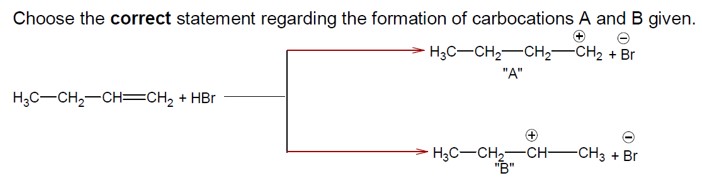
The addition of HBr to H? C−CH? −CH=CH? proceeds via carbocation formation.
Formation of a 1° Carbocation (A): H? C−CH?
Formation of a 2° Carbocation (B): H? C−CH? −C? H−CH?
The 2° carbocation (B) is more stable than the 1° carbocation (A). Therefore, the activation energy (Ea) for the formation of B
Upvote