
Ncert Solutions Chemistry Class 11th
Get insights from 2k questions on Ncert Solutions Chemistry Class 11th, answered by students, alumni, and experts. You may also ask and answer any question you like about Ncert Solutions Chemistry Class 11th
- 2k
Questions
- 0
Discussions
- 0
Active Users
- 29
Followers
Have a question about Ncert Solutions Chemistry Class 11th? Ask our experts
Keep it short & simple. Type complete word. Avoid abusive language.
A group 15 element, which is a metal and forms a hydride with strongest reducing power among group 15 hydrides. The element is:
A group 15 element, which is a metal and forms a hydride with strongest reducing power among group 15 hydrides. The element is:
Bismuth (Bi) is a metal in group 15. Its hydride is BiH? , which is the strongest reducing agent due to its the lowest thermal stability.
 Upvote
Given below are two statements:
Statement I : Both CaCl2.6H2O and MgCl2.8H2O undergo dehydration on heating.
Statement II : BeO is amphoteric whereas the oxides of other elements in the same
group are acidic.
In the light of the above statements, choose the correct answer from the options given below:
Given below are two statements:
Statement I : Both CaCl2.6H2O and MgCl2.8H2O undergo dehydration on heating.
Statement II : BeO is amphoteric whereas the oxides of other elements in the same
group are acidic.
In the light of the above statements, choose the correct answer from the options given below:
Hydrated halides of group 2 from Ca onwards undergo dehydration on heating. But the hydrated halide of Mg, i.e., MgCl? ·8H? O, does not undergo dehydration on heating but undergoes hydrolysis.
BeO is amphoteric, while other oxides of group 2 are basic in nature.
Upvote Match List – I with List – II
List – I List – II
Name of oxo acid Oxidation state of “P”
(a) Hypophosphorous acid (i) + 5
(b) Orthophosphoric acid (ii) + 4
(c) Hypophosphoric acid (iii) + 3
(d) Orthophosphorous acid (iv) + 2
(v) + 1
Choose the correct answer from the options given below:
Match List – I with List – II
List – I List – II
Name of oxo acid Oxidation state of “P”
(a) Hypophosphorous acid (i) + 5
(b) Orthophosphoric acid (ii) + 4
(c) Hypophosphoric acid (iii) + 3
(d) Orthophosphorous acid (iv) + 2
(v) + 1
Choose the correct answer from the options given below:
Oxidation States (O.S) of Phosphorus (P):
- Hypophosphorous acid – H? PO? : +1
- Orthophosphoric acid – H? PO? : +5
- Hypophosphoric acid – H? P? O? : +4
- Orthophosphorous acid – H? PO? : +3
Upvote The type of pollution that gets increased during the day time and in the presence of O3 is:
The type of pollution that gets increased during the day time and in the presence of O3 is:
Formation of photochemical smog, which is also known as oxidizing smog, takes place in the presence of sunlight and O?
Upvote Match List – I with List – II:
List – I List – II
Industrial process Application
(a) Haber’s process (i) HNO3 synthesis
(b) Ostwald’s process (ii) Aluminium extraction
(c) Contact process (iii) NH3 sythesis
(d) Hall-Heroult process (iv) H2SO4 synthesis
Choose the correct answer from the options given below:
Match List – I with List – II:
List – I List – II
Industrial process Application
(a) Haber’s process (i) HNO3 synthesis
(b) Ostwald’s process (ii) Aluminium extraction
(c) Contact process (iii) NH3 sythesis
(d) Hall-Heroult process (iv) H2SO4 synthesis
Choose the correct answer from the options given below:
(a) Haber's process is used for the synthesis of NH?
(b) Ostwald's process is used to synthesize HNO?
(c) Contact process is used for the synthesis of H? SO?
(d) Hall-Héroult process is used for the extraction of aluminium.
Upvote At 25°C, 50 g of iron reacts with HCl to form FeCl?. The evolved hydrogen gas expands against a constant pressure of 1 bar. The work done by the gas during this expansion is __________ J. (Round off to the nearest integer).
[Given: R= 8.314 J mol?¹ K?¹. Assume hydrogen is an ideal gas]
[Atomic mass of Fe is 55.85u]
At 25°C, 50 g of iron reacts with HCl to form FeCl?. The evolved hydrogen gas expands against a constant pressure of 1 bar. The work done by the gas during this expansion is __________ J. (Round off to the nearest integer).
[Given: R= 8.314 J mol?¹ K?¹. Assume hydrogen is an ideal gas]
[Atomic mass of Fe is 55.85u]
The reaction is Fe (s) + 2HCl (aq) → FeCl? (aq) + H? (g). 50 g of Fe corresponds to 0.89 moles, which produces 0.89 moles of H? (g). The work done by the gas is calculated using W = -Δn_gasRT. The work done by the gas is the positive value, 2218 J.
Answer: 2218 J
Upvote The exact volumes of 1 M NaOH solution required to neutralize 50 mL of 1M H₃PO₃ solution and 100 mL of 2M H₃PO₂ solution respectively, are
The exact volumes of 1 M NaOH solution required to neutralize 50 mL of 1M H₃PO₃ solution and 100 mL of 2M H₃PO₂ solution respectively, are
This problem involves the stoichiometry of acid-base neutralization.
o For the reaction with H? PO? (a dibasic acid), 100 mL of NaOH is required.
o For the reaction with H? PO? (a monobasic acid), 200 mL of NaOH is required.
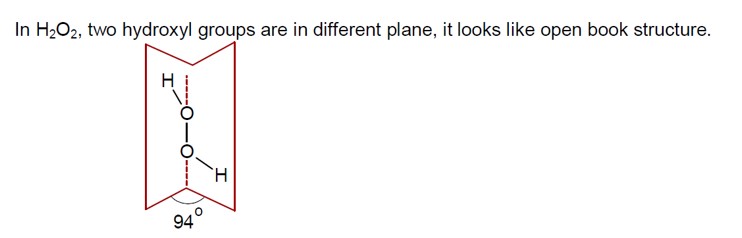
Upvote The correct statement about H₂O₂ are:
(A) Used in the treatment of effluents.
(B) Used as both oxidizing and reducing agents
(C) The two hydroxyl groups lie in the same plane.
(D) Miscible with water.
Choose the correct answer from the options given below:
The correct statement about H₂O₂ are:
(A) Used in the treatment of effluents.
(B) Used as both oxidizing and reducing agents
(C) The two hydroxyl groups lie in the same plane.
(D) Miscible with water.
Choose the correct answer from the options given below:
The gas phase reaction 2A(g) ? A?(g) At 400 K has ΔG° = +25.2 kJ mol?¹.
The equilibrium constant K? for this reaction is ________ ×10?². (Round off to the nearest integer).
[ Use: R = 8.3 J mol?¹ K?¹, In10 = 2.3, log? 2 = 0.30, 1atm = 1 bar]
[antilog (-0.3) = 0.501]
The gas phase reaction 2A(g) ? A?(g) At 400 K has ΔG° = +25.2 kJ mol?¹.
The equilibrium constant K? for this reaction is ________ ×10?². (Round off to the nearest integer).
[ Use: R = 8.3 J mol?¹ K?¹, In10 = 2.3, log? 2 = 0.30, 1atm = 1 bar]
[antilog (-0.3) = 0.501]
ΔG° = + 25.2 kJ / mol
Using ΔG° = -2.3 RT log Kp
25.2 × 10³ = - 2.3 × 8.3 × 400 log Kp
o 3.3 = log Kp
log (1 / 2×10³) = log Kp
Kp = 1 / (2×10³)
Using; Kp = Kc (RT)
1 / (2×10³) = Kc (0.083 × 400)? ¹
Upvote Iron (III) iodide (FeI? ) does not exist because it is unstable. The Fe³? ion is a strong enough oxidizing agent to be easily reduced to Fe²? by the I? ion, which in turn is oxidized.
Upvote