
Ncert Solutions Chemistry Class 11th
Get insights from 2k questions on Ncert Solutions Chemistry Class 11th, answered by students, alumni, and experts. You may also ask and answer any question you like about Ncert Solutions Chemistry Class 11th
- 2k
Questions
- 0
Discussions
- 0
Active Users
- 29
Followers
Have a question about Ncert Solutions Chemistry Class 11th? Ask our experts
Keep it short & simple. Type complete word. Avoid abusive language.
For a reaction,
4M(s) + nO₂(g) → 2M₂Oₙ(s),
the free energy change is plotted as a function of temperature. The temperature below which the oxide is stable could be inferred from the plot as the point at which
For a reaction,
4M(s) + nO₂(g) → 2M₂Oₙ(s),
the free energy change is plotted as a function of temperature. The temperature below which the oxide is stable could be inferred from the plot as the point at which
For oxide to be stable its ΔG value should be negative.
 Upvote

An alkaline earth metal ' M' readily forms water soluble sulphate and water insoluble hydroxide. Its oxide MO is very stable to heat and does not have rock-salt structure. M is:
<!-- [if !supportLineBreakNewLine]-->
<!--[endif]-->
An alkaline earth metal ' M' readily forms water soluble sulphate and water insoluble hydroxide. Its oxide MO is very stable to heat and does not have rock-salt structure. M is:
<!-- [if !supportLineBreakNewLine]-->
<!--[endif]-->
BeO is hexagonal wurtzite type structure.
Upvote Which of the following compounds will form the precipitate with aq. AgNO3 solution most readily?
<!-- [if !supportLineBreakNewLine]-->
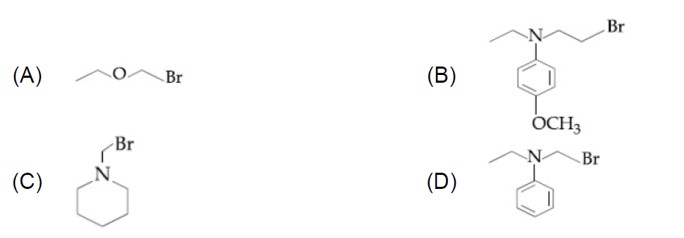
<!--[endif]-->
Which of the following compounds will form the precipitate with aq. AgNO3 solution most readily?
<!-- [if !supportLineBreakNewLine]-->
<!--[endif]-->
S 1 reaction depends on carbocation stability and cation form in 3 will be most stable.
Upvote H can easily gain electron to form its anion.
Upvote On combustion of Li, Na and K in excess of air, the major oxides formed, respectively, are:
On combustion of Li, Na and K in excess of air, the major oxides formed, respectively, are:
4Li + O? → 2Li? O oxide
2Na + O? → Na? O? peroxide
K + O? → KO? superoxide
Upvote Among the following compounds, which one has the shortest C – Cl bond?
<!-- [if !supportLineBreakNewLine]--><!--[endif]-->
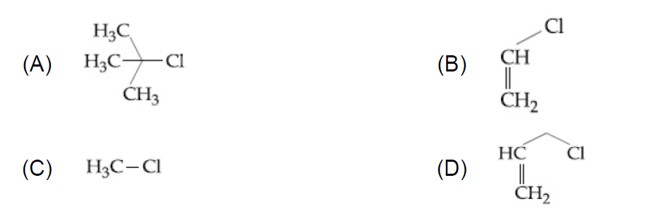
Among the following compounds, which one has the shortest C – Cl bond?
<!-- [if !supportLineBreakNewLine]--><!--[endif]-->
Due to resonance C – Cl bond in option B is the shortest.
Upvote For one mole of an ideal gas, which of these statements must be true?
(a) U and H each depends only on temperature
(b) Compressibility factor z is not equal to 1
(c) Cp,m – Cv,m = R
(d) dU = CvdT for any process
For one mole of an ideal gas, which of these statements must be true?
(a) U and H each depends only on temperature
(b) Compressibility factor z is not equal to 1
(c) Cp,m – Cv,m = R
(d) dU = CvdT for any process
U and H are temperature dependent
Cp, m – Cv, m = R (for 1 mole of ideal gas)
dU = CvdT
Upvote