
Ncert Solutions Chemistry Class 11th
Get insights from 2k questions on Ncert Solutions Chemistry Class 11th, answered by students, alumni, and experts. You may also ask and answer any question you like about Ncert Solutions Chemistry Class 11th
- 2k
Questions
- 0
Discussions
- 0
Active Users
- 29
Followers
Have a question about Ncert Solutions Chemistry Class 11th? Ask our experts
Keep it short & simple. Type complete word. Avoid abusive language.

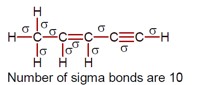
Number of sigma bonds are 10.
[Structure showing 10 sigma bonds in the molecule]
 Upvote

Given below are two statements:
Statement I: None of the alkaline earth metal hydroxides dissolves in alkali.
Statement II: Solubility of alkaline earth metal hydroxides in water increases down the group.
In the light of the above statements, choose the most appropriate answer from the options given below:
<!-- [if !supportLineBreakNewLine]-->
<!--[endif]-->
Solubility of 2 group hydroxide increases down the group.
Upvote For water at 100°C and 1 bar, ΔᵥₐₚH - ΔᵥₐₚU = _______ × 10² J mol⁻¹ (Round off to the Nearest integer) [Use: R = 8.31 J mol⁻¹ K⁻¹] [Assume volume of H₂O(l) is much smaller than volume of H₂O(g). Assume H₂O(g) can be treated as an ideal gas]
For water at 100°C and 1 bar, ΔᵥₐₚH - ΔᵥₐₚU = _______ × 10² J mol⁻¹ (Round off to the Nearest integer) [Use: R = 8.31 J mol⁻¹ K⁻¹] [Assume volume of H₂O(l) is much smaller than volume of H₂O(g). Assume H₂O(g) can be treated as an ideal gas]
H? O (l) → H? O (g)
ΔH° = ΔU° + ΔngRT
ΔH° - ΔU° = ΔngRT
= 1 × 8.31 × 373
= 3099.63 J/mol
= 30.9963 × 10² J/mol
≈ 31 × 10² J/mol
Upvote The density of NaOH solution is 1.2 gm cm⁻³. The molality of this solution is _______ m. (Round off to the Nearest integer) [Use: Atomic masses: Na 23.0u O: 16.0 u H:1.0 u Density of H₂O: 1.0g cm⁻³]
The density of NaOH solution is 1.2 gm cm⁻³. The molality of this solution is _______ m. (Round off to the Nearest integer) [Use: Atomic masses: Na 23.0u O: 16.0 u H:1.0 u Density of H₂O: 1.0g cm⁻³]
Let volume of solution = x ml
So mass of solution = 1.2x
And mass of water = x gm
Mass of solute = 0.2x
Molality = (W_solute * 1000) / (M_solute * W_solvent) = (0.2x * 1000) / (40 * x) = 5 m
Upvote PCl₅ ⇌ PCl₃ + Cl₂ Kc = 1.844. 3.0 moles of PCl₅ is introduced in a 1L closed reaction vessel at 380K. The number of moles of PCl₅ at equilibrium is _______ × 10⁻³. (Round off to the Nearest integer)
PCl₅ ⇌ PCl₃ + Cl₂ Kc = 1.844. 3.0 moles of PCl₅ is introduced in a 1L closed reaction vessel at 380K. The number of moles of PCl₅ at equilibrium is _______ × 10⁻³. (Round off to the Nearest integer)
PCl? (g)? PCl? (g) + Cl? (g); Kc = 1.844
t=0: 3, 0, 0
equilibrium: 3-x, x
Kc = x² / (3-x) = 1.844
x² + 1.844x - 5.532 = 0
x = (-1.844 + √ (1.844² - 4 (1) (-5.532)/2 = (-1.844 + √25.528)/2 ≈ 1.604
At equilibrium number of moles of PCl? = (3 - 1.604) = 1.396 mol
= 1396 × 10? ³ mol
Upvote The correct order of following 3d metal oxides, according to their oxidation numbers is:
(a) CrO?
(b) Fe?O?
(c) MnO?
(d) V?O?
(e) Cu?O
<!-- [if !supportLineBreakNewLine]-->
<!--[endif]-->
The correct order of following 3d metal oxides, according to their oxidation numbers is:
(a) CrO?
(b) Fe?O?
(c) MnO?
(d) V?O?
(e) Cu?O
<!-- [if !supportLineBreakNewLine]-->
<!--[endif]-->
Oxidation states:
CrO? (+6), Fe?O? (+3), MnO? (+4), V?O? (+5), Cu?O (+1)
(a), (b), (c), (d), (e)
Order of oxidation numbers:
Cu?O < Fe?O? < MnO? < V?O? < CrO?. Hence correct order is; e < b < c < d < a
Upvote Which one among the following resonating structure is not correct?
[Images of four resonance structures of an N-oxide compound]
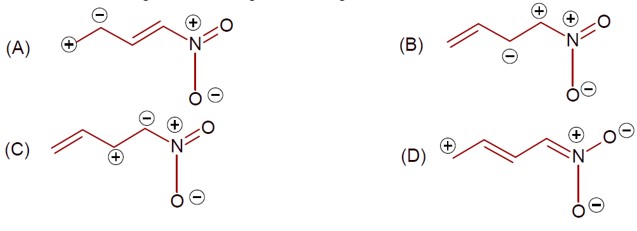
Which one among the following resonating structure is not correct?
[Images of four resonance structures of an N-oxide compound]
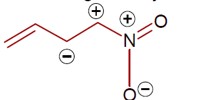
Same charge on adjacent atom is not stable. Hence the incorrect resonating structure is,
[Image of the incorrect resonance structure with adjacent positive charges]
Upvote A system does 200 J of work and at the same time absorbs 150 J of heat. The magnitude of the change in internal energy is __________ J. (Nearest integer)
A system does 200 J of work and at the same time absorbs 150 J of heat. The magnitude of the change in internal energy is __________ J. (Nearest integer)
q = +150 J
w = -200 J
∴ ΔU = q + w = 150 - 200 = -50 J
So, magnitude of ΔU is 50 J.
Upvote Given below are two statements: One is labelled as Assertion A and the other is labelled as Reason R.
Assertion A: Lithium halides are some what covalent is nature.
Reason R: Lithium possess high polarisation capability.
In the light of the above statements, choose the most appropriate answer from the options given below:
<!-- [if !supportLineBreakNewLine]-->
<!--[endif]-->
Given below are two statements: One is labelled as Assertion A and the other is labelled as Reason R.
Assertion A: Lithium halides are some what covalent is nature.
Reason R: Lithium possess high polarisation capability.
In the light of the above statements, choose the most appropriate answer from the options given below:
<!-- [if !supportLineBreakNewLine]-->
<!--[endif]-->
Due to small size Li have more polarizing power so most of the compound of Li are covalent.
Upvote Match List- I with List-II:
<!-- [if !supportLineBreakNewLine]-->
<!--[endif]-->
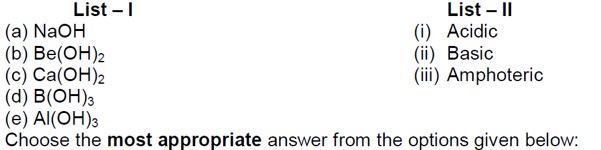
Match List- I with List-II:
<!-- [if !supportLineBreakNewLine]-->
<!--[endif]-->
NaOH - Base
Be (OH)? - Amphoteric
Ca (OH)? - Base
B (OH)? - Acidic
Al (OH)? - Amphoteric
Upvote