
Ncert Solutions Chemistry Class 11th
Get insights from 2k questions on Ncert Solutions Chemistry Class 11th, answered by students, alumni, and experts. You may also ask and answer any question you like about Ncert Solutions Chemistry Class 11th
- 2k
Questions
- 0
Discussions
- 0
Active Users
- 29
Followers
Have a question about Ncert Solutions Chemistry Class 11th? Ask our experts
Keep it short & simple. Type complete word. Avoid abusive language.
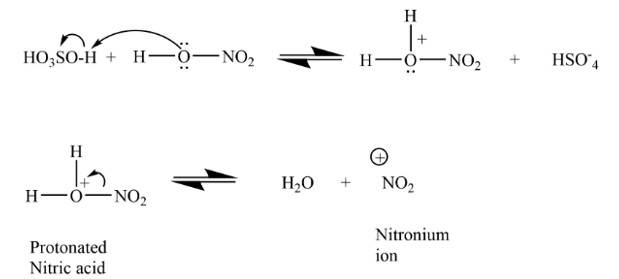
Assertion (A): Nitration of benzene with nitric acid requires the use of concentrated sulphuric acid.
Reason (R): The mixture of concentrated sulphuric acid and concentrated nitric acid produces the electrophile, NO2 +.
(i) Both A and R are correct and R is the correct explanation of A.
(ii) Both A and R are correct but R is not the correct explanation of A.
(iii) Both A and R are not correct.
(iv) A is not correct but R is correct.
This is a assertion and reason answer type question as classified in NCERT Exemplar
(i) The sulphuric acid helps in furnishing NO2+ (electrophile).

 Upvote

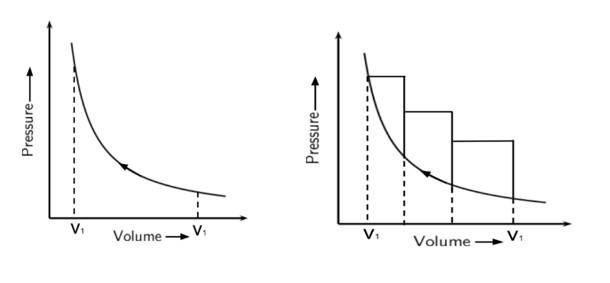
The pressure volume work for an ideal gas can be calculated by using the expression w = - dv. The work can also be calculated from the pV−plot by using the area under the curve within the specified limits. When an ideal gas is compressed (a) reversibly or (b) irreversibly from volume Vi to Vf. Choose the correct option.
(i) w (reversible) = w (irreversible)
(ii) w (reversible) < w (irreversible)
(iii) w (reversible) > w (irreversible)
(iv) w (reversible) = w (irreversible) + pex.?V
Kindly go through the solution
option (ii)
 Upvote
In an adiabatic process, no transfer of heat takes place between system and surroundings. Choose the correct option for free expansion of an ideal gas under adiabatic condition from the following.
(i) q = 0, ∆T ≠ 0, w = 0
(ii) q ≠ 0, ∆T = 0, w = 0
(iii) q = 0, ∆T = 0, w = 0
(iv) q = 0, ∆T < 0, w ≠ 0 Vf
This is a Multiple Choice Questions as classified in NCERT Exemplar
Option (iii)
In free expansion, w=0 because volume is constant, as the process is adiabatic q = 0 and from first law of thermodynamics.
U=q+w
This means that internal energy remains constant.
Upvote Assertion (A): Toluene on Friedal Crafts methylation gives o– and p–xylene.
Reason (R): CH3-group bonded to benzene ring increases electron density at o– and p– position.
(i) Both A and R are correct and R is the correct explanation of A.
(ii) Both A and R are correct but R is not the correct explanation of A.
(iii) Both A and R are not correct.
(iv) A is not correct but R is correct.
Assertion (A): Toluene on Friedal Crafts methylation gives o– and p–xylene.
Reason (R): CH3-group bonded to benzene ring increases electron density at o– and p– position.
(i) Both A and R are correct and R is the correct explanation of A.
(ii) Both A and R are correct but R is not the correct explanation of A.
(iii) Both A and R are not correct.
(iv) A is not correct but R is correct.
This is a assertion and reason answer type question as classified in NCERT Exemplar
(i) The -CH3 group is an activating group and it directs the upcoming substituent to the ortho and para position.
Upvote It is cyclic and has conjugated 8π-electron system but it is not an aromatic compound.
Reason (R) : (4n + 2) π electrons rule does not hold good and ring is not planar.
(i) Both A and R are correct and R is the correct explanation of A.
(ii) Both A and R are correct but R is not the correct explanation of A.
(iii) Both A and R are not correct.
(iv) A is not correct but R is correct.
It is cyclic and has conjugated 8π-electron system but it is not an aromatic compound.
Reason (R) : (4n + 2) π electrons rule does not hold good and ring is not planar.
(i) Both A and R are correct and R is the correct explanation of A.
(ii) Both A and R are correct but R is not the correct explanation of A.
(iii) Both A and R are not correct.
(iv) A is not correct but R is correct.
This is a assertion and reason answer type question as classified in NCERT Exemplar
(i) Because cyclooctatetraene is tubbed shaped.
Upvote Match the reactions given in Column I with the reaction types in Column II.
Column I
Column II
(i) CH2=CH2 + H2O CH3CH2OH
(a) Hydrogenation
(ii) CH2 ≡ CH2 + H2 CH3CH3
(b) Halogenation
(iii) CH2 ≡ CH2 + Cl2 → ClCH2CH2Cl
(c) Polymerisation
(iv) 3CH ≡ CH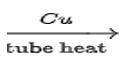 C6H6
(d) Hydration
(e) Condensation
Match the reactions given in Column I with the reaction types in Column II.
|
Column I |
Column II |
|
(i) CH2=CH2 + H2O |
(a) Hydrogenation |
|
(ii) CH2 ≡ CH2 + H2 |
(b) Halogenation |
|
(iii) CH2 ≡ CH2 + Cl2 → ClCH2CH2Cl |
(c) Polymerisation |
|
(iv) 3CH ≡ CH |
(d) Hydration |
|
(e) Condensation |
This is a matching answer type question as classified in NCERT Exemplar
(i) → (d); (ii) → (a); (iii) → (b) : (iv) → (c)
Upvote Match the following reactants in Column I with the corresponding reaction products in Column II.
Column I
Column II
(i) Benzene + Cl2
(a) Benzoic acid
(ii)Benzene + CH3Cl
(b) Methyl phenyl ketone
(iii)Benzene + CH3COCl
(c) Toluene
(iv)Toluene
(d) Chlorobenzene
(e) Benzene hexachloride
Match the following reactants in Column I with the corresponding reaction products in Column II.
|
Column I |
Column II |
|
(i) Benzene + Cl2 |
(a) Benzoic acid |
|
(ii)Benzene + CH3Cl |
(b) Methyl phenyl ketone |
|
(iii)Benzene + CH3COCl |
(c) Toluene |
|
(iv)Toluene |
(d) Chlorobenzene |
|
(e) Benzene hexachloride |
This is a matching answer type question as classified in NCERT Exemplar
(i) → (d); (ii) → (c); (iii) → (b) : (iv) → (a)
Upvote ∆fU of formation of CH4 (g) at certain temperature is –393 kJ/mol. The value of ∆fH is
(i) zero
(ii) < ∆f U
(iii) > ∆f U
(iv) Equal to ∆fU
∆fU of formation of CH4 (g) at certain temperature is –393 kJ/mol. The value of ∆fH is
(i) zero
(ii) < ∆f U
(iii) > ∆f U
(iv) Equal to ∆fU
This is a Multiple Choice Questions as classified in NCERT Exemplar
The correct option is B <ΔU
The balanced equation for the combustion of methane is:
CH4 (g)+2O2 (g)→CO2 (g)+2H2O (l)
Here, Δng=1−3=−2
ΔH =ΔU +ΔngRT
ΔH =−393−2RT
∴ΔH <ΔU
Upvote Match the hydrocarbons in Column I with the boiling points given in Column II.
Column I
Column II
(i) n-pentane
(a) 282.5 K
(ii) iso-pentane
(b) 309 K
(iii) neo-pentane
(c) 301 K
Match the hydrocarbons in Column I with the boiling points given in Column II.
|
Column I |
Column II |
|
(i) n-pentane |
(a) 282.5 K |
|
(ii) iso-pentane |
(b) 309 K |
|
(iii) neo-pentane |
(c) 301 K |
This is a matching answer type question as classified in NCERT Exemplar
(i) → (b); (ii) → (c); (iii) → (a)
Upvote During complete combustion of one mole of butane, 2658 kJ of heat is released. The thermochemical reaction for above change is
(i) 2C4H10(g) + 13O2(g) → 8CO2(g) + 10H2O(l) ∆c H = –2658.0 kJ/mol
(ii) C4H10(g) + O2 (g) → 4CO2 (g) + 5H2O (g) ∆c H = –1329.0 kJ/mol
(iii) C4H10(g) + O2 (g) → 4CO2 (g) + 5H2O (l) ∆c H = –2658.0 kJ/mol
(iv) C4H10 (g) + O2 (g) → 4CO2 (g) + 5H2O (l) ∆c H = +2658.0 kJ/mol
During complete combustion of one mole of butane, 2658 kJ of heat is released. The thermochemical reaction for above change is
(i) 2C4H10(g) + 13O2(g) → 8CO2(g) + 10H2O(l) ∆c H = –2658.0 kJ/mol
(ii) C4H10(g) + O2 (g) → 4CO2 (g) + 5H2O (g) ∆c H = –1329.0 kJ/mol
(iii) C4H10(g) + O2 (g) → 4CO2 (g) + 5H2O (l) ∆c H = –2658.0 kJ/mol
(iv) C4H10 (g) + O2 (g) → 4CO2 (g) + 5H2O (l) ∆c H = +2658.0 kJ/mol
This is a Multiple Choice Questions as classified in NCERT Exemplar
option (iii)
Standard enthalpy of combustion is defined as the enthalpy change per mole (or per unit amount) of a substance when it undergoes combustion and all the reactants and products being in their standard states at the specifie
Upvote