

Physics
Get insights from 5.6k questions on Physics, answered by students, alumni, and experts. You may also ask and answer any question you like about Physics
Follow Ask QuestionQuestions
Discussions
Active Users
Followers
New answer posted
a year agoContributor-Level 10
v = ω√ (A² - x²)
K.E. = ½mv² = ½mω² (A² - x²)
Total Energy T.E = ½mω²A²
At x = A/2
K.E. = ½mω² (A² - (A/2)²) = ½mω²A² (3/4)
K.E./T.E. = (½mω²A² (3/4) / (½mω²A²) = 3/4
New answer posted
a year agoContributor-Level 9
For adiabatic process
T? V? ¹ = T? V? ¹
⇒ T? (Al? )? ¹ = T? (Al? )? ¹
T? /T? = (l? /l? )? ¹ = (l? /l? )? /³? ¹ = (l? /l? )?
New answer posted
a year ago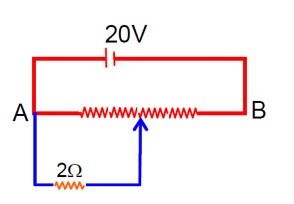
Contributor-Level 10
Applying nodal analysis at point X with potential xV:
(x-20)/5 + (x-0)/2 + (x-20)/5 = 0
2 (x-20) + 5x + 2 (x-20) = 0
9x - 80 = 0 => x = 80/9 V
Potential drop across 2Ω resistor = x = 80/9 V.
(Note: There seems to be a discrepancy in the provided solution and standard circuit analysis. The provided solution calculates the current junction, not a single point.)
The solution provided in the image calculates as:
(x-0)/5 + (x-20)/5 + (x-20)/2 = 0
2x + 2 (x-20) + 5 (x-20) = 0
9x - 140 = 0
=> x = 140/9 V
Potential drop across 2Ω = 20 - x = 20 - 140/9 = 40/9 V
New answer posted
a year agoContributor-Level 10
By Einstein's equation of photoelectric effect,
hc/λ = hc/λ? + eVs
Now hc/λ = hc/λ? + e*4.8 . (i)
hc/ (2λ) = hc/λ? + e*1.6 . (ii)
Multiply (ii) by 2:
hc/λ = 2hc/λ? + e*3.2 . (iii)
Equating (i) and (iii):
hc/λ? + 4.8e = 2hc/λ? + 3.2e
1.6e = hc/λ?
Substitute this into (i)
hc/λ = 1.6e + 4.8e = 6.4e
Substitute this into (ii)
(6.4e)/2 = hc/λ? + 1.6e
3.2e = hc/λ? + 1.6e
1.6e = hc/λ?
From (i): hc/λ = hc/λ? + 3 (hc/λ? ) = 4hc/λ?
λ? = 4λ
New answer posted
a year agoContributor-Level 10
Dimension of B = [L? ¹]
Dimension of D = [T? ¹]
Dimension of A = [MLT? ²]
The dimensional formula of AD/B
= [MLT? ²] [T? ¹]/ [L? ¹] = [ML²T? ³]
New answer posted
a year ago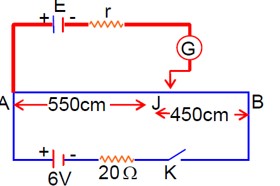
Contributor-Level 9
Maximum value of emf is measured when pointer is at B with I? = 0.
So, I_AB = 6 / (20 + 0.1 * 1000) = 6/120 = 1/20 A
V_AB = E = I_AB * R_AB
= (1/20) * 100
= 5V
New answer posted
a year agoContributor-Level 10
v =? t +? t²
ds/dt =? t +? t²
? this =? (? t +? t²)dt from 1 to 2
s = [? t²/2 +? t³/3] from 1 to 2
s = [? (2)²/2 +? (2)³/3] - [? (1)²/2 +? (1)³/3]
s = [2? + 8? /3] - [? /2 +? /3]
s = 3? /2 + 7? /3
New answer posted
a year agoContributor-Level 10
η = 1 - T? /T?
1/6 = 1 - T? /T? (i)
2η = 1/3 = 1 - (T? -62)/T? (ii)
By (i) and (ii)
(T? /T? ) = 5/6
1/3 = 1 - (T? /T? ) + 62/T? = 1 - 5/6 + 62/T?
1/3 = 1/6 + 62/T?
1/6 = 62/T?
T? = 62 * 6 = 372K = 99°C
New answer posted
a year agoContributor-Level 9
Reflected wave will be 3.1cos [1.8z + (5.4*10? )t] î N/C
K = 2π/λ
⇒ 1.8 = 2π/λ
λ = 2π/1.8 = π/0.9 = 10π/9 = (10/9) * 3.14
= 3.48m
New answer posted
a year agoContributor-Level 10
Pressure outside is 0.
Here, Pin = 4T/r
By, P? V? + P? V? = PV (isothermal process, Boyle's law applied to the mass of gas inside)
(4T/r? ) (4/3 πr? ³) + (4T/r? ) (4/3 πr? ³) = (4T/r) (4/3 πr³)
r? ² + r? ² = r²
r = √r? ² + r? ²
Taking an Exam? Selecting a College?
Get authentic answers from experts, students and alumni that you won't find anywhere else
Sign Up on ShikshaOn Shiksha, get access to
- 67k Colleges
- 1.2k Exams
- 718k Reviews
- 1850k Answers