

Physics
Get insights from 5.6k questions on Physics, answered by students, alumni, and experts. You may also ask and answer any question you like about Physics
Follow Ask QuestionQuestions
Discussions
Active Users
Followers
New answer posted
a year ago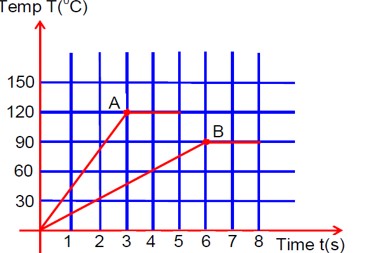
Contributor-Level 9
dQA = mACA dTA
dQB = mBCB dTB
dQA/dt = dQB/dt
⇒ mACA (dTA/dt) = mBCB (dTB/dt)
⇒ (dTA/dt)/ (dTB/dt) = (mBCB)/ (mACA)
Assuming mA = mB
(dTA/dt)/ (dTB/dt) = CB/CA
CA/CB = (dTB/dt)/ (dTA/dt) = (90/6)/ (120/3) = 15/40 = 3/8
New answer posted
a year agoContributor-Level 10
Enet = Eo/k
Enet = E_free - E_bound = qf/Aε? - qb/Aε?
Eo = qf/Aε?
So, (qf-qb)/Aε? = qf/ (kAε? )
qf - qb = qf/k
qb = qf (1 - 1/k)
New answer posted
a year agoContributor-Level 10
Given 2q? = q? and v? /v? = 2/3, m? = m?
r = mv/qB
r? /r? = (m? /m? ) * (v? /v? ) * (q? /q? )
r? /r? = (1) * (2/3) * (2) = 4/3
New answer posted
a year agoContributor-Level 10
a = F/m = (8î + 2? )
r = ut + ½ at²
r = 0 + ½ (8î + 2? ) 10²
r = 400î + 100?
New answer posted
a year agoContributor-Level 10
g = (4/3)πRρG . (i) (ρ = density)
Now ρ = M/V = M/ (4/3)πR³)
R³ = M/ (4/3)πρ) => R ∝ (M/ρ)¹/³
From equation (i)
g ∝ Rρ ∝ (M/ρ)¹/³ρ = M¹/³ρ²/³
For planet, M' = 2M, ρ' = ρ
g'/g = (M'/M)¹/³ (ρ'/ρ)²/³ = (2)¹/³ (1)²/³ = 2¹/³
W' = mg' = m (2¹/³g) = 2¹/³ (mg) = 2¹/³W
New answer posted
a year agoContributor-Level 10
μ = sin (A + δm)/2) / sin (A/2)
Since, δm = A
μ = sin (A) / sin (A/2) = (2sin (A/2)cos (A/2) / sin (A/2)
μ = 2cos (A/2
New answer posted
a year ago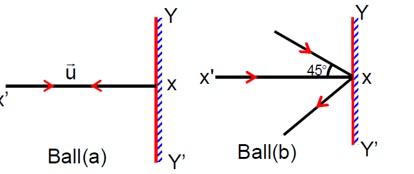
Contributor-Level 9
For ball (a): I? = Δp? = 2mu
For ball (b): I? = Δp? = 2mu cos 45°
I? /I? = 2mu / (2mu cos 45°) = √2
New answer posted
a year agoContributor-Level 10
By t = mx² + nx
dt/dx = 2mx + n
V = dx/dt = 1/ (2mx + n)
a = v (dv/dx) = V (d/dx (1/ (2mx+n) = V [-2m/ (2mx+n)²] = -2mV³
So, Retardation will be (2mv³)
New answer posted
a year agoContributor-Level 10
I = I? cosωt
Current is changing from its maximum value to rms value (I? /√2)
I? /√2 = I? cosωt
cosωt = 1/√2
ωt = π/4
2π * 50t = π/4
t = 1/400 s = 2.5 ms
New answer posted
a year ago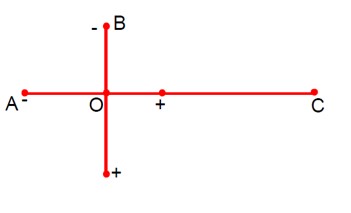
Contributor-Level 10
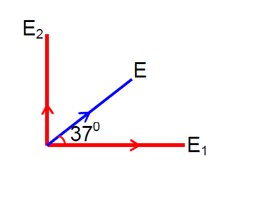
tan 37° = E? /E?
E? = k (2p? /r³) axial direction
E? = k (p? /r³) equatorial direction
tan 37° = (k p? /r³) / (k 2p? /r³) = p? / (2p? ) = 3/4
p? /p? = 2/3
Taking an Exam? Selecting a College?
Get authentic answers from experts, students and alumni that you won't find anywhere else
Sign Up on ShikshaOn Shiksha, get access to
- 67k Colleges
- 1.2k Exams
- 718k Reviews
- 1850k Answers