

Physics
Get insights from 5.6k questions on Physics, answered by students, alumni, and experts. You may also ask and answer any question you like about Physics
Follow Ask QuestionQuestions
Discussions
Active Users
Followers
New answer posted
a year agoContributor-Level 10
I? / I? = (MR²/2) / (mr²/4)
[ M = σπR², m = σπr² ]
= 2 (M/m) (R²/r²)
= 2 (σπR²/σπr²) (R²/r²)
= 2 (R²/r²)² = 2R? /r?
New answer posted
a year ago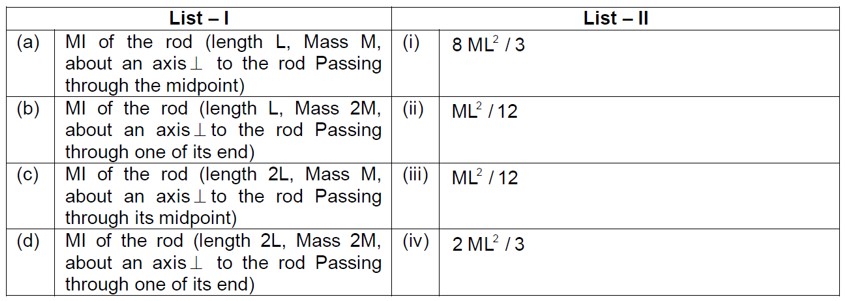
Contributor-Level 10
(a) I = ML²/12
(b) I = (2M)L²/3
(c) I = M (2L)²/12 = ML²/3
(d) I = (2M) (2L)²/3 = 8ML²/3
New answer posted
a year agoContributor-Level 9
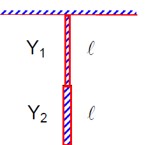
Y? = (F/A) / (Δl? /l)
Y? = (F/A) / (Δl? /l)
Y = (F/A) / (Δl? + Δl? )/ (2l)
= (F/A) / ( (1/2) * (Δl? /l + Δl? /l) )
= (F/A) / ( (1/2) * (F/ (AY? ) + F/ (AY? ) )
= 2Y? Y? / (Y? + Y? )
New answer posted
a year agoContributor-Level 9
Bandwidth
= (ω? + ω? ) - (ω? - ω? )
= 2ω?
= 2 (2πf? )
= 4πf?
= 2π (2f? )
= 2π (2*10? ) rad/s
= 2 * 10? Hz
= 200 kHz
New answer posted
a year agoContributor-Level 10
T sin θ = (1/4πε? ) * q²/ (2lsinθ)²
T cos θ = mg
∴ tan θ = q² / (4πε? mg * 4l²sin²θ)
[tan θ ≈ θ, for small angle]
So, θ³ = q² / (16πε? mgl²)
θ = ( q² / (16πε? mgl²) )¹/³
Also separation = 2l sin θ ≈ 2lθ
= 2l ( q² / (16πε? mgl²) )¹/³
= ( 8q²l³ / (16πε? mgl²) )¹/³
= ( q²l / (2πε? mg) )¹/³
New answer posted
a year agoContributor-Level 10
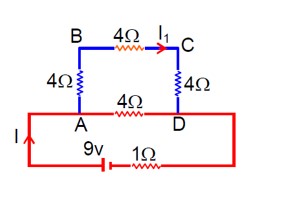
Each side of the square has a resistance of 16/4 = 4Ω.
The side AC has the 9V, 1Ω source.
The other three sides (AB, BD, DC) form a path with resistance 4+4+4 = 12Ω.
This is in parallel with the side AC (4Ω).
Total resistance of the loop part: (12*4)/ (12+4) = 48/16 = 3Ω.
Total resistance of the circuit: R_total = 3Ω + 1Ω (internal) = 4Ω.
Total current from source I = V/R_total = 9/4 A.
This current splits.
Current through path ABDC, I? = I * (R_AC / (R_ABDC + R_AC) = (9/4) * (4/16) = 9/16 A.
Potential at B: V_B = V_A - I? R_AB = 9 - (9/16)*4 = 9 - 9/4 = 27/4 V.
Potential at D: V_D = V_C + I? R_CD = 0 + (9/16)*4 = 9/4 V.
Potential drop a
New answer posted
a year agoContributor-Level 10
τ = Iα
I = ½MR² = ½ (10) (0.2)² = 0.2 kgm²
α = (ωf - ωi)/Δt = (0 - 600*2π/60)/10 = -2π rad/s²
τ = |Iα| = 0.2 * 2π = 0.4π = 4π * 10? ¹ Nm
New answer posted
a year agoContributor-Level 10
W = ∫Fxdy
W = ∫ (5y + 20)dy from 0 to 10
W = [5y²/2 + 20y] from 0 to 10
W = (5 (10)²/2 + 20 (10) - 0 = 250 + 200 = 450 J
New answer posted
a year agoContributor-Level 10
Binding Energy = (Δm)c²
= [Zmp + (A-Z)mn - MAl]c²
= [ (13*1.00726 + 14*1.00866) - 27.18846] u
= [ (13.09438 + 14.12124) - 27.18846] u
= [27.21562 - 27.18846] u
= 0.02716 u
= 0.02716 x = 27.16x * 10? ³
New answer posted
a year agoContributor-Level 9
C? = dQ/ndT = (dU + pdV)/ndT
= C? + (pdV/ndT)
C? - C? = pdV/ndT = R - For ideal Gas [Box: PV = nRT, pdV = nRdT]
C? - C? = 1.1R - For Non – Idea gas (for Real gas)
And Real gas behaves as ideal gas at high temperature & low pressure.
∴ T_B > T_A
Taking an Exam? Selecting a College?
Get authentic answers from experts, students and alumni that you won't find anywhere else
Sign Up on ShikshaOn Shiksha, get access to
- 67k Colleges
- 1.2k Exams
- 718k Reviews
- 1850k Answers