

Physics
Get insights from 5.6k questions on Physics, answered by students, alumni, and experts. You may also ask and answer any question you like about Physics
Follow Ask QuestionQuestions
Discussions
Active Users
Followers
New answer posted
a year agoContributor-Level 10
According to question
|x| = |y| and
|x - y| = n|x + y|
x² + y² - 2x·y = n² (x² + y² + 2x·y)
(1 - n²) (x² + y²) = (1 + n²)2x·y
(1 - n²) (x² + y²) = (1 + n²)2xy cosθ
(1 - n²) (2x²) = (1 + n²) (2x²)cosθ
cos θ = (1 - n²)/ (1 + n²)
θ = cos? ¹ (1 - n²)/ (1 + n²) = cos? ¹ (- (n²-1)/ (n²+1)
New answer posted
a year agoContributor-Level 10
For electron,
λe = h/p ⇒ (KE)e = ½mv² = p²/ (2m) = (h²/λ²)/ (2m)
For photon,
λp = h/p ⇒ (K.E.)p = pc = hc/λ
KEe / KEp = (h²/ (2mλ²) / (hc/λ) = h/ (2mcλ)
But for electron p = mv = h/λ so h/λ = mv
KEe / KEp = mv / (2mc) = v/2c
New answer posted
a year agoContributor-Level 9
Displacement in 4? second
= S? - S?
= (1/2)g [2n - 1]
= (1/2)g [2*4 - 1]
= (1/2) * 9.8 * 7
= 34.3m
As this distance matches with data given in question for position of next drop. So drops are falling at the rate of 1 drop/second.
New answer posted
a year agoContributor-Level 10
Body is dropped from height 75m with initial velocity (upward) 10m/s
So, s = ut + ½ at²
-75 = 10t - ½ gt²
5t² - 10t - 75 = 0
By solving t = 5 sec.
In 5sec. balloon covered
h = 10 * 5 = 50m
Now height of balloon = 75 + 50 = 125m
New answer posted
a year ago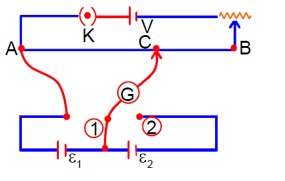
Contributor-Level 10
ε? = 250 * Potential Gradient
ε? + ε? = 400 * Potential Gradient
(ε? )/ (ε? + ε? ) = 250/400 = 5/8
By solving above
ε? /ε? = 5/3
New answer posted
a year ago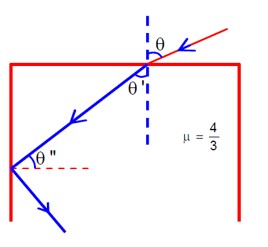
Contributor-Level 10
By shell's law
(sin θ)/ (sin θ') = 4/3 . (i)
For TIR on second surface
sin θ' > sin θc
(θ' + θ' = 90)
sin (90 - θ') > sin θc
cos θ' > sin θc
1 - sin²θ' > sin²θc (By equation (i) )
1 - (3/4 sin θ)² > sin²θc
[sin θc = 3/4]
1 - (9/16)sin²θ > (9/16)
1 - 9/16 > (9/16)sin²θ
7/16 > (9/16)sin²θ
sinθ < 7/3
New answer posted
a year agoContributor-Level 9
λ = h/mv = h/√2mK
For same K:
λ ∝ 1/√m
λ? : λ? : λ? = 1/√m? : 1/√m? : 1/√4m?
As m? > m? ,
λ? > λ? > λ?
New answer posted
a year agoContributor-Level 9
μ? sin 30° = μ? sin θ
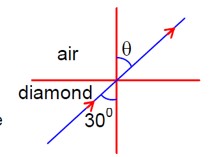
sinθ = 1.21 > 1
Refraction is not possible, total internal reflection
New answer posted
a year agoContributor-Level 9
3N? /4 = N? e?
⇒ e? = 4/3
t? = (1/λ) ln (4/3)
t? = ln2/λ
t? - t? = (1/λ)ln2 - (1/λ)ln (4/3)
= (1/λ)ln (2/ (4/3) = (1/λ)ln (3/2)
New answer posted
a year agoContributor-Level 9
β = λD / (d? + a? sinωt)
β? - β? = λD/ (d? - a? ) - λD/ (d? + a? )
= λD [ (d? + a? ) - (d? - a? ) / (d? ² - a? ²) ]
= 2λDa? / (d? ² - a? ²)
Taking an Exam? Selecting a College?
Get authentic answers from experts, students and alumni that you won't find anywhere else
Sign Up on ShikshaOn Shiksha, get access to
- 67k Colleges
- 1.2k Exams
- 718k Reviews
- 1850k Answers