
Probability
Get insights from 304 questions on Probability, answered by students, alumni, and experts. You may also ask and answer any question you like about Probability
- 304
Questions
- 0
Discussions
- 0
Active Users
- 4
Followers
Have a question about Probability? Ask our experts
Keep it short & simple. Type complete word. Avoid abusive language.
The probability of guessing correctly at least 8 out of 10 answers on a true-false type examination is
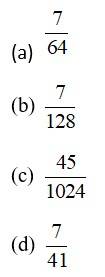
The probability of guessing correctly at least 8 out of 10 answers on a true-false type examination is

This is a Objective Type Questions as classified in NCERT Exemplar
Sol:
 Upvote

Two cards are drawn from a well-shuffled deck of 52 playing cards with replacement. The probability that both cards are queens is:
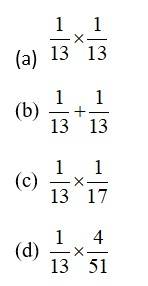
Two cards are drawn from a well-shuffled deck of 52 playing cards with replacement. The probability that both cards are queens is:

This is a Objective Type Questions as classified in NCERT Exemplar
Sol:
Upvote Which one is not a requirement of a binomial distribution?
(a) There are 2 outcomes for each trial
(b) There is a fixed number of trials
(c) The outcomes must be dependent on each other
(d) The probability of success must be the same for all the trials
Which one is not a requirement of a binomial distribution?
(a) There are 2 outcomes for each trial
(b) There is a fixed number of trials
(c) The outcomes must be dependent on each other
(d) The probability of success must be the same for all the trials
This is a Objective Type Questions as classified in NCERT Exemplar
Sol:
Upvote Two dice are thrown. If it is known that the sum of the numbers on the dice was less than 6, the probability of getting a sum of 3, is
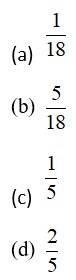
Two dice are thrown. If it is known that the sum of the numbers on the dice was less than 6, the probability of getting a sum of 3, is

This is a Objective Type Questions as classified in NCERT Exemplar
Sol:
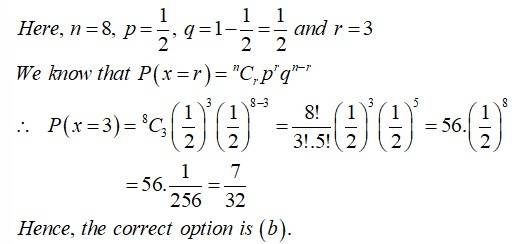
Upvote Eight coins are tossed together. The probability of getting exactly 3 heads is
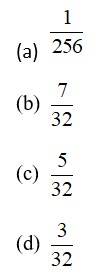
Eight coins are tossed together. The probability of getting exactly 3 heads is

This is a Objective Type Questions as classified in NCERT Exemplar
Sol:
 Upvote
A flashlight has 8 batteries out of which 3 are dead. If two batteries are selected without replacement and tested, the probability that both are dead is
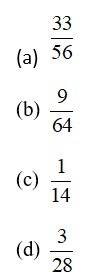
A flashlight has 8 batteries out of which 3 are dead. If two batteries are selected without replacement and tested, the probability that both are dead is

This is a Objective Type Questions as classified in NCERT Exemplar
Sol:
Upvote A box contains 3 orange balls, 3 green balls, and 2 blue balls. Three balls are drawn at random from the box without replacement. The probability of drawing 2 green balls and one blue ball is
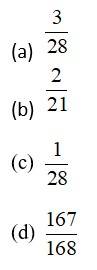
A box contains 3 orange balls, 3 green balls, and 2 blue balls. Three balls are drawn at random from the box without replacement. The probability of drawing 2 green balls and one blue ball is

This is a Objective Type Questions as classified in NCERT Exemplar
Sol:
Upvote A die is thrown and a card is selected at random from a deck of 52 playing cards. The probability of getting an even number on the die and a spade card is
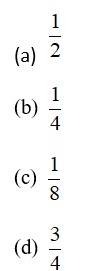
A die is thrown and a card is selected at random from a deck of 52 playing cards. The probability of getting an even number on the die and a spade card is

This is a Objective Type Questions as classified in NCERT Exemplar
Sol:
Upvote Assume that in a family, each child is equally likely to be a boy or a girl. A family with three children is chosen at random. The probability that the eldest child is a girl, given that the family has at least one girl is
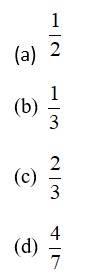
Assume that in a family, each child is equally likely to be a boy or a girl. A family with three children is chosen at random. The probability that the eldest child is a girl, given that the family has at least one girl is

This is a Objective Type Questions as classified in NCERT Exemplar
Sol:
Upvote Three persons, A, B, and C, fire at a target in turn, starting with A. Their probability of hitting the target are 0.4, 0.3, and 0.2 respectively. The probability of exactly two hits is:
(a) 0.024
(b) 0.188
(c) 0.336
(d) 0.452
Three persons, A, B, and C, fire at a target in turn, starting with A. Their probability of hitting the target are 0.4, 0.3, and 0.2 respectively. The probability of exactly two hits is:
(a) 0.024
(b) 0.188
(c) 0.336
(d) 0.452
This is a Objective Type Questions as classified in NCERT Exemplar
Sol:
Upvote