
Probability
Get insights from 304 questions on Probability, answered by students, alumni, and experts. You may also ask and answer any question you like about Probability
- 304
Questions
- 0
Discussions
- 0
Active Users
- 4
Followers
Have a question about Probability? Ask our experts
Keep it short & simple. Type complete word. Avoid abusive language.
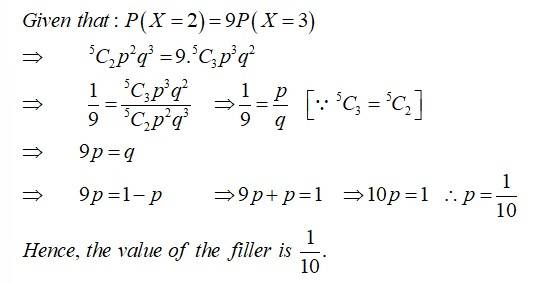
If follows binomial distribution with parameters , , and , , then _____
If follows binomial distribution with parameters , , and , , then _____
This is a Fill in the Blanks Type Questions as classified in NCERT Exemplar
Sol:
 Upvote

This is a Fill in the Blanks Type Questions as classified in NCERT Exemplar
Sol:
Upvote If and are two events such that:
, , , and , then _____
If and are two events such that:
, , , and , then _____
This is a Fill in the Blanks Type Questions as classified in NCERT Exemplar
Sol:
Upvote If , , and are three independent events such that , then:
.
If , , and are three independent events such that , then:
.
This is a True or False Type Questions as classified in NCERT Exemplar
Sol:
Upvote This is a True or False Type Questions as classified in NCERT Exemplar
Sol:
Upvote This is a True or False Type Questions as classified in NCERT Exemplar
Sol:
Upvote This is a True or False Type Questions as classified in NCERT Exemplar
Sol:
Upvote Another name for the mean of a probability distribution is expected value.
Another name for the mean of a probability distribution is expected value.
This is a True or False Type Questions as classified in NCERT Exemplar
Sol:
Upvote This is a True or False Type Questions as classified in NCERT Exemplar
Sol:
Upvote Two independent events are always mutually exclusive.
Two independent events are always mutually exclusive.
This is a True or False Type Questions as classified in NCERT Exemplar
Sol:
Upvote