Probability

Get insights from 304 questions on Probability, answered by students, alumni, and experts. You may also ask and answer any question you like about Probability

  • 304

    Questions

  • 0

    Discussions

  • 0

    Active Users

  • 4

    Followers

Have a question about Probability? Ask our experts

Ask Your Question

Keep it short & simple. Type complete word. Avoid abusive language.

New answer posted•a year ago
S
a year ago

This is a Objective Type Questions as classified in NCERT Exemplar

Sol:

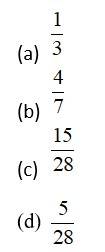
According  to  Question  74,Let  E1  be  event  that  first  ball  is  red.          E2 be  event  that  exactly  two  of  the  three  balls  are  red.∴  P(E1)=P(R).P(R).P(B)+P(R).P(R).P(R)+P(R).P(B).P(R)+P(R).P(B).P(B)                   =58.47.36+58.47.36+58.37.46+58.37.26                   =60336+60336+60336+30336=210336P(E1∩E2)=P(R).P(B).P(R)+P(R).P(R).P(B)                          =58.37.46+58.47.36=60336+60336=120336∴P(E2/E1)=P(E1∩E2)P(E1)=120/336210/336=47Hence,  the  correct  option  is  (b).

Thumbs Up IconUpvote Thumbs Down Icon
New answer posted•a year ago
S
a year ago

This is a Objective Type Questions as classified in NCERT Exemplar
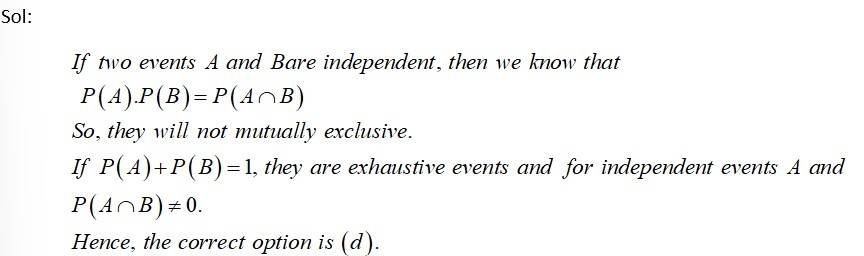
Sol:

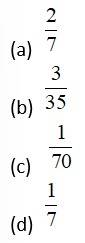
Given  that:E  and  F  are  two  independent  events  such  thatP(E)=0.3,  and  P(E∪F)=0.5∴        P(E∪F)=P(E)+P(F)−P(E∩F)                             0.5=0.3+P(F)−P(E).P(F)⇒             0.5−0.3=P(F)[1−P(E)]      ⇒0.2=P(F)(1−0.3)⇒                        0.2=P(F).(0.7)∴                        P(F)=0.20.7=27Now  P(E/F)−P(F/E)=P(E∩F)P(F).P(E∩F)P(E)        =P(E).P(F)P(F).P(E).P(F)P(E)=P(E)−P(F)=310−27=170Hence,  the  correct  option  is  (c).

Thumbs Up IconUpvote Thumbs Down Icon
New answer posted•a year ago
S
a year ago

This is a Objective Type Questions as classified in NCERT Exemplar

Sol:

  A  and  B  are  two  independent  events∴          P (A∩B)=P (A).P (B)Hence,   the  correct  option  is   (c).

Thumbs Up IconUpvote Thumbs Down Icon
New answer posted•a year ago
S
a year ago

This is a Objective Type Questions as classified in NCERT Exemplar

Sol:

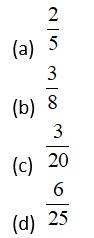
G i v e n     t h a t : P ( A ) = 3 8 ,     P ( B ) = 5 8     a n d     P ( A ∪ B ) = 3 4 ∴                 P ( A ∪ B ) = P ( A ) + P ( B ) − P ( A ∩ B )                                                           3 4 = 3 8 + 5 8 − P ( A ∩ B ) ⇒               P ( A ∩ B ) = 3 8 + 5 8 − 3 4 = 1 4 N o w     P ( A / B ) . P ( A ' / B ) = P ( A ∩ B ) P ( B ) . P ( A ' ∩ B ) P ( B )                                                                                                         = P ( A ∩ B ) P ( B ) . P ( B ) − P ( A ∩ B ) P ( B )                                                                                                         = 1 4 5 . ( 5 8 − 1 4 ) 5 = 2 5 . 3 5 = 6 2 5 H e n c e ,     t h e     c o r r e c t     o p t i o n     i s     ( d ) .

Thumbs Up IconUpvote Thumbs Down Icon
New answer posted•a year ago
S
a year ago

This is a Objective Type Questions as classified in NCERT Exemplar

Sol:

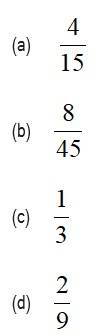
G i v e n     t h a t :     A     a n d     B     a r e     i n d e p e n d e n t     e v e n t s s u c h     t h a t     P ( A ) = 3 5     ∴ P ( A ' ) = 1 − 3 5 = 2 5                                             P ( B ) = 4 9   ∴ P ( B ' ) = 1 − 4 9 = 5 9 ∴                 P ( A ' ∩ B ' ) = P ( A ' ) . P ( B ' ) = 2 5 . 5 9 = 2 9 H e n c e ,     t h e     c o r r e c t     o p t i o n     i s     ( d ) .

Thumbs Up IconUpvote Thumbs Down Icon
New answer posted•a year ago
S
a year ago

This is a Objective Type Questions as classified in NCERT Exemplar

Sol:

G i v e n     t h a t :     P ( A ) > 0     a n d     P ( B ) ≠ 1 ∴                       P ( A ' / B ' ) = P ( A ' ∩ B ' ) P ( B ' ) = 1 − P ( A ∪ B ) P ( B ' ) H e n c e ,     t h e     c o r r e c t     o p t i o n     i s     ( c ) .

...Read more

Thumbs Up IconUpvote Thumbs Down Icon
New answer posted•a year ago
S
a year ago

This is a Objective Type Questions as classified in NCERT Exemplar

Sol:

G i v e n     t h a t :     P ( A ) = 7 1 3 ,     P ( B ) = 9 1 3 ,     P ( A ∩ B ) = 4 1 3     P ( A ' / B ) = P ( A ' ∩ B ) P ( B ) = P ( B ) − P ( A ∩ B ) P ( B )                                           = 9 1 3 − 4 1 3 9 1 3 = 5 1 3 9 1 3 = 5 9 H e n c e ,     t h e     c o r r e c t     o p t i o n     i s     ( d ) .

Thumbs Up IconUpvote Thumbs Down Icon
New answer posted•a year ago
S
a year ago

This is a Objective Type Questions as classified in NCERT Exemplar

Sol:

G i v e n     t h a t :     P ( B ) = 3 5 ,     P ( A / B ) = 1 2 ,     P ( A ∪ B ) = 4 5     P ( A / B ) = P ( A ∩ B ) P ( B ) ⇒                         1 2 = P ( A ∩ B ) 3 5                 ⇒ P ( A ∩ B ) = 3 1 0 P ( A ∪ B ) = P ( A ) + P ( B ) − P ( A ∩ B )                                     4 5 = P ( A ) + 3 5 − 3 1 0                     P ( A ) = 4 5 − 3 5 + 3 1 0 = 1 5 + 3 1 0 = 5 1 0 = 1 2 N o w     P ( A ∪ B ) ' + P ( A ' ∪ B )                                               = 1 − P ( A ∪ B ) + 1 − P ( A ∩ B ' )                                               = 2 − 4 5 − P ( A ) . P ( B ' )                                               = 6 5 − 1 2 . ( 1 − 3 5 ) = 6 5 − 1 2 × 2 5 = 6 5 − 1 5 = 5 5 = 1 H e n c e ,     t h e     c o r r e c t     o p t i o n     i s     ( d ) .

Thumbs Up IconUpvote Thumbs Down Icon
New answer posted•a year ago
S
a year ago

This is a Objective Type Questions as classified in NCERT Exemplar

Sol:

A c c o r d i n g     t o     E x e r c i s e     6 4 ,     w e     h a v e     P ( B ) = 3 5 ,     P ( A / B ) = 1 2 ,     P ( A ∪ B ) = 4 5     P ( B / A ' ) = P ( B ∩ A ' ) P ( A ' ) = P ( B ) − P ( A ∩ B ) 1 − P ( A ) = 3 5 − 3 1 0 1 − 1 2 = 3 1 0 1 2 = 3 5 H e n c e ,     t h e     c o r r e c t     o p t i o n     i s     ( d ) .

Thumbs Up IconUpvote Thumbs Down Icon