
Probability
Get insights from 304 questions on Probability, answered by students, alumni, and experts. You may also ask and answer any question you like about Probability
- 304
Questions
- 0
Discussions
- 0
Active Users
- 4
Followers
Have a question about Probability? Ask our experts
Keep it short & simple. Type complete word. Avoid abusive language.
A die is thrown three times. Let X be ‘the number of twos seen’. Find the expectation of X.
A die is thrown three times. Let X be ‘the number of twos seen’. Find the expectation of X.
This is a Short Answer Type Questions as classified in NCERT Exemplar
Sol:
 Upvote

<p><strong> A die is thrown three times. Let X be ‘the number of twos seen’. Find the expectation of X.</strong></p>
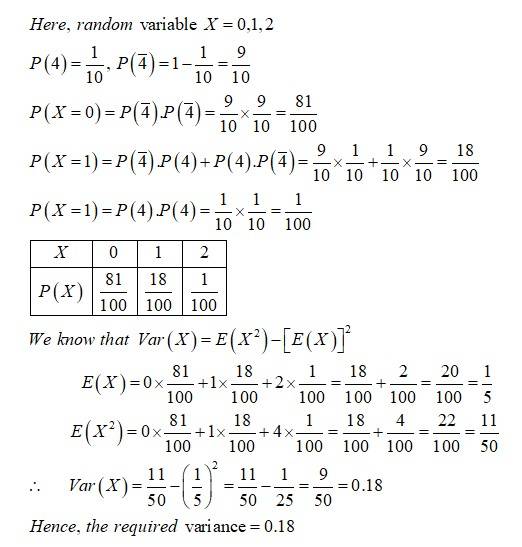
A biased die is such that and other scores being equally likely. The die is tossed twice. If X is the ‘number of fours seen’, find the variance of the random variable X.
A biased die is such that and other scores being equally likely. The die is tossed twice. If X is the ‘number of fours seen’, find the variance of the random variable X.
This is a Short Answer Type Questions as classified in NCERT Exemplar
Sol:
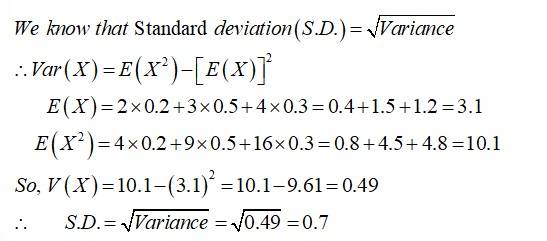
Upvote For the following probability distribution, determine the standard deviation of the random variable X.
X
2
3
4
P(X)
0.2
0.5
0.3
For the following probability distribution, determine the standard deviation of the random variable X.
|
X |
2 |
3 |
4 |
|
P(X) |
0.2 |
0.5 |
0.3 |
This is a Short Answer Type Questions as classified in NCERT Exemplar
Sol:
 Upvote
The probability distribution of a random variable X is given below:
X
0
1
2
3
P(X)
k
i. Determine the value of k.
ii. Determine P and P .
iii. Find .
The probability distribution of a random variable X is given below:
|
X |
0 |
1 |
2 |
3 |
|
P(X) |
k |
i. Determine the value of k.
ii. Determine P and P .
iii. Find .
This is a Short Answer Type Questions as classified in NCERT Exemplar
Sol:
Upvote Consider the probability distribution of a random variable X:
X
0
1
2
3
4
P(X)
0.1
0.25
0.3
0.2
0.15
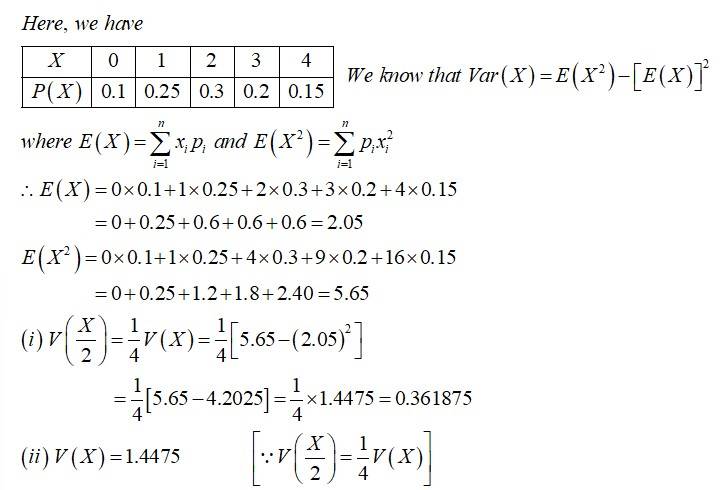
Calculate:(i) (ii) Variance of X.
Consider the probability distribution of a random variable X:
|
X |
0 |
1 |
2 |
3 |
4 |
|
P(X) |
0.1 |
0.25 |
0.3 |
0.2 |
0.15 |
Calculate:(i) (ii) Variance of X.
This is a Short Answer Type Questions as classified in NCERT Exemplar
Sol:
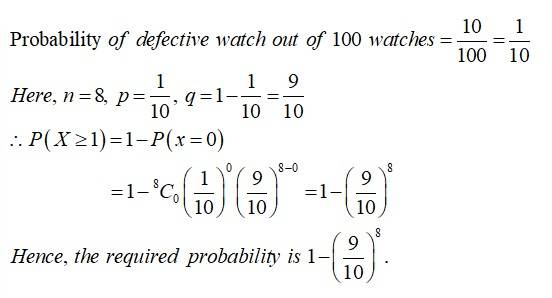
Upvote A lot of 100 watches is known to have 10 defective watches. If 8 watches are selected (one by one with replacement) at random, what is the probability that there will be at least one defective watch?
A lot of 100 watches is known to have 10 defective watches. If 8 watches are selected (one by one with replacement) at random, what is the probability that there will be at least one defective watch?
This is a Short Answer Type Questions as classified in NCERT Exemplar
Sol:
Upvote The probability of a man hitting a target is 0.25. He shoots 7 times. What is the probability of his hitting at least twice?
The probability of a man hitting a target is 0.25. He shoots 7 times. What is the probability of his hitting at least twice?
This is a Short Answer Type Questions as classified in NCERT Exemplar
Sol:
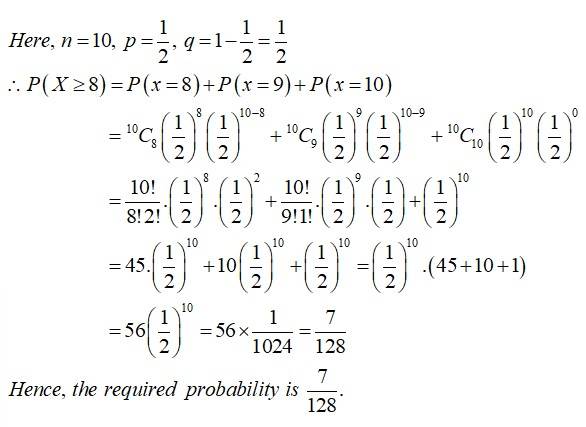
Upvote Ten coins are tossed. What is the probability of getting at least 8 heads?
Ten coins are tossed. What is the probability of getting at least 8 heads?
This is a Short Answer Type Questions as classified in NCERT Exemplar
Sol:
Upvote A die is thrown 5 times. Find the probability that an odd number will come up exactly three times.
A die is thrown 5 times. Find the probability that an odd number will come up exactly three times.
This is a Short Answer Type Questions as classified in NCERT Exemplar
Sol:
Upvote