
Probability
Get insights from 304 questions on Probability, answered by students, alumni, and experts. You may also ask and answer any question you like about Probability
- 304
Questions
- 0
Discussions
- 0
Active Users
- 4
Followers
Have a question about Probability? Ask our experts
Keep it short & simple. Type complete word. Avoid abusive language.
Two dice are tossed. Find whether the following two events and are independent: , where denotes a typical sample point.
Two dice are tossed. Find whether the following two events and are independent: , where denotes a typical sample point.
This is a Short Answer Type Questions as classified in NCERT Exemplar
Sol:
 Upvote

A and B throw a pair of dice alternately. A wins the game if he gets a total of 6 and B wins if she gets a total of 7. If A starts the game, find the probability of winning the game by A in the third throw of the pair of dice.
A and B throw a pair of dice alternately. A wins the game if he gets a total of 6 and B wins if she gets a total of 7. If A starts the game, find the probability of winning the game by A in the third throw of the pair of dice.
This is a Short Answer Type Questions as classified in NCERT Exemplar
Sol:
Upvote Find the variance of the distribution:
x
0
1
2
3
4
5
P(x)
1/6
5/18
2/9
1/6
1/9
1/18
Find the variance of the distribution:
|
x |
0 |
1 |
2 |
3 |
4 |
5 |
|
P(x) |
1/6 | 5/18 | 2/9 | 1/6 | 1/9 | 1/18 |
This is a Short Answer Type Questions as classified in NCERT Exemplar
Sol:
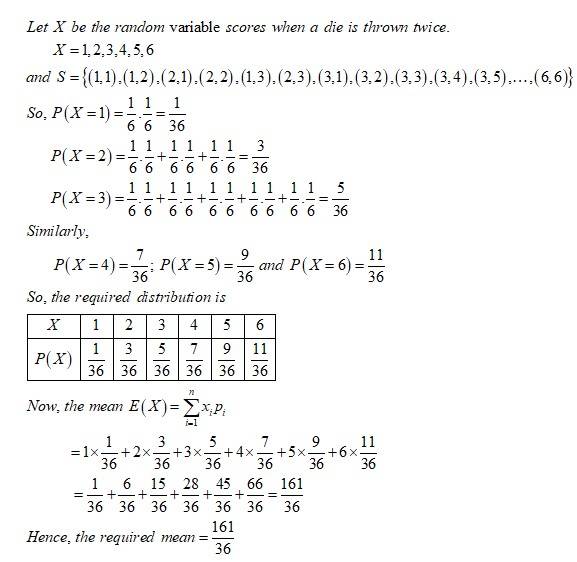
Upvote Find the probability distribution of the maximum of the two scores obtained when a die is thrown twice. Determine also the mean of the distribution.
Find the probability distribution of the maximum of the two scores obtained when a die is thrown twice. Determine also the mean of the distribution.
This is a Short Answer Type Questions as classified in NCERT Exemplar
Sol:
Upvote Two natural numbers , are drawn one at a time, without replacement from the set . Find
Two natural numbers , are drawn one at a time, without replacement from the set . Find
This is a Short Answer Type Questions as classified in NCERT Exemplar
Sol:
Upvote Suppose that 6% of the people with blood group O are left-handed and 10% of those with other blood groups are left-handed. 30% of the people have blood group O. If a left-handed person is selected at random, what is the probability that he/she will have blood group O?
Suppose that 6% of the people with blood group O are left-handed and 10% of those with other blood groups are left-handed. 30% of the people have blood group O. If a left-handed person is selected at random, what is the probability that he/she will have blood group O?
This is a Short Answer Type Questions as classified in NCERT Exemplar
Sol:
Upvote Suppose you have two coins which appear identical in your pocket. You know that one is fair and one is 2-headed. If you take one out, toss it and get a head, what is the probability that it was a fair coin?
Suppose you have two coins which appear identical in your pocket. You know that one is fair and one is 2-headed. If you take one out, toss it and get a head, what is the probability that it was a fair coin?
This is a Short Answer Type Questions as classified in NCERT Exemplar
Sol:
Upvote A factory produces bulbs. The probability that any one bulb is defective is and they are packed in boxes of 10. From a single box, find the probability that:
i. one of the bulbs is defective
ii. exactly two bulbs are defective
iii. more than 8 bulbs work properly
A factory produces bulbs. The probability that any one bulb is defective is and they are packed in boxes of 10. From a single box, find the probability that:
i. one of the bulbs is defective
ii. exactly two bulbs are defective
iii. more than 8 bulbs work properly
This is a Short Answer Type Questions as classified in NCERT Exemplar
Sol:
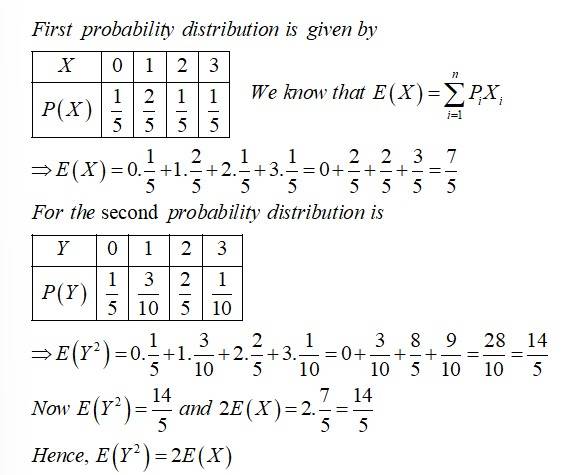
Upvote Two probability distributions of the discrete random variable X and Y are given below:
X
0
1
2
3
P(X)
Y
0
1
2
3
P(Y)
Prove that .
Two probability distributions of the discrete random variable X and Y are given below:
|
X |
0 |
1 |
2 |
3 |
|
P(X) |
|
Y |
0 |
1 |
2 |
3 |
|
P(Y) |
Prove that .
This is a Short Answer Type Questions as classified in NCERT Exemplar
Sol:
 Upvote
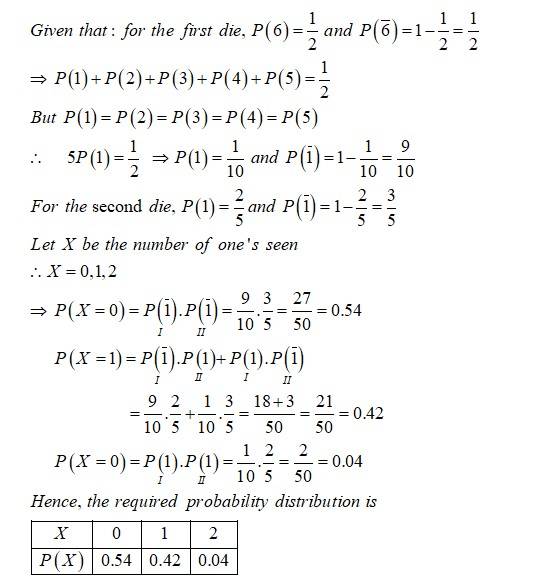
Two biased dice are thrown together. For the first die , the other scores being equally likely, while for the second die, and the other scores are equally likely. Find the probability distribution of ‘the number of ones seen’.
Two biased dice are thrown together. For the first die , the other scores being equally likely, while for the second die, and the other scores are equally likely. Find the probability distribution of ‘the number of ones seen’.
This is a Short Answer Type Questions as classified in NCERT
Sol:
 Upvote