
Quantitative Aptitude Prep Tips for MBA
Get insights from 224 questions on Quantitative Aptitude Prep Tips for MBA, answered by students, alumni, and experts. You may also ask and answer any question you like about Quantitative Aptitude Prep Tips for MBA
- 224
Questions
- 0
Discussions
- 0
Active Users
- 9
Followers
Have a question about Quantitative Aptitude Prep Tips for MBA? Ask our experts
Keep it short & simple. Type complete word. Avoid abusive language.
81! when divided by 83 leaves a remainder +1 (as 83 is prime) Hence the total remainder is +1 * 81 = 81.
 Upvote

In a school, temporary staff of 1000 people was recruited in which 600 were employed in cleaning department while 400 were employed in teaching department. The average salary of each temporary employee is Rs. 600. Each employee in cleaning department earns Rs. 100 more than that in teaching department. What is the salary of each employee in cleaning department?
In a school, temporary staff of 1000 people was recruited in which 600 were employed in cleaning department while 400 were employed in teaching department. The average salary of each temporary employee is Rs. 600. Each employee in cleaning department earns Rs. 100 more than that in teaching department. What is the salary of each employee in cleaning department?
Average salary of each temporary employee is 600.
1000 temporary employee,
Total salary = 6,00,000
let teaching departement = Rs. x / staff and cleaning department salary = x + 100
Now, 600 (x + 100) + 400 (x) = 6,00,000
x=540
Hence answer, x+100= 540+100=640
Upvote If A gives B Rs. 20 then A has 40% of what B has. Instead if B gives Rs. 40 to A then B will have 40% of what A has. What is the amount originally A has?
If A gives B Rs. 20 then A has 40% of what B has. Instead if B gives Rs. 40 to A then B will have 40% of what A has. What is the amount originally A has?
We have (A – 20) = 0.4 (B + 20), i.e. A – 0.4B = 28
And (B – 40) = 0.4 (A + 40), i.e. B – 0.4A = 56
Solving we get, A = Rs. 60
Upvote P, Q & R started travelling from the same point x in the same direction. P & Q started at 10:00 a.m. Then R started at 12 : 00 p.m. R overtook P at 2 : 00 p.m. and then doubled his speed. R overtook Q at 3:00 p.m. The ratio of speed of P & Q is
P, Q & R started travelling from the same point x in the same direction. P & Q started at 10:00 a.m. Then R started at 12 : 00 p.m. R overtook P at 2 : 00 p.m. and then doubled his speed. R overtook Q at 3:00 p.m. The ratio of speed of P & Q is
Let speeds of P, Q & R be P, Q & R km/hr respectively.
Thus 4P = 2R
= . (1)
= 5Q = 4R = . (2)
From (1) & (2),
=
=
Upvote In the given figure, PQRS is a square and M and N are midpoints of their respective sides. Find the area of the quadrilateral PMRN.
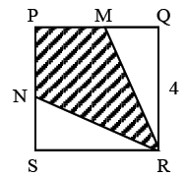
In the given figure, PQRS is a square and M and N are midpoints of their respective sides. Find the area of the quadrilateral PMRN.
Since M is the midpoint of side PQ, the length of MQ is 2.
Hence, the area of? MQR = × 2 × 4 = 4.
Also area of? NSR = 4. Thus, the unshaded area of the figure = 4 + 4 = 8.
Hence, the area of quadrilateral PMRN
= Area of the square PQRS – The unshaded area of the figure
= 16 – 8 = 8
Upvote The first term of a series in A.P. is 17, the last term is and the sum of the series is Find the common difference.
The first term of a series in A.P. is 17, the last term is and the sum of the series is Find the common difference.
Let n = the number of terms.
Then,
Let d be the common difference.
Then (= the eleventh term) = 17 + 10d
Upvote Two container A & B contain oil. 60% of contents of container A was transferred to container B. Then 50% contents of container B was transferred to A. The quantity of oil in container A to that of container B is now 11 : 7. What was ratio of initial volumes of oil in containers of A and B?
Two container A & B contain oil. 60% of contents of container A was transferred to container B. Then 50% contents of container B was transferred to A. The quantity of oil in container A to that of container B is now 11 : 7. What was ratio of initial volumes of oil in containers of A and B?
Let oil in containers be A & B.
After 1st operation
Container A = 0.4 A
Container B = 0.6 A + B
After 2nd operation
Container A = 0.4 A + 0.3 A + 0.5 B
Container B = 0.3 A + 0.5 B
=
1.6A = 2B
Volume of A : B = 5 : 4.
Upvote In the figure given below, ABCD is a rectangle. The area of the isosceles right triangle ABE = 7 cm2; EC = 3(BE). The area of ABCD (in cm2) is
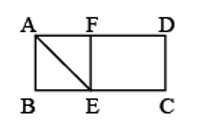
In the figure given below, ABCD is a rectangle. The area of the isosceles right triangle ABE = 7 cm2; EC = 3(BE). The area of ABCD (in cm2) is
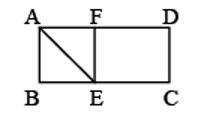
Area of Δ ABE = 7 cm2
Area of ABEF = 14 cm2
Area of ABCD = 14 × 4 = 56 cm2
(As CE = 3 × BE) = 56 cm2
Upvote There are three glasses of equal capacity. The ratio of milk & water in the three is 2 : 5, 3 : 4, 4 : 5. The mixture of these three is put into a bucket. Find ratio of water to milk in the bucket.
There are three glasses of equal capacity. The ratio of milk & water in the three is 2 : 5, 3 : 4, 4 : 5. The mixture of these three is put into a bucket. Find ratio of water to milk in the bucket.
I | II | III |
2 : 5 | 3 : 4 | 4 : 5 |
|
|
|
Hence new ratio
= 73 : 116
Upvote A car running from point P1 to point P2 meets with an accident 50 km from point P1, after which it travels with three- fifths of its original velocity and arrives 3 hours late at point P2; if the accident had occurred 50 km further on, it would have been only 2 hours late. Find the distance from point P1 to point P2.
A car running from point P1 to point P2 meets with an accident 50 km from point P1, after which it travels with three- fifths of its original velocity and arrives 3 hours late at point P2; if the accident had occurred 50 km further on, it would have been only 2 hours late. Find the distance from point P1 to point P2.
Let the distance be x km and speed be y km/hr and t be the time in hours. Then the equation will be x = yt …. (1),
Therefore,
Also,
On solving the above equations, we get speed is km/hr time is 6 hrs, and distance is 200 km.
Upvote