Structure of Atom
Get insights from 125 questions on Structure of Atom, answered by students, alumni, and experts. You may also ask and answer any question you like about Structure of Atom
- 125
Questions
- 0
Discussions
- 0
Active Users
- 7
Followers
Have a question about Structure of Atom? Ask our experts
Keep it short & simple. Type complete word. Avoid abusive language.
A certain orbital has n= 4 and m? = -3. The number of radial nodes in this orbital is _______ (Round off to the nearest integer).
A certain orbital has n= 4 and m? = -3. The number of radial nodes in this orbital is _______ (Round off to the nearest integer).
For n = 4, the possible values of l are 0, 1, 2, 3.
For l = 3, and m = -3.
Radial nodes = (n - l - 1) = (4 - 3 - 1) = 0
Ans = 0
 Upvote

The difference between the radii of 3rd and 4th orbits of Li²⁺ in ΔR₁. The difference between the radii of 3rd and 4th orbits of He⁺ is ΔR₂. Ratio ΔR₁: ΔR₂ is:
The difference between the radii of 3rd and 4th orbits of Li²⁺ in ΔR₁. The difference between the radii of 3rd and 4th orbits of He⁺ is ΔR₂. Ratio ΔR₁: ΔR₂ is:
ΔR? = (a? /3) (16 – 9)
ΔR? = (a? /2) (16 – 9)
∴ ΔR? /ΔR? = 2/3
Upvote The shortest wavelength of H atom in the Lyman series is λ₁. The longest wavelength in the Balmer Series of H⁺ is:
The shortest wavelength of H atom in the Lyman series is λ₁. The longest wavelength in the Balmer Series of H⁺ is:
For hydrogen atom :
For Lyman series n? = 1 & n? = ∞
1/λH = RH [1/1² - 1/∞²] So, λ = 1/RH
For He? ion Balmer series n? = 2 & n? = 3
1/λHe? = RH × Z² [1/n? ² - 1/n? ²]
1/λHe? = RH × 4 × [1/4 - 1/9] = RH × 4 × (5/36)
1/λHe? = (5/9)RH = (5/9) (1/λ)
(λHe? ) = (9/5)λ
Upvote The region in the electromagnetic spectrum where the Balmer series lines appear is:
The region in the electromagnetic spectrum where the Balmer series lines appear is:
Balmer series lies in the visible region.
Upvote Among the statements (I-IV), the correct ones are:
(I) Be has smaller atomic radius compared to <!-- [if gte msEquation 12]>
(II) Be has higher ionization enthalpy than Al.
(III) Charge/radius ratio of is greater than that of <!-- [if gte msEquation 12]>
(IV) Both Be and Al form mainly covalent compounds.
<!-- [if !supportLineBreakNewLine]-->
<!--[endif]-->
Among the statements (I-IV), the correct ones are:
(I) Be has smaller atomic radius compared to <!-- [if gte msEquation 12]>
(II) Be has higher ionization enthalpy than Al.
(III) Charge/radius ratio of is greater than that of <!-- [if gte msEquation 12]>
(IV) Both Be and Al form mainly covalent compounds.
<!-- [if !supportLineBreakNewLine]-->
<!--[endif]-->
Charge / radius ratio of and is same because of diagonal relationship. Remaining statements are correct.
Upvote The strengths of 5.6 volume hydrogen peroxide (of density ) in terms of mass percentage and molarity , respectively, are:
(Take molar mass of hydrogen peroxide as <!-- [if gte msEquation 12]>
The strengths of 5.6 volume hydrogen peroxide (of density ) in terms of mass percentage and molarity , respectively, are:
(Take molar mass of hydrogen peroxide as <!-- [if gte msEquation 12]>
For
Molarity
Molarity
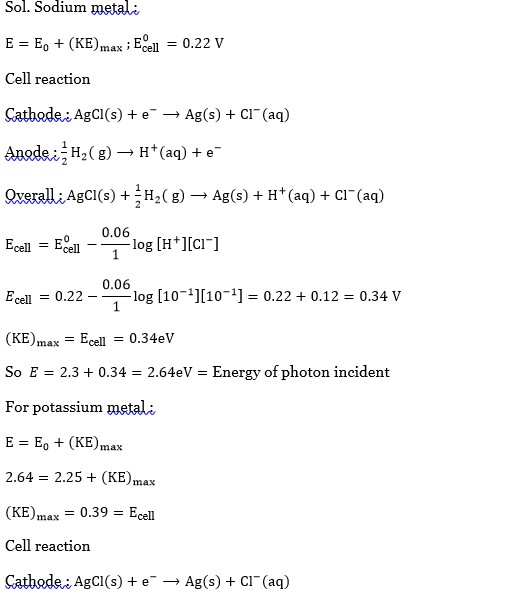
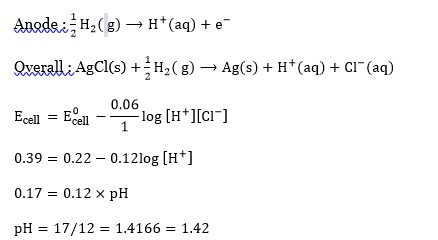
Upvote The photoelectric current from Na (work function, w? = 2.3eV) is stopped by the output voltage of the cell
Pt(s)/H?(g, 1 bar) | HCl (aq., pH = 1)|AgCl(s)|Ag(s).
The pH of aq. HCl required to stop the photoelectric current from K(w? = 2.25 eV), all other conditions remaining the same, is × 10?² (to the nearest integer).
Given,
2.303(RT/F) = 0.06 V; E°(AgCl|Ag|Cl?) = 0.22 V
<!-- [if !supportLineBreakNewLine]-->
<!--[endif]-->
The photoelectric current from Na (work function, w? = 2.3eV) is stopped by the output voltage of the cell
Pt(s)/H?(g, 1 bar) | HCl (aq., pH = 1)|AgCl(s)|Ag(s).
The pH of aq. HCl required to stop the photoelectric current from K(w? = 2.25 eV), all other conditions remaining the same, is × 10?² (to the nearest integer).
Given,
2.303(RT/F) = 0.06 V; E°(AgCl|Ag|Cl?) = 0.22 V
<!-- [if !supportLineBreakNewLine]-->
<!--[endif]-->