
Structure of Atom
Get insights from 125 questions on Structure of Atom, answered by students, alumni, and experts. You may also ask and answer any question you like about Structure of Atom
- 125
Questions
- 0
Discussions
- 0
Active Users
- 7
Followers
Have a question about Structure of Atom? Ask our experts
Keep it short & simple. Type complete word. Avoid abusive language.
Shown below are portions of orbital diagrams representing the ground state electron configuration of certain elements. If ‘x’ of them violates Pauli exclusion principle and ‘y’ of them violates Hund’s Rule then what is ‘x’ multiplies ‘y’?

Shown below are portions of orbital diagrams representing the ground state electron configuration of certain elements. If ‘x’ of them violates Pauli exclusion principle and ‘y’ of them violates Hund’s Rule then what is ‘x’ multiplies ‘y’?
The Pauli exclusion principle states that no two electrons in an atom can have the same four quantum numbers. In other words, only two electrons may exist in the same atomic orbital, and these electrons must have opposite spins. (a) and (f) violate the Pauli exclusion principle. Hund's rule states t
 Upvote

Out of the following, which is the correct match for radial probability of finding the electron of 2s orbital?
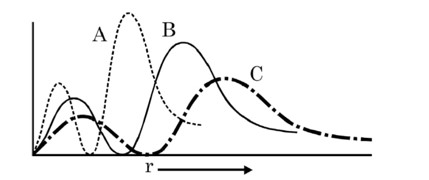
Out of the following, which is the correct match for radial probability of finding the electron of 2s orbital?
As Z increases, r0 decreases
Hence upon increasing Z, nuclear distance of node decreases.
Upvote The maximum number of electrons with n = 3 and l = 3 is:
The maximum number of electrons with n = 3 and l = 3 is:
As 3f-orbital does not exist as value of l cannot be equal to n, hence no electron can be accommodated.
Upvote A proton and a Li3+ nucleus are accelerated by the same potential. If <!-- [if gte mso 9]><xml>
A proton and a Li3+ nucleus are accelerated by the same potential. If <!-- [if gte mso 9]><xml>
Using
m = mass of proton
= 0.2 = 2 × 10⁻¹
So; x = 2
Upvote Which of the following graphs correctly represents the variation of particle momentum with associated de-Broglie wavelength ?
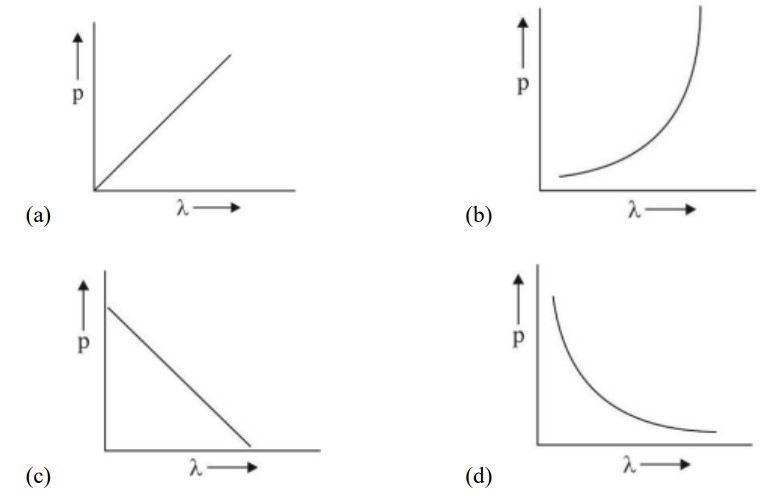
Which of the following graphs correctly represents the variation of particle momentum with associated de-Broglie wavelength ?
λ = h/p there is inverse relation between de-Broglie wavelength and momentum, hence the graph will be rectangular hyperbola.
Upvote The number of neutrons and electrons respectively, present in the radioactive isotope of hydrogen is:
<!-- [if !supportLineBreakNewLine]-->
<!--[endif]-->
The number of neutrons and electrons respectively, present in the radioactive isotope of hydrogen is:
<!-- [if !supportLineBreakNewLine]-->
<!--[endif]-->
Radioactive isotope of hydrogen is tritium (³H)
Number of neutron = 3 - 1 = 2
Number of electron = 1
Upvote In which transition, in a sample of H atoms, only one type of photon is emitted?
<!-- [if !supportLineBreakNewLine]-->
<!--[endif]-->
In which transition, in a sample of H atoms, only one type of photon is emitted?
<!-- [if !supportLineBreakNewLine]-->
<!--[endif]-->
Only in n = 2 → n = 1 (one single type of photon is emitted)
Upvote If the Thompson model of the atom was correct, then the result of Rutherford's gold foil experiment would have been:
<!-- [if !supportLineBreakNewLine]-->
<!--[endif]-->
If the Thompson model of the atom was correct, then the result of Rutherford's gold foil experiment would have been:
<!-- [if !supportLineBreakNewLine]-->
<!--[endif]-->
When alpha particles pass through the gold foil, alpha particle deflected because according to Thompson model positive charge dispersed through out the atom.
Upvote The relation between nm, (nm = the number of permissible values of magnetic quantum number (m)) for a given value of azimuthal quantum number (l), is
<!-- [if !supportLineBreakNewLine]-->
<!--[endif]-->
The relation between nm, (nm = the number of permissible values of magnetic quantum number (m)) for a given value of azimuthal quantum number (l), is
<!-- [if !supportLineBreakNewLine]-->
<!--[endif]-->
nm = 2l + 1
As there are (2l + 1) number of permissible values of magnetic quantum number.
Hence, l = (nm - 1)/2
Upvote