
Structure of Atom
Get insights from 125 questions on Structure of Atom, answered by students, alumni, and experts. You may also ask and answer any question you like about Structure of Atom
- 125
Questions
- 0
Discussions
- 0
Active Users
- 7
Followers
Have a question about Structure of Atom? Ask our experts
Keep it short & simple. Type complete word. Avoid abusive language.
The work function of sodium metal is 4.41 × 10⁻¹⁹ J. If photons of wavelength 300 nm are incident on the metal, the kinetics energy of the ejected electrons will be (h = 6.63 × 10⁻³⁴ Js; c = 3 × 10⁸ m/s) × 10⁻²¹ J. [numerical value].
The work function of sodium metal is 4.41 × 10⁻¹⁹ J. If photons of wavelength 300 nm are incident on the metal, the kinetics energy of the ejected electrons will be (h = 6.63 × 10⁻³⁴ Js; c = 3 × 10⁸ m/s) × 10⁻²¹ J. [numerical value].
KE_max = hc/λ - φ = 6.63e-19 - 4.41e-19 = 2.22e-19 = 222e-21 J.
 Upvote

The number of subshells associated with n=4 and m=-2 quantum numbers is:
The number of subshells associated with n=4 and m=-2 quantum numbers is:
For n=4, l can be 0,1,2,3. m=-2 is possible for l=2,3. So 2 subshells (4d, 4f).
Upvote The figure that is not a direct manifestation of the quantum nature of atom is
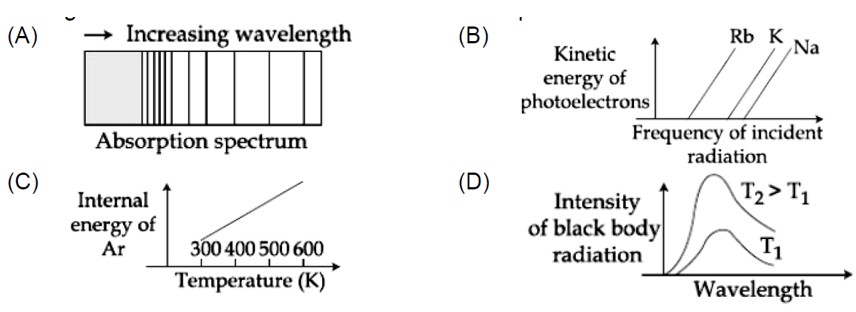
The figure that is not a direct manifestation of the quantum nature of atom is
1, 2 and 3 are according to quantum theory but (4) is statement of kinetic theory of gases
Upvote <p><strong>The figure that is not a direct manifestation of the quantum nature of atom is:</strong><br><strong><!-- [if !supportLineBreakNewLine]--></strong></p>
<div class="photo-widget-full">
<div class="figure"><picture><source srcset="" media="(max-width: 500px)"><img src="https://images.shiksha.com/mediadata/images/1756116516phpVtPBfd.jpeg" alt="" width="661" height="236" loading="lazy"></picture></div>
</div>
<p> </p>
<p><br><!--[endif]--></p>
The increasing order of pK♭ values of the following compounds is:
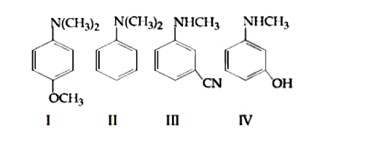
The increasing order of pK♭ values of the following compounds is:
Kindly consider the following figure
Upvote The correct statement about probability density (except at infinite distance from nucleus) is:
<!-- [if !supportLineBreakNewLine]-->
<!--[endif]-->
The correct statement about probability density (except at infinite distance from nucleus) is:
<!-- [if !supportLineBreakNewLine]-->
<!--[endif]-->
Probability density of plots
From the given graph answer is (1)
Upvote For the Balmer series in the spectrum of atom, the correct statements among (I) to (IV) are :
(I) As wavelength decreases, the lines in the series converge
(II) The integer is equal to 2
(III) The lines of longest wavelength corresponds to
(IV) The ionization energy of hydrogen can be calculated from wave number of these lines
For the Balmer series in the spectrum of atom, the correct statements among (I) to (IV) are :
(I) As wavelength decreases, the lines in the series converge
(II) The integer is equal to 2
(III) The lines of longest wavelength corresponds to
(IV) The ionization energy of hydrogen can be calculated from wave number of these lines
For atom
For Balmer series:
If
Upvote What does the energy of an orbital in a multi electron atom depend on?
What does the energy of an orbital in a multi electron atom depend on?
In a hydrogen atom, which we know has a single electron, the orbital energy will only depend on the principal quantum number (n). Here, the orbitals like 2s and 2p have the same energy (degenerate).
It's a little different with multielectron atoms. The energy depends on both n and the azimuthal quant
Upvote