Amines
Get insights from 162 questions on Amines, answered by students, alumni, and experts. You may also ask and answer any question you like about Amines
- 162
Questions
- 0
Discussions
- 0
Active Users
- 0
Followers
Have a question about Amines? Ask our experts
Keep it short & simple. Type complete word. Avoid abusive language.
This is a Multiple Choice Questions as classified in NCERT Exemplar
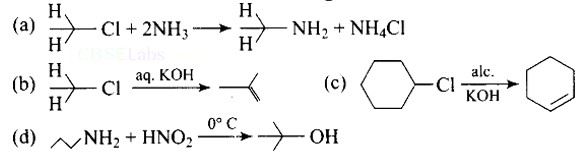
Ans: option a and c
(a) Primary alkyl halides react with ammonia to give primary amines. Correct reaction.
(B) Elimination process doesn't occur with aq. KOH, hydrolysis process takes place. (B) is incorrect.
(c) Dehydrohalogen
Which of the following amines can be prepared by Gabriel synthesis?
(a) Isobutyl amine
(b) 2-Phenylethylamine
(c) N-Methylbenzylamine
(d) Aniline
Which of the following amines can be prepared by Gabriel synthesis?
(a) Isobutyl amine
(b) 2-Phenylethylamine
(c) N-Methylbenzylamine
(d) Aniline
This is a Multiple Choice Questions as classified in NCERT Exemplar
Ans: (a and b)
Gabriel synthesis is a method for producing primary amines. When phthalimide is treated with ethanolic potassium hydroxide, it forms a potassium salt of phthalimide, which when heated with an alkyl halide and the
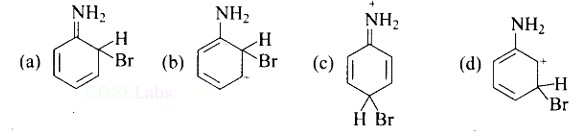
Arenium ion involved in the bromination of aniline is.
This is a Multiple Choice Questions as classified in NCERT Exemplar
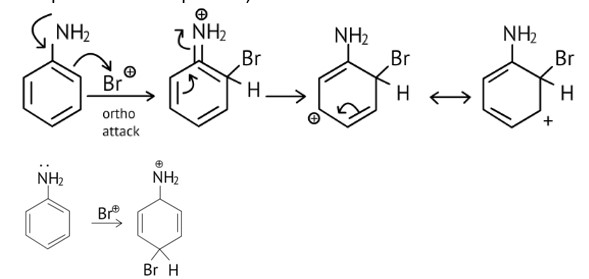
Ans: A, B & C
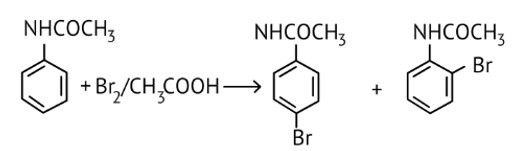
As the NH2 group is Ortho para directing group, so Br+ attacks only at the o and p positions thus the products formed corresponds to the option A, B and C.
This is a Multiple Choice Questions as classified in NCERT Exemplar
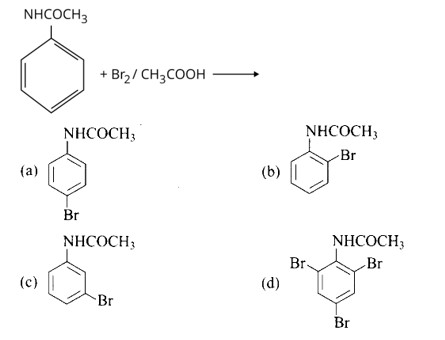
Ans: Option a and b
NHCOCH3 is an ortho- para directing group so ortho-para products are formed.
The reagents that can be used to convert benzenediazonium chloride to benzene are __________.
(i) SnCl2 /HCl
(ii) CH3CH2OH
(iii) H3 PO2
(iv) LiAlH4<!--[endif]-->
The reagents that can be used to convert benzenediazonium chloride to benzene are __________.
(i) SnCl2 /HCl
(ii) CH3CH2OH
(iii) H3 PO2
(iv) LiAlH4<!--[endif]-->
This is a Multiple Choice Questions as classified in NCERT Exemplar
Ans: option (B and C)
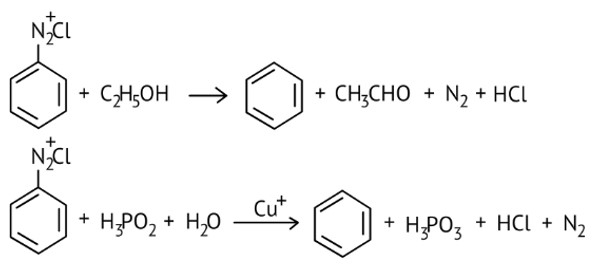
Certain mild reducing agents like hypophosphorous acid (phosphinic acid) or ethanol reduce diazonium salts to arenes and themselves get oxidised to phosphorous acid and ethanol, respectively.
Which of the following species are involved in the carbylamine test?
(A) R-NC
(B) CHCl3
(C) COCl2
(D) NaNO2+HCl
Which of the following species are involved in the carbylamine test?
(A) R-NC
(B) CHCl3
(C) COCl2
(D) NaNO2+HCl
This is a Multiple Choice Questions as classified in NCERT Exemplar
Ans: (A and B)
When aliphatic and aromatic primary amines are heated with chloroform and ethanolic potassium hydroxide, they form isocyanides or carbylamines, which have a foul odor. This reaction does not occur in secondary or terti
Reduction of nitrobenzene by which of the following reagents give aniline?
(A) Sn/HCl
(B) Fe/HCl
(C) H2−Pd
(D) Sn/NH4OH
Reduction of nitrobenzene by which of the following reagents give aniline?
(A) Sn/HCl
(B) Fe/HCl
(C) H2−Pd
(D) Sn/NH4OH
This is a Multiple Choice Questions as classified in NCERT Exemplar
Ans: (A, B & C)
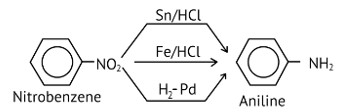
Nitro compounds are reduced to amines by passing hydrogen gas through an acidic medium containing finely divided nickel, palladium, or platinum, as well as by reduction with metals in an acidic medium.
Which of the following cannot be prepared by Sandmeyer’s reaction?
(A) Chlorobenzene
(B) Bromobenzene
(C) Iodobenzene
(D) Fluorobenzene
Which of the following cannot be prepared by Sandmeyer’s reaction?
(A) Chlorobenzene
(B) Bromobenzene
(C) Iodobenzene
(D) Fluorobenzene
This is a Multiple Choice Questions as classified in NCERT Exemplar
Ans: (C and D)
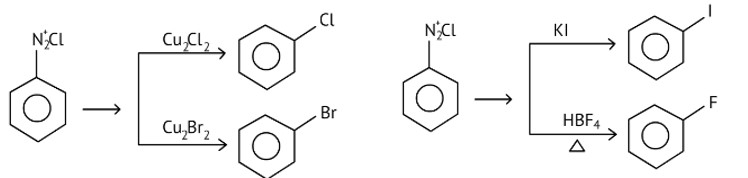
Chlorobenzene and bromobenzene are prepared by the sandmeyer's reaction.
While fluorobenzene and iodobenzene are prepared by simple heating of diazonium salt with aqueous KI Solution.
Which of the following methods of preparation of amines will not give the same number of carbon atoms in the chain of amines as in the reactant?
(A) Reaction of nitrile with LiAlH4
(B) Reaction of amide with LiAlH4 followed by treatment with water.
(C) Heating alkyl halide with potassium salt of phthalimide followed by hydrolysis
(D) Treatment of amide with bromine in aqueous solution of sodium hydroxide.
This is a Multiple Choice Questions as classified in NCERT Exemplar
Ans: (D)
Aliphatic and arylalkyl primary amines can be prepared by the reduction of the corresponding nitriles with LiAlH4
Heating alkyl halide with primary, secondary and tertiary amine can be prepared by reduction of LiAlH4 followed
Which of the following should be most volatile?
(A) II
(B) IV
(C) I
(D) III
Which of the following should be most volatile?
(A) II
(B) IV
(C) I
(D) III
This is a Multiple Choice Questions as classified in NCERT Exemplar
Ans: (B)
Among primary, secondary, and tertiary amines, tertiary amines are the most volatile compounds as they don't have any strong intermolecular H-bonding between N-H like the primary and secondary amines have.
So due to wea