

Chemistry
Get insights from 6.9k questions on Chemistry, answered by students, alumni, and experts. You may also ask and answer any question you like about Chemistry
Follow Ask QuestionQuestions
Discussions
Active Users
Followers
New answer posted
a year agoContributor-Level 10
13.49
2 A (g) → A? (g)
Δn_g = 1 - 2
Δn_g = 1
ΔH = ΔU + Δn_gRT
ΔH = -20 * 10³ + (-1)8.31 * 298
ΔH = -22477.572 J mol? ¹
ΔG = ΔH - TΔS
ΔG = -22477.572 - (-30)298 = -22477.572 + 8940
ΔG = -13537.57 J mol? ¹
New answer posted
a year agoContributor-Level 10
Δ? > P
Pairing of electron will take place
Number of unpaired electron = 0
µ = 0.00
New answer posted
a year agoContributor-Level 10
(A) Trans
(B) Cis
Optically inactive due to presence of plane of symmetry
Optically active no plane of symmetry
New answer posted
a year agoContributor-Level 10
Boiling and clark's method (Ca (OH)? ) are used for removing temporary hardness. Whereas, calgon, sodium carbonate ion exchange method are used for removing permanent hardness.
New answer posted
a year agoContributor-Level 10
Hydrogen peroxide has open book type structure. It is coloureless in free state
New answer posted
a year agoContributor-Level 10
Zone refining is used to obtain high purity elements which are used in the manufacture of semiconductors. Boron and silicon both are used in semiconductors.
New answer posted
a year ago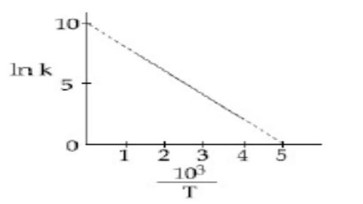
Contributor-Level 10
lnK = -E_a/RT + I
-E_a/R = slope is negative
⇒ -E_a/R = (10-0)/ (5-0)
E_a = 2R
Taking an Exam? Selecting a College?
Get authentic answers from experts, students and alumni that you won't find anywhere else
Sign Up on ShikshaOn Shiksha, get access to
- 67k Colleges
- 1.2k Exams
- 716k Reviews
- 1850k Answers