

Chemistry
Get insights from 6.9k questions on Chemistry, answered by students, alumni, and experts. You may also ask and answer any question you like about Chemistry
Follow Ask QuestionQuestions
Discussions
Active Users
Followers
New answer posted
a year ago
Contributor-Level 9
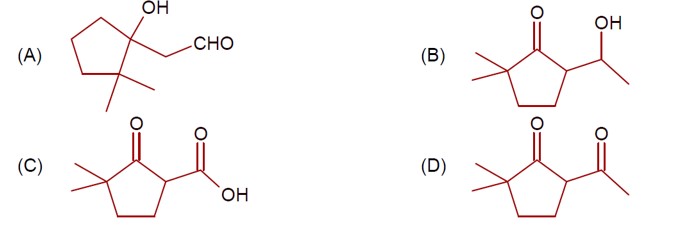
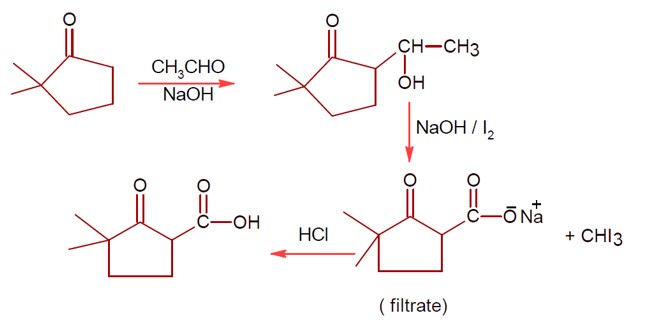
[Aldol condensation of 2-methylcyclopentanone with acetaldehyde to form an aldol product, which then undergoes iodoform reaction to give a carboxylic acid and iodoform.]
New answer posted
a year agoContributor-Level 10
Rate = K [A]?
K = Rate / [A]?
= (mole L? ¹s? ¹) / (mole L? ¹)?
= mole¹? L? ¹ s? ¹
Unit of K: mole¹? L? ¹ s? ¹
New answer posted
a year agoContributor-Level 10
Rutherford atomic model can not explain hydrogen spectrum it is explained by Bohr's atomic model and from Bohr's atomic model, uncertainity principle can't be explained.
New answer posted
a year ago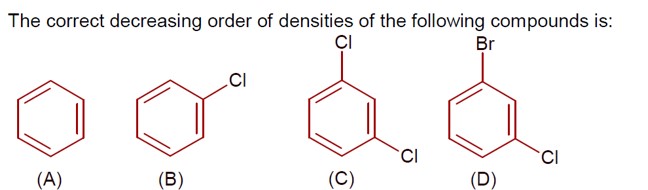
Contributor-Level 10
Density ∝ molar mass, as size of given molecules is nearly same
New answer posted
a year ago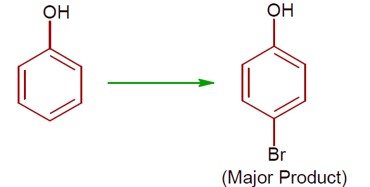
Contributor-Level 9
(a) Phenol with Br? / H? O gives 2,4,6-tribromophenol. (High ionisation due to polar solvent and high activation of ring)
(b) Phenol with Br? in CS? /CHCl? /FeBr? gives a mixture of o- and p-bromophenol, with p-bromophenol as the major product. (less ionisation due to non- polar solvent)
[Chemical reactions showing bromination of phenol under different conditions]
New answer posted
a year agoContributor-Level 10
(A) Concentration of Ag & Au done by NaCN. It is known as Mac Arthur Process (cyanide process)
(B) Blast furnace produces pig Fe.
(C) Blister Cu → Reverberatory furnace. In this furnace smelting & roasting of ore take place
CuFeS? + O? → Cu? O + FeO
(D) Froth floatation process is used for concentration of sulphide ores.
New answer posted
a year agoContributor-Level 10
Polyamide copolymers are biodegradable polymers.
Polymers Nylon-2 Nylon-6 are polyamides and monomers of Nylon-2 nylon-6 are:
H? N–CH? –COOH (Glycine) & H? N– (CH? )? –COOH (Aminocaproic acid)
New answer posted
a year agoContributor-Level 10
Bohr's model played an important role in the development of quantum theory. It introduced the idea of quantised electron orbits. It disproved claims of classical mechanics, which predicted that electrons would spiral into the nucleus. Bohr proposed that electrons can exist only in specific, stable energy levels called stationary states. There would be transitions between these levels that would help Bohr explain the line spectra of hydrogen. That together linked the atomic structure with the concept of energy quantisation. Even though the model could not explain multi-electron atoms, it laid the foundation for modern quantum mechanics.
Taking an Exam? Selecting a College?
Get authentic answers from experts, students and alumni that you won't find anywhere else
Sign Up on ShikshaOn Shiksha, get access to
- 67k Colleges
- 1.2k Exams
- 716k Reviews
- 1850k Answers