

Chemistry
Get insights from 6.9k questions on Chemistry, answered by students, alumni, and experts. You may also ask and answer any question you like about Chemistry
Follow Ask QuestionQuestions
Discussions
Active Users
Followers

New answer posted
a year agoContributor-Level 9
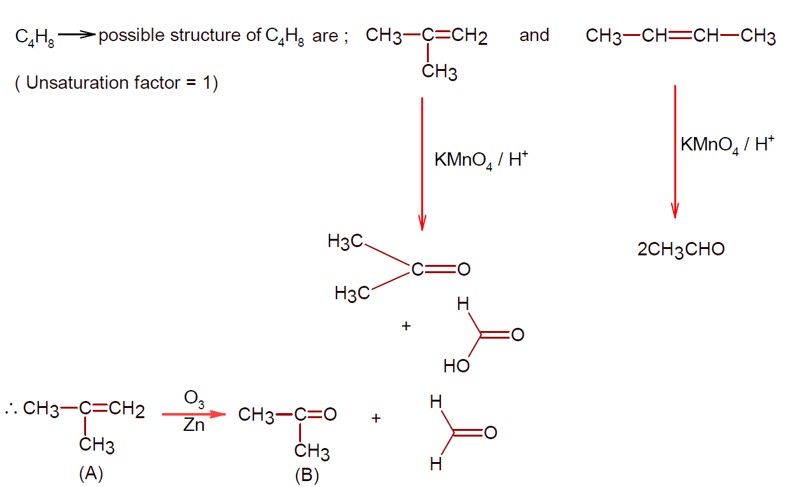
C? H? → possible structure of C? H? are; CH? -C (CH? )=CH? and CH? -CH=CH-CH?
(Unsaturation factor = 1)
Ozonolysis of CH? -C (CH? )=CH? gives acetone (B) and formaldehyde.
Oxidation of CH? -C (CH? )=CH? with KMnO? /H? gives acetone (B) and CO?
The question states it gives C? H? O (B). Hence the alkene is 2-Methylpropene (A).
[Reaction scheme showing ozonolysis and permanganate oxidation of 2-methylpropene]
New answer posted
a year ago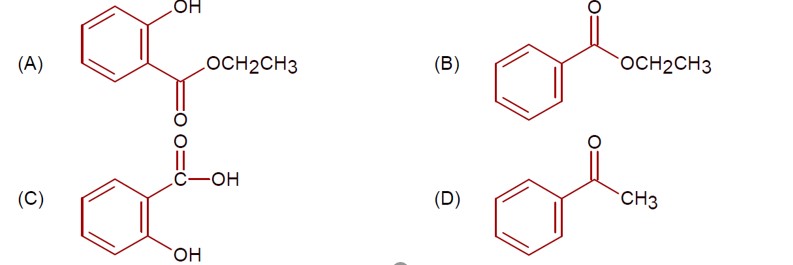
Contributor-Level 10
All carbonyl compound (aldehyde and ketone) give orange precipitate with 2,4-dinitrophenyl hydrazine (Brady's reagent)
New answer posted
a year agoContributor-Level 10
CrO? ²? (Cr? ) → Cr? ³, Total oxidation number change = 3
MnO? (Mn? ) → Mn? ², Total oxidation number change = 5
Cr? O? ²? (Cr? ) → 2Cr? ³, Total oxidation number change = 6
C? O? ²? (C? ³) → 2CO? (C? ), Total oxidation number change = 2
New answer posted
a year agoContributor-Level 10
(A) [PtCl? (NH? )? ], Number of GI = 2
(B) [Ni (CO)? ], Number of G.I = 0 as it is tetrahedral.
(C) [Ru (H? O)? Cl? ] Number of G.I = 2 (Facial and Meridional)
(D) [CoCl? (NH? )? ]? Number of G.I = 2 (Cis and trans)
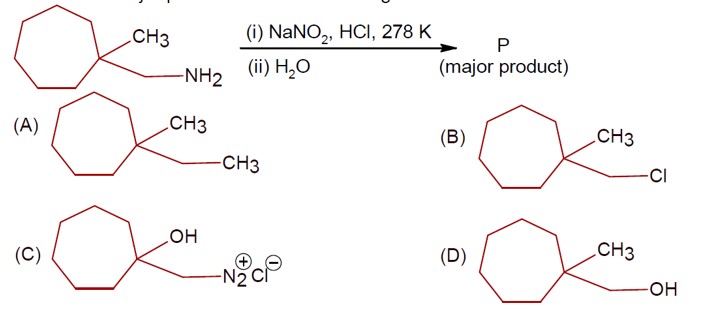

New answer posted
a year agoContributor-Level 9
B.D.E H-H < B.D.E D-D
B.D.E H-H = 435.9 kJ / mole
B.D.E D-D = 443.4 kJ / mole
E H ≈ E D - 7.5
New answer posted
a year agoContributor-Level 9
Gabriel phthalimide is used for the preparation of 1° aliphatic amine not 1° aromatic amines since 1° aromatic amines do not undergo nucleophilic substitution reaction.
New answer posted
a year agoContributor-Level 10
Rotamers or conformers arises due to free rotation along σ - bond.
New answer posted
a year agoContributor-Level 10
Barfoed test:-
In this test, copper acetate in dilute acid is reduced in 30 seconds by mono saccharides while disaccharides takes several minutes.
Taking an Exam? Selecting a College?
Get authentic answers from experts, students and alumni that you won't find anywhere else
Sign Up on ShikshaOn Shiksha, get access to
- 67k Colleges
- 1.2k Exams
- 716k Reviews
- 1850k Answers