

Chemistry
Get insights from 6.9k questions on Chemistry, answered by students, alumni, and experts. You may also ask and answer any question you like about Chemistry
Follow Ask QuestionQuestions
Discussions
Active Users
Followers
New answer posted
a year agoContributor-Level 10
Energy of orbitals in same subshell decrease on increasing the atomic number.
New answer posted
a year agoContributor-Level 10
are paramagnetic
Weakly attracted by magnetic field
NaCl and H2O are diamagnetic
Weakly repelled by magnetic field.
New answer posted
a year agoBeginner-Level 5
The reason why bond angle is larger in than are given below.
- In , there is one lone pair on the nitrogen atom increases repulsion, while the lone pair on phosphorus is in a higher energy orbital and causes less repulsion.
- Nitrogen is a small and electronegative atom whereas phosphorus is larger and less electronegative than nitrogen.
- In , the bonding orbitals are nearly pure p-orbitals, which are less directionals–p hybridization, on the other hand, the bond pairs remain fairly directed, leading to a larger bond angle.
Hence, the bond angle in is about 107° ( less than the ideal tetrahedral 109.5°) due to lone pair pres
New answer posted
a year agoBeginner-Level 5
The NO (Nitric Oxide) has 11 valence electrons while the NO? (Nitrosonium ion) has 10 valence electrons due to removal of one antibonding electron. Due to this, the bond order of NO increases from? 2.5 to 3 in the NO? (Nitrosonium ion).
As per the NCERT, since the bond order of NO? (3) is higher than that of NO (2.5), the bond in Nitrosonium ion is stronger bond and the stronger the bond, the shorter bond length.
Hence bond length in NO? is shorter the NO.
New answer posted
a year agoContributor-Level 10
Phenolphthalein is the indicator of weak acid which produces pink colour in basic medium.
New answer posted
a year agoContributor-Level 10
Always fresh solution of starch used and recorded immediately after the blue colour appears. Na2S2O3 is used in limited amount.
New answer posted
a year agoContributor-Level 10
Enzyme inhibitors are competitive inhibitors if they inhibit the attachment of substrate on active site of enzyme. Enzyme inhibitors are non- competitive inhibitors if they changes the active site of enzyme after binding at allosteric site.
New answer posted
a year ago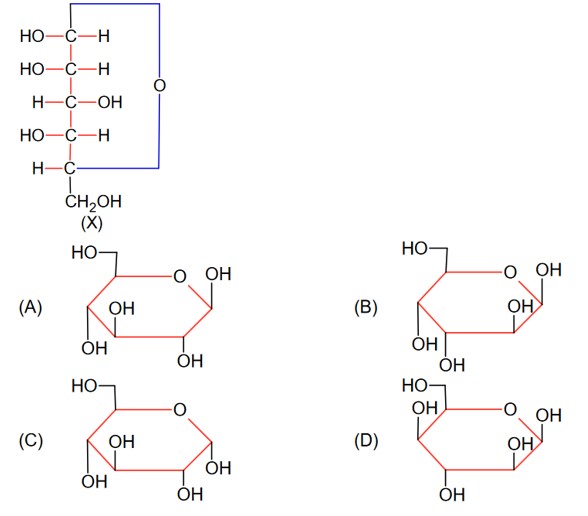
Contributor-Level 10
->Correct pyranose structure.
-> -OH group in left is up and –OH group in right is below.
Taking an Exam? Selecting a College?
Get authentic answers from experts, students and alumni that you won't find anywhere else
Sign Up on ShikshaOn Shiksha, get access to
- 67k Colleges
- 1.2k Exams
- 716k Reviews
- 1850k Answers