Maths

Get insights from 6.5k questions on Maths, answered by students, alumni, and experts. You may also ask and answer any question you like about Maths

Follow Ask Question
6.5k

Questions

0

Discussions

18

Active Users

0

Followers

New answer posted

a year ago

0 Follower 4 Views

A
alok kumar singh

Contributor-Level 10

  f ( x ) + f ( x + k ) = n ∀ x ∈ R ,     & k > 0 . . . . . . . . . . . . ( i )

Replace x by x + k.          

f ( x + k ) + f ( x + 2 k ) = n . . . . . . . . . . . . . . . ( i i )

From (i) & (ii), f(x + 2k) = f(x).

∴ f ( x )  is periodic with period = 2k.

I 1 = ∫ 0 4 n k f ( x )   d x = 2 x ∫ 0 2 k f ( x ) d x . . . . . . . . . . . . . . . . . . . ( i i )

I 2 = ∫ − k 3 k f ( x )   d x put x = t + k

= ∫ − 2 k 2 k t ( t + k ) d t = 2 ∫ 0 2 k f ( t + k ) d t

= 2 n ∫ 0 2 k n d x = 4 n 2 k .


New answer posted

a year ago

0 Follower 3 Views

A
alok kumar singh

Contributor-Level 10

  f ( r 4 ) = 2 , f ( r 2 ) = 0 & f ' ( r 2 ) = 1

g(x)   ∫ ( f ' ( t ) s e c   t + t a n   t     s e c   t     f ( t ) ) d t

= [ f ( t ) s e c   t ] x π / 4

=   2 * 2 − f ( x ) s e c x

= 2 c o s x − f ( x ) c o s x

=   2 s i n x + 1 s i n x = 3

New answer posted

a year ago

0 Follower 27 Views

A
alok kumar singh

Contributor-Level 10

f ( x ) = { [ x ] , x < 0 | 1 − x | , x ≥ 0 g ( x ) = { c x − x ,     x < 0 ( x − 1 ) 2 − 1 ,     x ≥ 0

fog

f o g ( [ e x − x ] , ( e x − x < 0 )                                             ( x < 0 ) [ ( x − 1 ) 2 − 1 ] ( x − 1 ) 2 − 1 < 0                                 x ≥ 0 | 1 − e x + x | ,     e x − x ≥ 0                                                 x < 0 | 1 − ( x + 1 ) 2 + 1 | ,     ( x − 1 ) 2 − 1 ≥ 0     x ≥ 0 ,     x ∈ ( 2 , ∞ ) (

 Not possible as of inequalities give ? .  

ex – x < 0, x < 0                 (x 1)2 – 1 < 0

Not possible                     (x – 1 + 1)(x – 1 – 1) < 0

(x)(x – 2) < 0

x   ∈ ( 0 , 2 )

continuous  ∀ x < 0

f o g { | 1 − e x + x |               ,   x < 0 | 1 − ( x − 1 ) 2 + 1 | , x = 0 | 1 − ( x − 1 ) 2 + 1 | , x ≥ 2 Discontinuous at 0

continuous   ∀ x

  ∴  fog is discontinuous at 0

New answer posted

a year ago

0 Follower 5 Views

A
alok kumar singh

Contributor-Level 10

  a + a1……an, 100               n arithmetic mean 100

a + n = 33 ……. (i)

( a 1 a n = 1 7 )

( a + d ) ( 1 0 0 − d ) = 7 7

7a + 8d = 100…………… (ii)

a + (n + 1)d = 100………………. (iiI)

Solving these equations (i), (ii) & (iii), we get

n = 23 & d =    1 5 4

a = 10

New answer posted

a year ago

0 Follower 19 Views

A
alok kumar singh

Contributor-Level 10

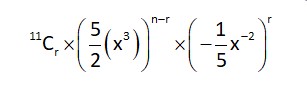
  ( 1 − x 2 + 3 x 3 ) ( 5 2 x 3 − 1 5 x 2 ) 1 1 , x ≠ 0

(r + 1)th term for expansion of   ( 5 2 x 3 − 1 5 x 2 ) 1 1

  n – r = x3

r = y   0 ≤ x , y ≤ 1 1     s h o u l d     b e     n a t u r a l     n u m b e r .

= 11Cy   * ( 5 2 ) x * ( − 1 5 ) y * x ( 3 x − 2 y )

for term to be independent of x, power of x should be zero.

(3x – 2y) = 0 (when 1 is multiplied).

3x + 3y = 33

y = 3 3 5 ( N o     s o l u t i o n )  

3x – 2y + 2 = 0 where (-x2) is multiplied).

3x +  3y = 33

y = 7, x = 4

3 x − 2 y + 3 = 0 3 x + 3 y = 3 3 }

∴   coefficient of term independent of x.

( − 1 ) * 1 1 ? C 7 * ( 5 2 ) 4 * ( − 1 5 ) 7

= 3 3 2 0 0

New answer posted

a year ago

0 Follower 20 Views

A
alok kumar singh

Contributor-Level 10

Let the number of chocolates given to C1, C2, C3 & C4 be a, b, c, d respectively.

Given 4   ≤ b ≤ 7

2 ≤ c ≤ 6

Now using these the maximum number of chocolates that can be given to C1 or C4 is 24 (where b & c are given 2 & 4 chocolates).

∴ 0 ≤ a ≤ 2 4

0 ≤ d ≤ 2 4

& a + b + c + d = 30

So, total possible solution to the above equation.

Coefficient of x30 in.

( x 0 + x + x 2 + . . . . + x 2 4 ) ( x 4 + x 5 + . . . . + x 7 ) ( x 2 + x 3 + . . . . + x 6 ) ( x 0 + x + x 2 + . . . . + x 2 4 )

=  (1+....+x24)2(x4)(1+x+....+x3)*x2(1+x+....+x4)

= ( x 5 6 − 2 x 3 1 + x 6 ) * ( x 9 − x 4 − x 5 + 1 ) * ( x − 1 ) − 4

x56 & x31 can never give x30 so we discard them.

x 6 * x 9 * ( x − 1 ) − 4 → 1 5 + 4 − 1 ? C 4 − 1 = 1 8 ? C 3

Coefficient x30 ® 18C3 – 23C3 – 22C3 + 27C3

=   1 8 * 1 7 * 1 6 6 − 2 3 * 2 2 * 2 1 6 − 2 2 * 2 1 * 2 0 6 + 2 7 * 2 6 * 2 5 6

= 430

New answer posted

a year ago

0 Follower 4 Views

A
alok kumar singh

Contributor-Level 10

f ( − 2 ) + f ( 3 ) = 0 . One root of f (x) = 0 is (-1)

Let's assume other root to be a

∴ f ( x ) = a ( x + 1 ) ( x − α )

Given that f (-2) + f (3) = 0

a (-2 + 1) (-2 -a) + a (3 + 1) (3 - a) = 0

Þ 14 -3a = 0 Þ a =    1 4 3

∴ sum of roots =   1 4 3 − 1 = 1 1 3

New answer posted

a year ago

0 Follower 4 Views

A
alok kumar singh

Contributor-Level 10

R1 =  { ( a , 1 ) ∈ N * N : | a − b | ≤ 1 3 }

  ( a , a ) ∈ R 1 a s | a − a | ≤ 1 3 ( R e f l e x i v e )

( a , b ) & ( b , a ) ∈ R 1 a s | a − b | = | b − a | → ( s y m m e t r i c ) .

But it is not necessary that if (a,b) & (b, c)  ∈R,  then  (a,c)∈R

Eg   − ( 2 1 , 1 0 ) ∈ R & ( 1 0 , 1 ) ∈ R     b u t ( 2 1 , 1 ) ∉ R 1

R2 =   { ( a , b ) ∈ N * N : | a − b | ≠ 1 3 ∴ R 2 → N o t     e q u i v a l e n c e     s o l u t o i n . }

( a , b ) & ( b , a ) ∈ R 2 a s | a − b | = | b − a |

But it is not necessary that if (a, b) & (b, c)  ∈ R 2  then (a, c) also ∈ R 2 .

Eg – (21, 1)   ∈ R 2 & ( 1 , 8 ) ∈ R 2     b u t     ( 2 1 , 8 ) ∉ R 2

New answer posted

a year ago

0 Follower 2 Views

P
Payal Gupta

Contributor-Level 10

f ( x ) = a x 2 + b x + c  

g (x) = px + q

f ( g ( x ) ) = a ( p x + q ) 2 + b ( p ) ( + q ) + c                

⇒ 8 x 2 − 2 x = a ( p x + q ) 2 + b ( p x + q ) + c                

Compare 8 = ap2 …………… (i)

-2 = a (2pq) + bp

0 = aq2 + bq + c

9 ( f ( x ) ) = p ( a x 2 + b x + c ) + q                

? 4x2 + 6x + 1 = apx2 + bpx + cp + q

? Andhra Pradesh = 4 ……………. (ii)

6 = bp

1 = cp + q

From (i) & (ii), p = 2, q = -1

? b = 3, c = 1, a = 2

f (x) = 2x2 + 3x + 1

f (2) = 8 + 6 + 1 = 15

g (x) = 2x – 1

g (2) = 3

New answer posted

a year ago

0 Follower 9 Views

P
Payal Gupta

Contributor-Level 10

N=M2+M4+.....+M98

=(−α2  I)+(−α2  I)2+....+(−α2  I)49

=I(−α2+α4−α6+....−α98)

N = −I(α2−α4+α6.......+α98)

=−Iα2(1−(−α2)49)1−(−α2)

N = −I α2(1+α98)1+α2

Now (I−m2)N=−2I

(I+α2I)(−Iα2⋅(1+α98)1+α2=−2I

? α100 + α2 = 2

? α = ±1

Get authentic answers from experts, students and alumni that you won't find anywhere else

Sign Up on Shiksha

On Shiksha, get access to

  • 67k Colleges
  • 1.2k Exams
  • 718k Reviews
  • 1850k Answers

Share Your College Life Experience

×
×

This website uses Cookies and related technologies for the site to function correctly and securely, improve & personalise your browsing experience, analyse traffic, and support our marketing efforts and serve the Core Purpose. By continuing to browse the site, you agree to Privacy Policy and Cookie Policy.