
Ncert Solutions Chemistry Class 11th
Get insights from 2k questions on Ncert Solutions Chemistry Class 11th, answered by students, alumni, and experts. You may also ask and answer any question you like about Ncert Solutions Chemistry Class 11th
- 2k
Questions
- 0
Discussions
- 0
Active Users
- 29
Followers
Have a question about Ncert Solutions Chemistry Class 11th? Ask our experts
Keep it short & simple. Type complete word. Avoid abusive language.
The heat of combustion of ethanol into carbon dioxides and water is –327kcal at constant pressure. The heat evolved (in cal) at constant volume at 27°C (if all gases behave ideally) is (R=2calmol⁻¹K⁻¹) [numerical value].
The heat of combustion of ethanol into carbon dioxides and water is –327kcal at constant pressure. The heat evolved (in cal) at constant volume at 27°C (if all gases behave ideally) is (R=2calmol⁻¹K⁻¹) [numerical value].
ΔH=ΔU+ΔnRT. ΔU = -327000 - (1)2300 = -327600 cal.
 Upvote

Two elements A and B have similar chemical properties. They don't form solid hydrogencarbonates, but react with nitrogen to form nitrides. A and B, respectively, are:
<!-- [if !supportLineBreakNewLine]-->
<!--[endif]-->
Two elements A and B have similar chemical properties. They don't form solid hydrogencarbonates, but react with nitrogen to form nitrides. A and B, respectively, are:
<!-- [if !supportLineBreakNewLine]-->
<!--[endif]-->
Li and Mg form nitrides and have bicarbonates that are unstable
Upvote The internal energy change (in J) when 90 g of water undergoes complete evaporation at 100°C is
(Given: ΔH_vap for water at 373K = 41 kJ/mol, R = 8.314 JK?¹mol?¹)
The internal energy change (in J) when 90 g of water undergoes complete evaporation at 100°C is
(Given: ΔH_vap for water at 373K = 41 kJ/mol, R = 8.314 JK?¹mol?¹)
189000 to 190000
Sol. ΔH = ΔU + Δn? RT
41000 × 5 = ΔU + 5 × 8.314 × 373
205000 = ΔU + 15505.61
ΔU = 189494.39 J = 189494 J
Upvote Which one of the following graphs is not correct for ideal gas?
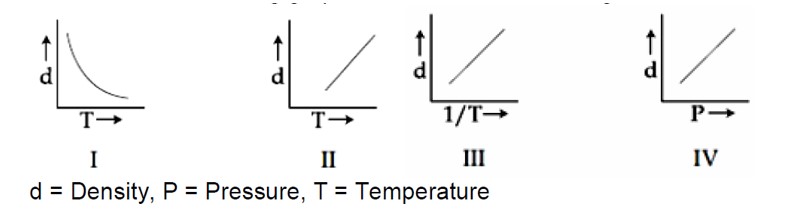
Which one of the following graphs is not correct for ideal gas?
For ideal gas
PM = dRT
d = [PM]/R * 1/T
So graph between dV ST is not straight line
Upvote While titration dilute HCl solution with aqueous NaOH, which of the following will not be required?
<!-- [if !supportLineBreakNewLine]-->
<!--[endif]-->
While titration dilute HCl solution with aqueous NaOH, which of the following will not be required?
<!-- [if !supportLineBreakNewLine]-->
<!--[endif]-->
In this acid base Titrating there is no use of Bunsen burner and measuring cylinder other laboratory equipments will be required for getting the end point of titration.
Upvote In presence of sunlight CFC's molecule divides & release chlorine free radical, which react with ozone give chlorine monoxide radical (CIO°) and oxygen.
CF? Cl? (g) → C (g) + C? Cl (g)
Cl° (g) + O? (g) → ClO° (g) + O? (g)
ClO° (g) + O (g) → Cl° (g) + O? (g)
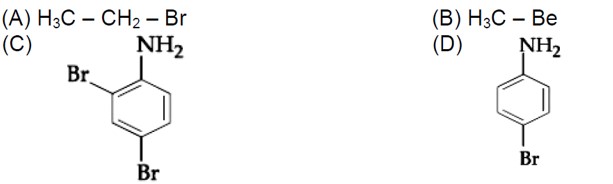
Upvote In Carius method of estimation of halogen, 0.172 g of an organic compound showed presence of 0.08 g of bromine. Which of these is the correct structure of the compound?
<!-- [if !supportLineBreakNewLine]-->
<!--[endif]-->
In Carius method of estimation of halogen, 0.172 g of an organic compound showed presence of 0.08 g of bromine. Which of these is the correct structure of the compound?
<!-- [if !supportLineBreakNewLine]-->
<!--[endif]-->
Mole of Bromine = 0.08/80 = 10? ³ mole
Molar mass of compound = 0.172/M = 10? ³
M = 0.172/10? ³ = 172g
Molar mass of
Upvote On heating compound (A) gives a gas (B) which is a constituent of air. This gas when treated with H? in the presence of a catalyst gives another gas (C) which is basic in nature. (A) should not be:
<!-- [if !supportLineBreakNewLine]-->
<!--[endif]-->
On heating compound (A) gives a gas (B) which is a constituent of air. This gas when treated with H? in the presence of a catalyst gives another gas (C) which is basic in nature. (A) should not be:
<!-- [if !supportLineBreakNewLine]-->
<!--[endif]-->
(1) Pb (NO? )? → PbO + 2NO?
(2) NH? NO? → N? + 2H? O
(3) (NH? )? Cr? O? → N? + Cr? O? + H? O
(4) NaN? → 3N? + 2Na
Upvote For a reaction X + Y = 2Z, 1.0 mol of X, 1.5 mol of Y and 0.5 mol of Z were taken in a 1 L vessel and allowed to react. At equilibrium, the concentration of Z was 1.0 mol L⁻¹. The equilibrium constant of the reaction is x/15. The value of x is
For a reaction X + Y = 2Z, 1.0 mol of X, 1.5 mol of Y and 0.5 mol of Z were taken in a 1 L vessel and allowed to react. At equilibrium, the concentration of Z was 1.0 mol L⁻¹. The equilibrium constant of the reaction is x/15. The value of x is
16.00
X + Y? 2Z
Initial 1.0 1.5 0.5
At equ m 1-x 1.5-x 0.5+2x
equ m conc 0.75 1.25 1.0
0.5 + 2x = 1
x = 0.25
K = 1 / (0.75 × 1.25)
K = 16/15
x = 16.00
Upvote