Ncert Solutions Chemistry Class 12th
Get insights from 2.6k questions on Ncert Solutions Chemistry Class 12th, answered by students, alumni, and experts. You may also ask and answer any question you like about Ncert Solutions Chemistry Class 12th
- 2.6k
Questions
- 0
Discussions
- 0
Active Users
- 79
Followers
Have a question about Ncert Solutions Chemistry Class 12th? Ask our experts
Keep it short & simple. Type complete word. Avoid abusive language.
A 6.50 molal solution of KOH (aq) has a density of 1.89 g cm-3. The molarity of the solution is________ mol dm-3. (Round off to the nearest Integer).
[Atomic masses : K = 39.0u, O = 16.0u, H= 1.0u]
A 6.50 molal solution of KOH (aq) has a density of 1.89 g cm-3. The molarity of the solution is________ mol dm-3. (Round off to the nearest Integer).
[Atomic masses : K = 39.0u, O = 16.0u, H= 1.0u]
A 6.5 molal solution means 6.5 moles of KOH is in 1 kg (1000 g) of solvent (H? O).
Moles of solute, n_B = 6.5
Mass of solute, W_B = 6.5 × 56 = 364 g
Mass of solvent, W_A = 1000 g
Mass of solution = 1364 g
Volume of solution = 1364 / 1.89 mL
Now, molarity = [6.5 / (1364 / 1.89)] × 1000 M = 9 M
Two salts A2X and MX have the same value of solubility product of 4.0 x 10⁻¹². The ratio of their molar solubilities i.eS A2X/S MX = ____________.
(Round off to the Nearest Integer).
Two salts A2X and MX have the same value of solubility product of 4.0 x 10⁻¹². The ratio of their molar solubilities i.eS A2X/S MX = ____________.
(Round off to the Nearest Integer).
Solubility product of A? X = 4S? ³
Where S? is the solubility of salt A? X.
Solubility product of MX = S? ²
Where S? is the solubility of MX.
Given 4S? ³ = 4 × 10? ¹² ⇒ S? = 10? M
Given S? ² = 4 × 10? ¹² ⇒ S? = 2 × 10? M
So, S? / S? = 10? / (2 × 10? ) = 50
A certain element crystallises in a bcc lattice of unit cell edge length 27 Å . If the same element under the same conditions crystallises in the fcc lattice, the edge length of the unit cell in Å will be ___________. (Round off to the nearest Integer).
[Assume each lattice point has a single atom] [Assume √3 = 1.73, √2 = 1.41]
Edge length in bcc, a? = 27 Å
Let, Edge length in fcc be a? Å
Now, the same element crystallises in bcc as well as fcc.
For bcc: 4r = √3 a? ⇒ r = (√3 / 4) a?
For fcc: 4r = √2 a? ⇒ r = a? / (2√2)
So, (√3 / 4) a? = a? / (2√2)
(√3 / 4) × 27 = a? / (2√2)
a? = 33.13 Å
The nearest integer is 33.
Antihistamines are antacids and antiallergics
The process that involves the removal of sulphur from the ores is:
Roasting is a process in which sulphur is removed as SO? gas from sulphide ores on heating in excess of oxygen.
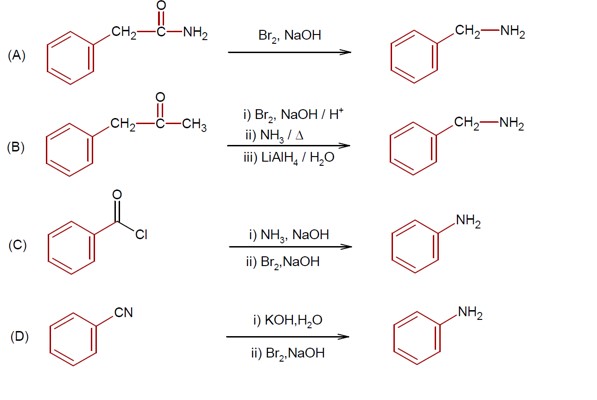
Which of the following reaction DOES NOT involve Hoffmann bromamide degradation?
R-CONH? + Br? + 4NaOH → R-NH? + 2NaBr + Na? CO? + 2H? O
This reaction is the Hoffmann bromamide degradation, in which an amide is converted to a 1° amine.
Given below are two statements:
Statement I: The E° value for Ce? / Ce³? is + 1.74V
Statement II: Ce is more stable in Ce? state than Ce³? state
In the light of the above statements, choose the most appropriate answer from the options given below:
<!-- [if !supportLineBreakNewLine]-->
<!--[endif]-->
The E° value for Ce? /Ce³? is +1.74 V, which suggests that Ce? is a strong oxidant, reverting to its common +3 oxidation state. So, Ce³? is more stable than Ce?
Given below are two statement: one is labelled as Assertion A and the other is labelled as Reason R:
Assertion A: Size of Bk³? ion is less than Np³? ion.
Reason R: The above is a consequence of the lanthanoid contraction.
In the light of the above statements, choose the correct answer from the options given below:
<!-- [if !supportLineBreakNewLine]-->
<!--[endif]-->
The size of the Bk³? ion is less than the Np³? ion because Berkelium (Bk) lies beyond Neptunium (Np) in the actinoid series, and the size variation here is because of the actinoid contraction.
Assertion A : Enol form of acetone [CH3COCH3] exists in <0.1% quantity. However, the enol
form of acetyl acetone [CH3COCH2OCCH3] exists in approximately 15% quantity.
Reason R : Enol form of acetylacetone is stabilized by intramolecular hydrogen bonding, which is
not possible in enol form of acetone.
Choose the correct statement:
The enol form of acetone exists in less than 0.1% quantity, since its keto form is highly stable. But in the case of acetylacetone, the enol form is stabilized by intramolecular H-bonding, so its quantity increases to approximately 15%.
The intramolecular H-bond in the enol form of acetylacetone is s