
Ncert Solutions Chemistry Class 12th
Get insights from 2.6k questions on Ncert Solutions Chemistry Class 12th, answered by students, alumni, and experts. You may also ask and answer any question you like about Ncert Solutions Chemistry Class 12th
- 2.6k
Questions
- 0
Discussions
- 0
Active Users
- 79
Followers
Have a question about Ncert Solutions Chemistry Class 12th? Ask our experts
Keep it short & simple. Type complete word. Avoid abusive language.
Which of the following reduction reaction CANNOT be carried out with coke?
Which of the following reduction reaction CANNOT be carried out with coke?
The reduction of aluminum oxide (Al? O? ) is performed through an electrolytic process in its molten state. This method is necessary because Al? O? is a highly ionic and stable compound.
 Upvote

A solute A dimerizes in water. The boiling point of a 2 molal solution of A is 100.52°C. The percentage association of A is ________. (Round off to the nearest integer).
[ Use: K? for water = 0.52 K kg mol?¹, Boiling point of water = 100°C]
A solute A dimerizes in water. The boiling point of a 2 molal solution of A is 100.52°C. The percentage association of A is ________. (Round off to the nearest integer).
[ Use: K? for water = 0.52 K kg mol?¹, Boiling point of water = 100°C]
m=2 molal
ΔT? = 100.52 – 100 = 0.52°C
Using, ΔT? = iK? m
0.52 = I × 0.52 × 2
i = 0.5
Now using, α = (1-i) / (1-1/n)
Where, n=2 (dimerisation)
α = (1-0.5) / (1-0.5) = 1
So, percentage association = 100%
Upvote The INCORRECT statement regarding the structure of C₆₀ is:
The INCORRECT statement regarding the structure of C₆₀ is:
In a C? fullerene molecule, all 60 carbon atoms are identical. Each carbon atom is bonded to three other carbon atoms via sigma bonds. The structure is composed of 20 six-membered rings and 12 five-membered rings.
Upvote Which of the following is least basic?
<!-- [if !supportLineBreakNewLine]-->
<!--[endif]-->
Which of the following is least basic?
<!-- [if !supportLineBreakNewLine]-->
<!--[endif]-->
In diacetamide (CH? CO)? NH), the lone pair of electrons on the nitrogen atom is delocalized through resonance with both adjacent carbonyl groups. This extensive resonance greatly decreases the electron density on the nitrogen atom.
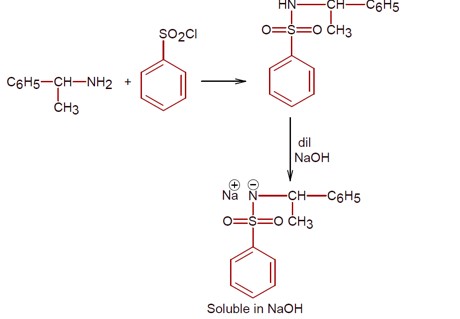
Upvote An organic compound "A" on treatment with benzene sulphonyl chloride gives compound B. B is soluble in dil. NaOH solution. Compound A is:
<!-- [if !supportLineBreakNewLine]-->
<!--[endif]-->
An organic compound "A" on treatment with benzene sulphonyl chloride gives compound B. B is soluble in dil. NaOH solution. Compound A is:
<!-- [if !supportLineBreakNewLine]-->
<!--[endif]-->
Only 1° amine react with benzene sulphonyl chloride to give a compound which is soluble in alkali
Upvote The charges on the colloidal CdS sol and TiO? sol are, respectively:
The charges on the colloidal CdS sol and TiO? sol are, respectively:
Metal sulphide sols are negatively charged while metal oxide sols are positively charged sols. So, CdS is negative while TiO? is positively charged sol.
Upvote The INCORRECT statements below regarding colloidal solutions is:
The INCORRECT statements below regarding colloidal solutions is:
Colloidal particles are small enough to pass through an ordinary filter but can be stopped by an ultrafilter paper due to their specific particle size range.
Upvote 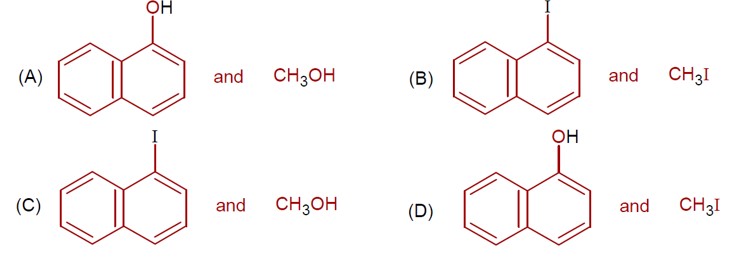
Ammonolysis of Alkyl halides followed by the treatment with NaOH solution can be used to prepare primary, secondary and tertiary amines. The purpose of NaOH in the reaction is:
<!-- [if !supportLineBreakNewLine]-->
<!--[endif]-->
Ammonolysis of Alkyl halides followed by the treatment with NaOH solution can be used to prepare primary, secondary and tertiary amines. The purpose of NaOH in the reaction is:
<!-- [if !supportLineBreakNewLine]-->
<!--[endif]-->
In the ammonolysis reaction, HCl is produced as a byproduct. To neutralize this acidic impurity, the mixture is treated with NaOH.
Upvote Match List – I with List – II:
| List – I | List – II |
| :--- | :--- |
| (a) Mercury | (i) Vapour phase refining |
| (b) Copper | (ii) Distillation Refining |
| (c) Silicon | (iii) Electrolytic Refining |
| (d) Nickel | (iv) Zone Refining
Choose the most appropriate answer from the option given below:
<!-- [if !supportLineBreakNewLine]-->
<!--[endif]-->
Match List – I with List – II:
| List – I | List – II |
| :--- | :--- |
| (a) Mercury | (i) Vapour phase refining |
| (b) Copper | (ii) Distillation Refining |
| (c) Silicon | (iii) Electrolytic Refining |
| (d) Nickel | (iv) Zone Refining
Choose the most appropriate answer from the option given below:
<!-- [if !supportLineBreakNewLine]-->
<!--[endif]-->
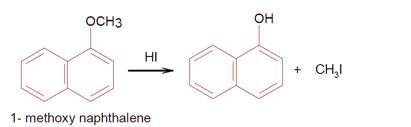
The following depicts a chemical reaction leading to a Major Product Y.
Mercury has low boiling point so is refined by distillation method.
Copper refining is done through electrolytic refining.
Silicon is refined by zone refining method.
Nickel is refined by vapour phase refining.
Upvote