
Ncert Solutions Chemistry Class 12th
Get insights from 2.6k questions on Ncert Solutions Chemistry Class 12th, answered by students, alumni, and experts. You may also ask and answer any question you like about Ncert Solutions Chemistry Class 12th
- 2.6k
Questions
- 0
Discussions
- 0
Active Users
- 79
Followers
Have a question about Ncert Solutions Chemistry Class 12th? Ask our experts
Keep it short & simple. Type complete word. Avoid abusive language.
In order to prepare a buffer solution of pH 5.74, sodium acetate is added to acetic acid. If the concentration of acetic acid in the buffer is 1.0 M, the concentration of sodium acetate in the buffer is _____ M. (Round off to the nearest integer).
[Given: pKa (acetic acid) = 4.74]
In order to prepare a buffer solution of pH 5.74, sodium acetate is added to acetic acid. If the concentration of acetic acid in the buffer is 1.0 M, the concentration of sodium acetate in the buffer is _____ M. (Round off to the nearest integer).
[Given: pKa (acetic acid) = 4.74]
For an acidic buffer solution, pH = pKa + log ( [Base]/ [Acid]).
Given pH = 5.74 and pKa = 4.74.
5.74 = 4.74 + log ( [Base]/1).
1 = log ( [Base]).
[Base] = 10M.
 Upvote

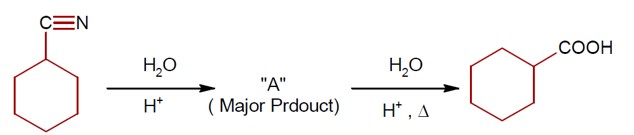
Consider the above chemical reaction and identify product "A":
<!-- [if !supportLineBreakNewLine]--><!--[endif]-->
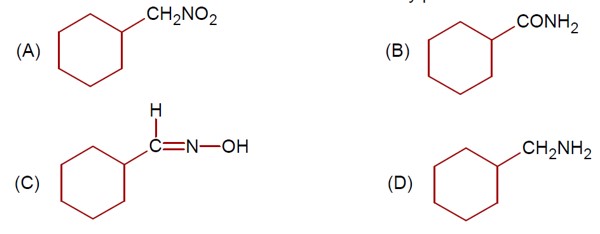
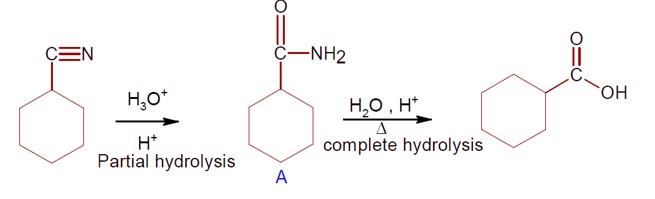
Consider the above chemical reaction and identify product "A":
<!-- [if !supportLineBreakNewLine]--><!--[endif]-->
In a binary compound, atoms of element A form a hcp structure and those of element M occupy 2/3 of the tetrahedral voids of the hcp structure. The formula of the binary compound is:
<!-- [if !supportLineBreakNewLine]-->
<!--[endif]-->
In a binary compound, atoms of element A form a hcp structure and those of element M occupy 2/3 of the tetrahedral voids of the hcp structure. The formula of the binary compound is:
<!-- [if !supportLineBreakNewLine]-->
<!--[endif]-->
o Let the number of atoms of element A be N.
o Tetrahedral voids = 2N.
o Atoms of element M = (2/3) × 2N = 4/3 N.
o The ratio M : A is (4/3 N) : N, which simplifies to 4:3.
o So, the formula of the compound is M? A?
Upvote 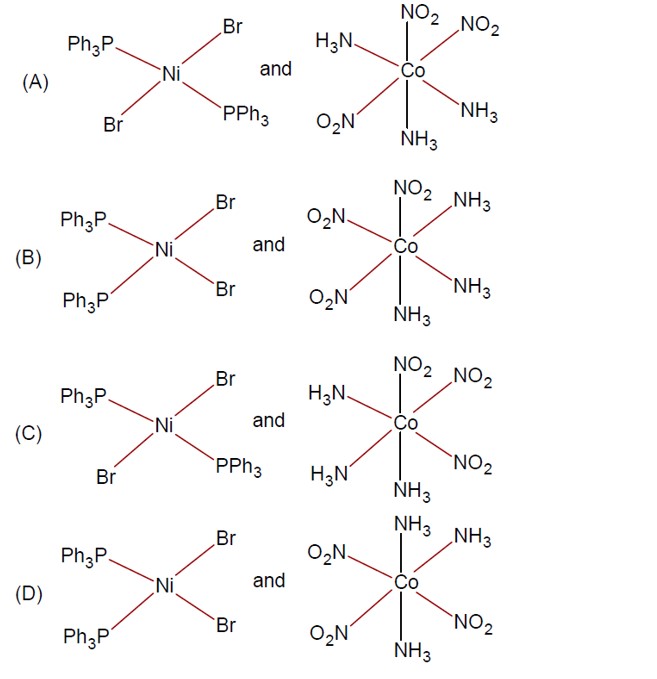
In the above reactions, the enzyme A and enzyme B respectively are:
C12H22O11 (Sucrose) + H2O --(Enzyme A)--> C6H12O6 (Glucose) + C6H12O6 (Fructose)
C6H12O6 --(Enzyme B)--> 2C2H5OH + 2CO2
In the above reactions, the enzyme A and enzyme B respectively are:
C12H22O11 (Sucrose) + H2O --(Enzyme A)--> C6H12O6 (Glucose) + C6H12O6 (Fructose)
C6H12O6 --(Enzyme B)--> 2C2H5OH + 2CO2
Inversion of Sucrose:
C? H? O? (Sucrose) + H? O - (Invertase)-> C? H? O? (Glucose) + C? H? O? (Fructose)
Fermentation of Glucose:
C? H? O? (Glucose) - (Zymase)-> 2C? H? OH (Ethanol) + 2CO?
Upvote Given below are two statements:
Statement I: 2-methylbutane on oxidation with KMnO4 gives 2-methylbutan-2-ol.
Statement II: n-alkanes can be easily oxidised to corresponding alcohols with KMnO4.
Choose the correct option:
<!-- [if !supportLineBreakNewLine]-->
<!--[endif]-->
Given below are two statements:
Statement I: 2-methylbutane on oxidation with KMnO4 gives 2-methylbutan-2-ol.
Statement II: n-alkanes can be easily oxidised to corresponding alcohols with KMnO4.
Choose the correct option:
<!-- [if !supportLineBreakNewLine]-->
<!--[endif]-->
KMnO? oxidizes alkanes that contain a tertiary hydrogen (3°H) to form tertiary alcohols.
n-alkanes, which do not contain tertiary hydrogens, are not oxidized by KMnO? under these conditions.
Upvote Match List – I with List – II:
List – I List – II
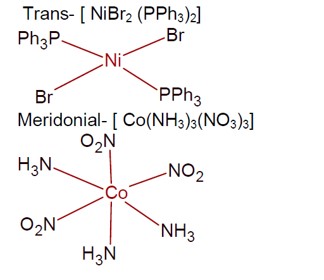
(a) [Co(NH3)6][Cr(CN)6] (i) Linkage isomerism
(b) [Co(NH3)3(NO2)3] (ii) Solvate isomerism
(c) [Cr(H2O)6]Cl3 (iii) Co-ordination isomerism
(d) cis - [CrCl2(ox)2]³? (iv) Optical isomerism
Choose the correct answer from the options given below:
<!-- [if !supportLineBreakNewLine]-->
<!--[endif]-->
Match List – I with List – II:
List – I List – II
(a) [Co(NH3)6][Cr(CN)6] (i) Linkage isomerism
(b) [Co(NH3)3(NO2)3] (ii) Solvate isomerism
(c) [Cr(H2O)6]Cl3 (iii) Co-ordination isomerism
(d) cis - [CrCl2(ox)2]³? (iv) Optical isomerism
Choose the correct answer from the options given below:
<!-- [if !supportLineBreakNewLine]-->
<!--[endif]-->
Co (NH? )? ] [Cr (CN)? ]: Co-ordination isomerism
[Co (NH? )? (NO? )? ]: Linkage isomerism
[Cr (H? O)? ]Cl? : Solvate isomerism
Cis- [CrCl? (Ox)? ]³? : Optical isomerism
Upvote The correct pair(s) of the ambident nucleophiles is (are):
(A) AgCN / KCN
(B) RCOOAg / RCOOK
(C) AgNO2 / KNO2
(D) Agl / KI
<!-- [if !supportLineBreakNewLine]-->
<!--[endif]-->
The correct pair(s) of the ambident nucleophiles is (are):
(A) AgCN / KCN
(B) RCOOAg / RCOOK
(C) AgNO2 / KNO2
(D) Agl / KI
<!-- [if !supportLineBreakNewLine]-->
<!--[endif]-->
CN? and NO? are examples of ambident nucleophiles.
Upvote Match List - I with List - II
List - I
(a) Chlorophyll
(b) Vitamin B?
(c) Anticancer drug
(d) Grubbs catalyst
List - II
(i) Ruthenium
(ii) Platinum
(iii) Cobalt
(iv) Magnesium
Choose the most appropriate answer from the options given below:
Match List - I with List - II
List - I
(a) Chlorophyll
(b) Vitamin B?
(c) Anticancer drug
(d) Grubbs catalyst
List - II
(i) Ruthenium
(ii) Platinum
(iii) Cobalt
(iv) Magnesium
Choose the most appropriate answer from the options given below:
o Chlorophyll: Magnesium present in chlorophyll.
o Vitamin B? : Cobalt (cyanocobalamin).
o Anticancer drug: Platinum (Coordination compound of platinum).
o Grubbs catalyst: Ruthenium.
Upvote