
P Block Elements
Get insights from 254 questions on P Block Elements, answered by students, alumni, and experts. You may also ask and answer any question you like about P Block Elements
- 254
Questions
- 0
Discussions
- 0
Active Users
- 0
Followers
Have a question about P Block Elements? Ask our experts
Keep it short & simple. Type complete word. Avoid abusive language.
The number of interhalogens from the following having square pyramidal structure is:
CIF3, IF7, BrF5, BrF3, I2Cl6, IF5, ClF, ClF5
The number of interhalogens from the following having square pyramidal structure is:
CIF3, IF7, BrF5, BrF3, I2Cl6, IF5, ClF, ClF5
->T-shaped (sp3d)
IF7 ->Pentagonal bipyramidal (sp3d3)
BrF5 -> Square pyramidal (sp3d2)
BrF3 ->T-Shaped (sp3d)
I2Cl6 -> Triangular bipyramidal (sp3d)
Square Pyramidal (sp3d2)
ClF -> (sp3)
ClF5 -> Square Pyramidal (sp3d2)
Br5, IF5 & ClF5 ® Square Pyramidal
 Upvote

Which one of the following group – 15 hydride is the strongest reducing agent?
Which one of the following group – 15 hydride is the strongest reducing agent?
Reducing power for group-15 hydrides increases down the group, so BiH3 is the strongest reducing agent.
Upvote
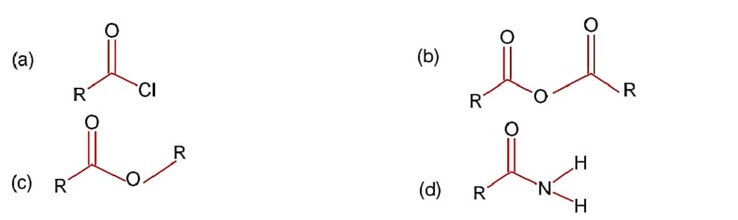
The correct order of their reactivity towards hydrolysis at room temperature is:
The correct order of their reactivity towards hydrolysis at room temperature is:
High leaving tendency corresponds to high reactivity towards hydrolysis. Hence order is.
Upvote Chemical nature of the nitrogen oxide compound obtained from a reaction of concentrated nitric acid and P4O10 (in 4:1 ratio) is:
Chemical nature of the nitrogen oxide compound obtained from a reaction of concentrated nitric acid and P4O10 (in 4:1 ratio) is:
Anhydride of HNO3 produced by the treatment of P4O10 (anhydring reagent) in ratio of 4 : 1 is N2O5 which is acidic in nature.
Upvote In which one of the following sets all species show disproportionation reaction?
In which one of the following sets all species show disproportionation reaction?
can show disproportionation reaction while
Upvote Experimentally reducing a functional group cannot be done by which one of the following reagents?
Experimentally reducing a functional group cannot be done by which one of the following reagents?
Na/H2 can not reduce a functional group as Na does not behaves as catalyst here.
Upvote Which one of the following correctly represents the order of stability of oxides, X2O; (X = halogen)?
Which one of the following correctly represents the order of stability of oxides, X2O; (X = halogen)?
Stability order of oxides (X2O) is,
l2O > Cl2O > Br2O
Bonds of halogen & oxygen are covalent due to less EN difference.
Stability of (I - O) bond is higher due to less polarity and that of (Cl-O) bond is higher due to multiple bonding.
Upvote In the given chemical reaction, colors of the Fe2+ and Fe3+ ions, are respectively:
In the given chemical reaction, colors of the Fe2+ and Fe3+ ions, are respectively:
In reaction ;
Colour of Fe2+ is green and that of Fe3+ is yellow.
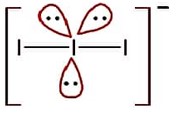
Upvote The number of lone pairs of electrons on the central I atom in <!-- [if gte mso 9]><xml>
The number of lone pairs of electrons on the central I atom in <!-- [if gte mso 9]><xml>
Water sample is called cleanest on the basis of which one of the BOD values given below:
Water sample is called cleanest on the basis of which one of the BOD values given below:
BOD is biological oxygen demand which represents the amount of oxygen required to degrade organic matter in water.
Higher the BOD more polluted the water is
So; here water sample with BOD = 3 ppm is the cleanest
Upvote