P Block Elements
Get insights from 254 questions on P Block Elements, answered by students, alumni, and experts. You may also ask and answer any question you like about P Block Elements
- 254
Questions
- 0
Discussions
- 0
Active Users
- 0
Followers
Have a question about P Block Elements? Ask our experts
Keep it short & simple. Type complete word. Avoid abusive language.
Which oxoacid of phosphorous has the highest number of oxygen atoms present in its chemical formula?
Which oxoacid of phosphorous has the highest number of oxygen atoms present in its chemical formula?
Pyrophosphorous acid = H4P2O5
Hypophosphorous acid = H4P2O6
Phosphoric acid = H3PO4
Pyrophosphoric acid = H4P2O7
 Upvote

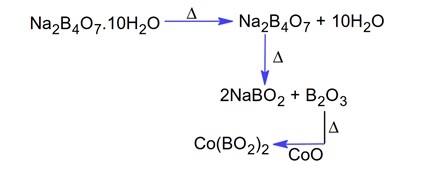
When borax is heated with CoO on a platinum loop, blue coloured bead formed is largely due to
When borax is heated with CoO on a platinum loop, blue coloured bead formed is largely due to
Cobalt (II) meta borate is a blue colour of Bead.
Upvote Portland cement contains ‘X’ to enhance the setting time. What is ‘X’?
Portland cement contains ‘X’ to enhance the setting time. What is ‘X’?
Here 'X' is the Gypsum (CaSO4.2H2O) which is used to enhance the setting of time
Upvote Given below are two statements.
Statement I: Stannane is an example of a molecular hydride.
Statement II: Stannane is a planar molecule.
In the light of the above statement, choose the most appropriate answer from the options given below.
Given below are two statements.
Statement I: Stannane is an example of a molecular hydride.
Statement II: Stannane is a planar molecule.
In the light of the above statement, choose the most appropriate answer from the options given below.
Stannane is the tetrahedral shape of molecule.
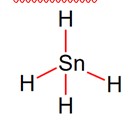
Hybridisation is- sp3, shape and structure are tetrahedral
Upvote Match List-I with List-II
List – I
List – II
(A)
4NH3(g) + 5O2(g) -> 4NO(g) + 6H2O(g)
(I)
NO(g)
(B)
N2(g) + 3H2(g) -> 2NH3(g)
(II)
H2SO4(I)
(C)
C12H22O11(aq) + H2O(I) -> C6H12O6 + C6H12O6
Glucose Fructose
(III)
Pt(s)
(D)
2SO2(g) + O2(g) -> 2SO3(g)
(IV)
Fe(s)
Choose the correct answer from the options given below
Match List-I with List-II
|
List – I |
List – II |
||
|
(A) |
4NH3(g) + 5O2(g) -> 4NO(g) + 6H2O(g) |
(I) |
NO(g) |
|
(B) |
N2(g) + 3H2(g) -> 2NH3(g) |
(II) |
H2SO4(I) |
|
(C) |
C12H22O11(aq) + H2O(I) -> C6H12O6 + C6H12O6 Glucose Fructose |
(III) |
Pt(s) |
|
(D) |
2SO2(g) + O2(g) -> 2SO3(g) |
(IV) |
Fe(s) |
Choose the correct answer from the options given below
(a) Nitric oxide formation -> Pt is used as catalyst
(b) Haber’s process -> Fe is used as catalyst
(c) Hydrolysis of ester -> Acid (H2SO4) is used as catalyst
(d) SO3 formation -> NO is used as catalyst
Upvote 
The sum of number of lone pairs of electrons present on the central atoms of XeO3, XeOF4 and XeF6, is___________.
The sum of number of lone pairs of electrons present on the central atoms of XeO3, XeOF4 and XeF6, is___________.
XeO3 ⇒ Number of lone pair = 1
XeOF4 ⇒ Number of lone pair = 1
XeF6 ⇒ Number of lone pair = 1
Upvote 
The number of interhalogens from the following having square pyramidal structure is:
CIF3, IF7, BrF5, BrF3, I2Cl6, IF5, ClF, ClF5
The number of interhalogens from the following having square pyramidal structure is:
CIF3, IF7, BrF5, BrF3, I2Cl6, IF5, ClF, ClF5
IF7 -> Pentagonal bipyramidal (sp3d3)
BrF5 -> Square pyramidal (sp3d2)
BrF3 -> T-Shaped (sp3d)
I2Cl6 -> Triangular bipyramidal (sp3d)
Square Pyramidal (sp3d2)
ClF -> (sp3)
ClF5 -> Square Pyramidal (sp3d2)
Br5, IF5 & ClF5 -> Square Pyramidal
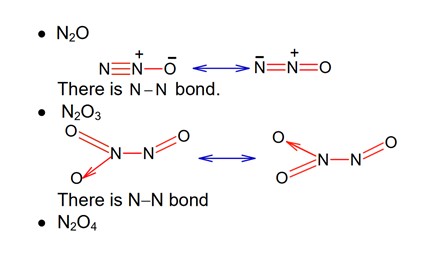
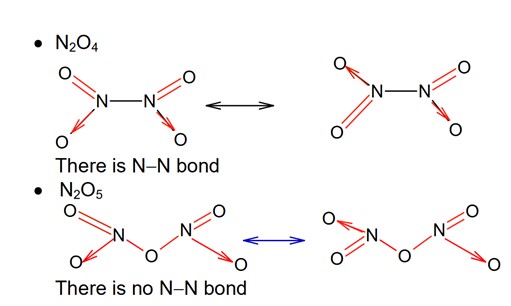
Upvote Among the given oxides of nitrogen ; N2O, N2O3, N2O4 and N2O5, the number of compound / (s) having N – N bond is:
Among the given oxides of nitrogen ; N2O, N2O3, N2O4 and N2O5, the number of compound / (s) having N – N bond is: