
P Block Elements
Get insights from 254 questions on P Block Elements, answered by students, alumni, and experts. You may also ask and answer any question you like about P Block Elements
- 254
Questions
- 0
Discussions
- 0
Active Users
- 0
Followers
Have a question about P Block Elements? Ask our experts
Keep it short & simple. Type complete word. Avoid abusive language.
Al2O3 was leached with alkali to get X. The solution of X on passing of gas Y, forms Z. X, Y and Z respectively are:
Al2O3 was leached with alkali to get X. The solution of X on passing of gas Y, forms Z. X, Y and Z respectively are:
Leaching of Al2O3 with alkali;
 Upvote

Given below are two statements : one is labelled as Assertion A and the other is labelled as Reason R.
Assertion A : In TlI3, isomorphous to CsI3, the metal is present in +1 oxidation state.
Reason R : Tl metal has fourteen f electrons in the electronic configuration.
In the light of the above statements, choose the most appropriate answer from the options given below:
Both (A) and (B) are correct but R is not correct explanation of A. In both
Upvote Calgon is used for water treatment. Which of the following statement is NOT true about Calgon?
Calgon is used for water treatment. Which of the following statement is NOT true about Calgon?
It does not contains 2nd most abundant element by weight in earth crust because that is Si Calgon ->Na2 [Na4 (PO3)6]
Upvote Given below are two statements:
Statement I : Colourless cupric metaborate is reduced to cuprous metaborate in a luminous flame.
Statement II : Cuprous metaborate is obtained by heating boric anhydride and copper sulpahte in a non-luminous flame.
In the light of the above statements, choose the most appropriate answer from the options given below
Given below are two statements:
Statement I : Colourless cupric metaborate is reduced to cuprous metaborate in a luminous flame.
Statement II : Cuprous metaborate is obtained by heating boric anhydride and copper sulpahte in a non-luminous flame.
In the light of the above statements, choose the most appropriate answer from the options given below
Blue cupric metaborate is reduced to cuprous metaborate in a luminous flame.
Cupric metaborate is obtained by heating boric anhydride & copper sulphate in a non-luminous flame as
Upvote Among the following allotropic forms of sulphur, the number of allotropic forms, which will show paramagnetism is…………………….
(a) α - sulphur (b) β - sulphur (c) S2 - form
Among the following allotropic forms of sulphur, the number of allotropic forms, which will show paramagnetism is…………………….
(a) α - sulphur (b) β - sulphur (c) S2 - form
α - sulphur & β - sulphur – Diamagnetic, S2 – form is paramagnetic due to presence of unpaired electron in π* orbital like O2.
Upvote Most suitable salt which can be used for efficient clotting of blood will be:
Most suitable salt which can be used for efficient clotting of blood will be:
Blood – Negatively charged colloid.
According to Hardy – Schulze Rule
FeCl3 is more efficient for blood clotting
Upvote Which of the following equation depicts the oxidizing nature of H2O2?
Which of the following equation depicts the oxidizing nature of H2O2?
(-1) oxidation (0)
Here, I- is reducing agent
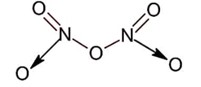
Upvote All given oxide have nitrogen – nitrogen bond except N2O5 as ;
Upvote SO2Cl2 on reaction with excess of water results into acidic mixture
SO2Cl2 + H2O -> H2SO4 + 2HCl
16 moles of NaOH is required for the complete neutralization of the resultant acidic mixture. The number of moles of SO2Cl2 used is:
SO2Cl2 on reaction with excess of water results into acidic mixture
SO2Cl2 + H2O -> H2SO4 + 2HCl
16 moles of NaOH is required for the complete neutralization of the resultant acidic mixture. The number of moles of SO2Cl2 used is:
Let a moles of SO2Cl2 is taken
Then no. of moles of H2SO4 = a moles
No. of moles of HCl = 2a moles
No. of moles of NaOH required = 2a + 2a = 4a = 16
Upvote