Chemistry

Get insights from 6.9k questions on Chemistry, answered by students, alumni, and experts. You may also ask and answer any question you like about Chemistry

Follow Ask Question
6.9k

Questions

0

Discussions

26

Active Users

0

Followers

New answer posted

8 months ago

0 Follower 1 View

P
Payal Gupta

Contributor-Level 10

For single H- atom, maximum number of spectral lines = (n – 1), n = orbit number of excited electron.

New answer posted

8 months ago

0 Follower 5 Views

P
Payal Gupta

Contributor-Level 10

V = 2 l , n = 0.25 Moles, P = 2 * 106 Pa, R = 8.314 J/mol.k

PV = nRT

2*106*2*103=0.25*8.314*T

T = 1654.7  1655 K

New answer posted

8 months ago

0 Follower 4 Views

P
Payal Gupta

Contributor-Level 10

      N2 (g)+3H2 (g)2NH3 (g)

t =  0 56 l            Excess 0

           -10 l                     +20 l

Final 46 l                  20 l

Vol. of N2 (g) remained unreacted = 46 l

New answer posted

8 months ago

0 Follower 1 View

S
Satyendra Dhyani

Beginner-Level 5

Molecules usually form chemical bond through either sharing or through rtransfering the electrons. During covalent bonding the electron pairs shared between atoms to form covalent bond are called shared pair or bond pair. At the same time, the electron pair which is not involved in sharing is called lone pair of electrons.

For example: CH4 has 4 bond pairs but H2O has 2 bond pairs and 2 lone pairs.

New answer posted

8 months ago

0 Follower 1 View

E
Esha Garg

Beginner-Level 5

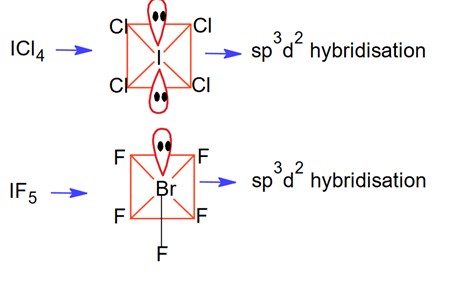
The Valence Shell Electron Pair Repulsion (VSEPR) Theory is an algorithm developed to predict the molecular geometry of the compounds. The VSEPR theory predict the molecular shape based on the repulsion between electron pairs (bonding and lone) around the central atom. As per the NCERT Textbooks:

According to this theory, the shape of a molecule depends upon the number of valence shell electron pairs around the central atom. Electron pairs repel each other and try to remain as far apart as possible to minimise repulsion, thus determining the geometry of the molecule.”

You can use this theory in primarily explaining the molecular str

...more

New answer posted

8 months ago

0 Follower 4 Views

P
Piyush Vimal

Beginner-Level 5

VSEPR theory predicts the shape of molecule based on postulate (assmptions). here are the important postulates as per the NCERT textbooks.

  • The molecular geometry shape depends upon the number of valence shell electron pairs (bonded and non-bonded) around the central atom.
  • The electron pairs (bonded and lone pairs) in the valence shell repel each other since their electron clouds are negatively charged.
  • These electron pairs arrange themselves to minimize  repulsion so that the molecule attains a stable structure with minimum energy.
  • All electron pair repulsion doesn't repel each other equally, Electron pairs follows this order:
    Lone pai
...more

New answer posted

8 months ago

0 Follower 74 Views

V
Vishal Baghel

Contributor-Level 10

2 (only 2 carbon will chiral in product form)

New answer posted

8 months ago

0 Follower 12 Views

V
Vishal Baghel

Contributor-Level 10

Degree of unsaturation = 4 + 1 -   ( 5 1 2 ) = 3

sp3 hybridized only one carbon

New answer posted

8 months ago

0 Follower 2 Views

V
Vishal Baghel

Contributor-Level 10

Organic compound -> NH3

2 N H 3 + H 2 S O 4 ( N H 4 ) 2 S O 4  

No. of millimoles of NH3 = 2 * no. of milimoles of H2SO4

= 2 * 2 * 2.5

= 10 milimoles

= No. of milimoles of N

Mass of nitrogen =  1 0 1 0 0 * 1 4 = 0 . 1 4 g m

% of Nitrogen in compound =  0 . 1 4 0 . 2 5 * 1 0 0

= 56%

New answer posted

8 months ago

0 Follower 8 Views

V
Vishal Baghel

Contributor-Level 10

  C o 3 +  will not get oxidized, so will not liberate H2 gas upon reaction with acidic solution.

No. of unpaired electron = 4

Spin only magnetic moment = 4 ( 4 + 2 ) B M = 2 4 B M 5 B M

Get authentic answers from experts, students and alumni that you won't find anywhere else

Sign Up on Shiksha

On Shiksha, get access to

  • 66k Colleges
  • 1.2k Exams
  • 687k Reviews
  • 1800k Answers

Share Your College Life Experience

×

This website uses Cookies and related technologies for the site to function correctly and securely, improve & personalise your browsing experience, analyse traffic, and support our marketing efforts and serve the Core Purpose. By continuing to browse the site, you agree to Privacy Policy and Cookie Policy.