

Class 11th
Get insights from 8k questions on Class 11th, answered by students, alumni, and experts. You may also ask and answer any question you like about Class 11th
Follow Ask QuestionQuestions
Discussions
Active Users
Followers
New answer posted
a year agoContributor-Level 10
In an LCR series AC circuit, the phase difference φ between current and voltage is: φ = tan? ¹ (X? - X? ) / R)
If each vibrational mode contributes two degrees of freedom and the total degrees of freedom f = 3 + 3 + 4 = 10, then:
β = 1 + 2/f = 1 + 2/10 = 1.2
New answer posted
a year ago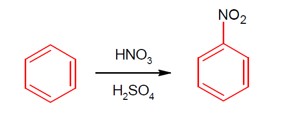
Contributor-Level 10
Moles of benzene = 3.9 g / 78 g/mol . This would produce (3.9 / 78) moles of nitrobenzene in 100% conversion.
Produced moles of nitrobenzene = 4.92 g / 123 g/mol .
% yield = [ (4.92 / 123) / (3.9 / 78) ] * 100 = [ (4.92 * 100 * 78) / (123 * 3.9) ] = 80.0%
Ans = 80
New answer posted
a year agoContributor-Level 10
Molality = (mole of solute * 1000) / wt of solvent (gm)
100 = (n_solute * 1000) / [ (1 - n_solute) * 18]
(1 - n_solute) / n_solute = 1000 / (100 * 18) = 10/18
18 (1 - n_solute) = 10 n_solute
18 - 18 n_solute = 10 n_solute
18 = 28 n_solute
n_solute = 18 / 28? 0.6428 = 64.28 * 10? ²
Ans = 64 (Rounded off)
New answer posted
a year agoContributor-Level 10
For n = 4, the possible values of l are 0, 1, 2, 3.
For l = 3, and m = -3.
Radial nodes = (n - l - 1) = (4 - 3 - 1) = 0
Ans = 0
New answer posted
a year agoContributor-Level 10
For the weak acid HA in the presence of strong acid HCl:
Ka = [ (Cα + 0.1) * Cα] / [C (1-α)] ≈ (0.1 * 10? ²α) / 10? ² = 0.1α
Given Ka = 2 * 10?
2 * 10? = 10? ¹ * α
α = 2 * 10?
Ans = 2
New answer posted
a year agoContributor-Level 9
According to principle of equi-partition of Energy, the average energy per molecules associated with each degree of freedom is (1/2)kT.
New answer posted
a year agoContributor-Level 10
Mole of CH? = 6.4 / 16 = 0.4 and mole of CO? = 8.8 / 44 = 0.2
Total mole = (0.4 + 0.2) = 0.6 mole of a non-reacting mixture of gas
Using Ideal Gas Law; P = nRT / V
P = (0.6 * 8.314 * 300) / 10 = 149.65 kPa
Ans = 150 (Rounded off)
New answer posted
a year agoContributor-Level 9
m (dv/dt) = P ⇒ ∫v dv = ∫ (P/m) dt ⇒ v = (2Pt/m)¹/²
⇒ ∫dx = ∫ (2P/m)¹/² t¹/² dt ⇒ x = (2P/m)¹/² (2/3)t³/² ⇒ x ∝ t³/²
New answer posted
a year agoContributor-Level 10
Partial Pressure of O? = K? * solubility (K? = Henry's constant)
Solubility = PO? / K? = 20 / (8.0 * 10? ) = 2.5 * 10? = 25 * 10? M
Ans = 25
New answer posted
a year agoContributor-Level 10
For a bouncing object with initial height h = 5m and coefficient of restitution e = 0.9 (so e² =0.81):
Total distance traveled, d = h + 2e²h + 2e? h + . = h * (1 + e²) / (1 - e²)
Total time taken, t = √* (2h/g)* + 2√* (2e²h/g)* + 2√* (2e? h/g)* + . = √* (2h/g)* * (1 + e) / (1 - e)
Average speed = d/t = √* (gh/2)* * (1 + e²) / (1 + e)² = 5 * (1.81) / (1.9)² = 2.50 m/s
Taking an Exam? Selecting a College?
Get authentic answers from experts, students and alumni that you won't find anywhere else
Sign Up on ShikshaOn Shiksha, get access to
- 67k Colleges
- 1.2k Exams
- 716k Reviews
- 1850k Answers