Classification of Organic Compounds
Get insights from 4 questions on Classification of Organic Compounds, answered by students, alumni, and experts. You may also ask and answer any question you like about Classification of Organic Compounds
- 4
Questions
- 0
Discussions
- 0
Active Users
- 0
Followers
Have a question about Classification of Organic Compounds? Ask our experts
Keep it short & simple. Type complete word. Avoid abusive language.
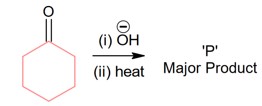
In the given reaction,
The number of p- electron present in the product ‘p’ in__________.
In the given reaction,
The number of p- electron present in the product ‘p’ in__________.
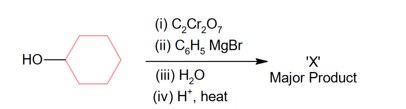
In the given reaction
The number of sp2 hybridised carbon(s) in compound ‘X’ is____________.
In the given reaction
The number of sp2 hybridised carbon(s) in compound ‘X’ is____________.
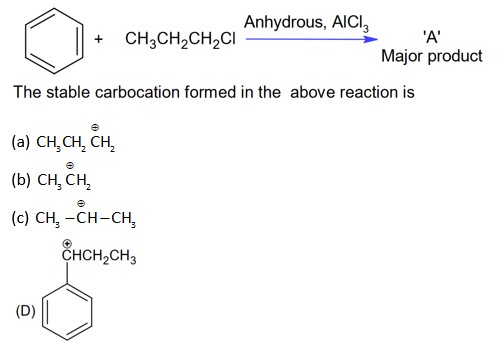
With AlCl3, alkyl halide will form cabocation which will show rearrangement.
The pKa of dimethylamine and pKa of acetic acid are 3.27 and 4.77 respectively at T(K). The correct option for the pH of dimethylammonium acetate solution is :
<!-- [if !supportLineBreakNewLine]-->
<!--[endif]-->
The pKa of dimethylamine and pKa of acetic acid are 3.27 and 4.77 respectively at T(K). The correct option for the pH of dimethylammonium acetate solution is :
<!-- [if !supportLineBreakNewLine]-->
<!--[endif]-->
Dimethylammonium acetate is a weak acid & weak base type of salt.
pH = 7 + ½ pK? – ½ pK?
= 7 + ½ × 4.77 – ½ × 3.27
= 7.75