

Chemistry
Get insights from 6.9k questions on Chemistry, answered by students, alumni, and experts. You may also ask and answer any question you like about Chemistry
Follow Ask QuestionQuestions
Discussions
Active Users
Followers
New answer posted
a year agoContributor-Level 9
H? O? can act as both an oxidizing & reducing agent in both acidic & basic medium. In the hydrogen economy, energy is stored & transmitted in the form of dihydrogen.
New answer posted
a year agoContributor-Level 9
Roasting is a process in which sulphur is removed as SO? gas from sulphide ores on heating in excess of oxygen.
New answer posted
a year agoContributor-Level 9
Bismuth (Bi) is a metal in group 15. Its hydride is BiH? , which is the strongest reducing agent due to its the lowest thermal stability.
New answer posted
a year agoContributor-Level 9
Hydrated halides of group 2 from Ca onwards undergo dehydration on heating. But the hydrated halide of Mg, i.e., MgCl? ·8H? O, does not undergo dehydration on heating but undergoes hydrolysis.
BeO is amphoteric, while other oxides of group 2 are basic in nature.
New answer posted
a year ago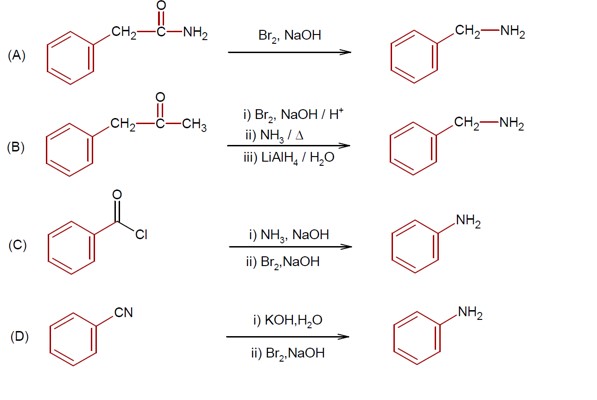
Contributor-Level 9
R-CONH? + Br? + 4NaOH → R-NH? + 2NaBr + Na? CO? + 2H? O
This reaction is the Hoffmann bromamide degradation, in which an amide is converted to a 1° amine.
New answer posted
a year agoContributor-Level 9
Oxidation States (O.S) of Phosphorus (P):
- Hypophosphorous acid – H? PO? : +1
- Orthophosphoric acid – H? PO? : +5
- Hypophosphoric acid – H? P? O? : +4
- Orthophosphorous acid – H? PO? : +3
New answer posted
a year agoContributor-Level 9
Formation of photochemical smog, which is also known as oxidizing smog, takes place in the presence of sunlight and O?
New answer posted
a year agoContributor-Level 9
Purification of a compound is independent of the physical state of the pure compound in chromatography techniques.
New answer posted
a year agoContributor-Level 9
H? O has a tetrahedral geometry and a bent shape with a bond angle of 104.5°, which is smaller than 109.5°. This is because of the presence of two lone pairs in H? O.
Taking an Exam? Selecting a College?
Get authentic answers from experts, students and alumni that you won't find anywhere else
Sign Up on ShikshaOn Shiksha, get access to
- 67k Colleges
- 1.2k Exams
- 716k Reviews
- 1850k Answers