

Chemistry
Get insights from 6.9k questions on Chemistry, answered by students, alumni, and experts. You may also ask and answer any question you like about Chemistry
Follow Ask QuestionQuestions
Discussions
Active Users
Followers
New answer posted
a year ago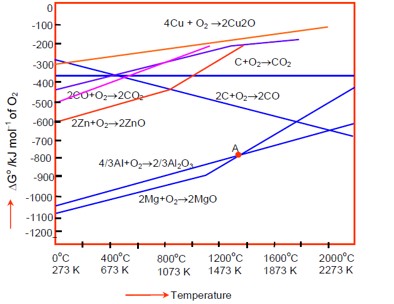
Contributor-Level 10
At the point of intersection in an Ellingham diagram? G for two processes becomes equal, so? G for the reduction becomes zero. A sudden increase in the slope indicates a change in the state of the metal oxide, i.e., from solid to liquid or liquid to vapor.
New answer posted
a year agoContributor-Level 10
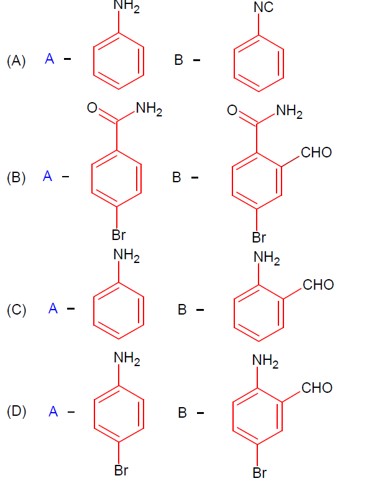
In the ammonolysis process, bond cleavage is carried out in the presence of NH? When a halide compound is treated with NH? , the halide ion (X? ) is substituted by an amino group (NH? ) in a nucleophilic substitution reaction.
New answer posted
a year ago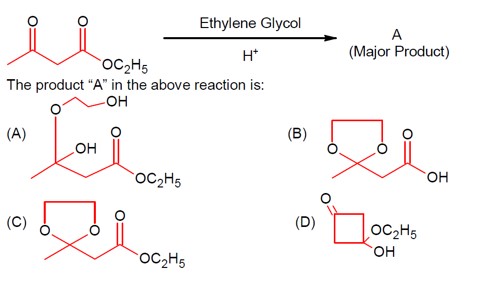
Contributor-Level 10
A more reactive carbonyl, i.e., a ketone, is masked with ethylene glycol first in an acidic medium.
New answer posted
a year agoContributor-Level 10
Allosteric inhibitors are a type of drug-enzyme inhibitor that binds to a site other than the active site of the enzyme, causing a conformational change that affects the active site. The statement in the document incorrectly states they bind at the active site due to steric factors.
New answer posted
a year agoContributor-Level 10
A divalent metal ion with an atomic number (Z) of 25 is Mn²?
Mn²? (Z=25) has the electronic configuration: 3d? 4s? (n=5, five unpaired electrons).
The magnetic moment (μ) is calculated as: μ = √ [n (n+2)] = √ [5 (5+2)] = √35 = 5.92 BM.
New answer posted
a year agoContributor-Level 10
In an aqueous medium, all alkali metal cations are converted into their hydrated form. More intensely positive cations have more hydration, and hence the size of the cation increases after hydration. Therefore, the Li? cation has a larger size in hydrated form and the least conductivity. The order of conductivity of alkali metal ions is: Li? < Na? < K? < Rb? < Cs?
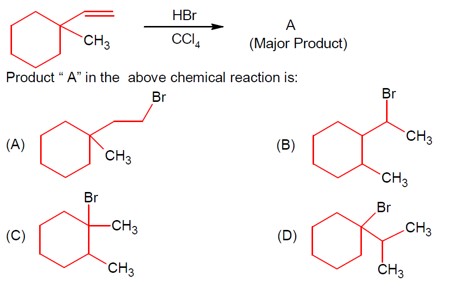
New answer posted
a year agoContributor-Level 10
Except for option (D), all are the important characteristics of D? O. D? O is useful for the isotopic leveling effect in reaction mechanisms. The dielectric constants of H? O and D? O are respectively 80 and 60.
Taking an Exam? Selecting a College?
Get authentic answers from experts, students and alumni that you won't find anywhere else
Sign Up on ShikshaOn Shiksha, get access to
- 67k Colleges
- 1.2k Exams
- 716k Reviews
- 1850k Answers