

Chemistry
Get insights from 6.9k questions on Chemistry, answered by students, alumni, and experts. You may also ask and answer any question you like about Chemistry
Follow Ask QuestionQuestions
Discussions
Active Users
Followers
New answer posted
a year ago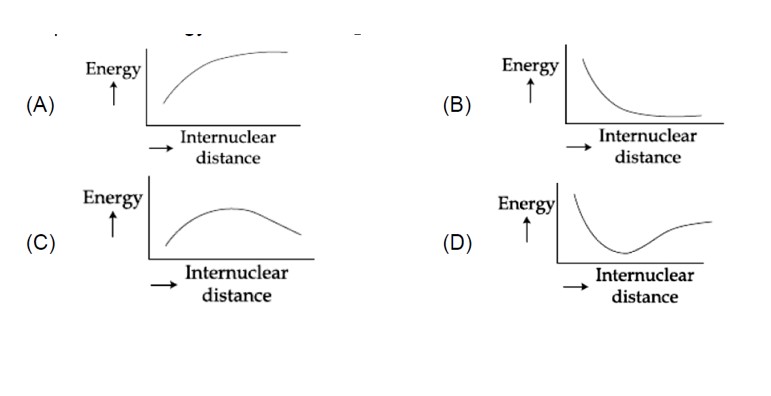
Contributor-Level 10
With decrease in inter-nuclear distance, the potential energy of the system decreases, reaches a minimum value and then sharply increases due to rise in inter-electronic as well as inter-nuclear repulsions
New answer posted
a year agoContributor-Level 10
Among its different uses noradrenaline is used as an anti-depressant.
New answer posted
a year agoContributor-Level 10
ρ = M/V
∴ 6.17 = (2 x MX? ) / (N? x (300 x 10? ¹? )³)
Solving MX? = 50 g
∴ No. of molecules in 200 g
= (200/50) x N? = 4 N?
New answer posted
a year agoContributor-Level 10
In water gas shift reaction carbon monoxide is oxidized into carbon dioxide by treating it with steam in presence of catalyst.
New answer posted
a year agoContributor-Level 10
For A
0.693/300 = (2.303/t) log (A? /A? )
For B
0.693/180 = (2.303/t) log (B? /B? )
Given A? = B? & A? = 4B?
Substituting & solving we get t = 900 s
New answer posted
a year ago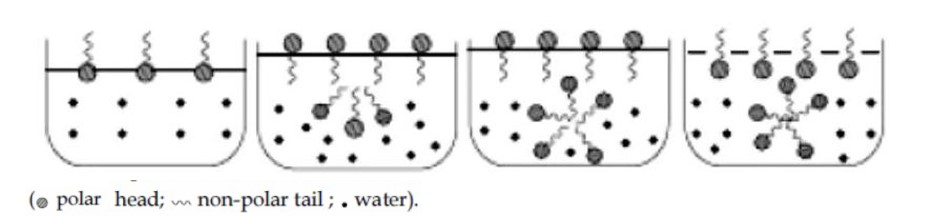
Contributor-Level 10
At CMC, the particles cluster together through lyophobic end to form associated colloid called micelle. Further all lyophilic ends (polar head) get projected towards water.
New answer posted
a year ago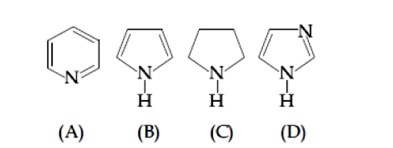
Contributor-Level 10
B is least basic as lone pair of electron is present in resonance so as to make the system aromatic in nature
D is most basic as it results in formation of equivalent resonating structures upon attack of H?
Among A and C, the former is less basic as sp² hybridistion of nitrogen decrease its basic strength.
Hence option 3 follows
New answer posted
a year agoContributor-Level 10
According to Aufbau's principal, the increasing energy of atomic orbitals for sixth period element follows the order
6s < 4f < 5d < 6p
New answer posted
a year agoContributor-Level 10
The major functions of hormones are:
- Regulating Metabolism
- Controlling Growth and Development
- Managing Stress and Energy
- Regulating Sleep and Mood
Taking an Exam? Selecting a College?
Get authentic answers from experts, students and alumni that you won't find anywhere else
Sign Up on ShikshaOn Shiksha, get access to
- 67k Colleges
- 1.2k Exams
- 716k Reviews
- 1850k Answers