

Class 12th
Get insights from 12k questions on Class 12th, answered by students, alumni, and experts. You may also ask and answer any question you like about Class 12th
Follow Ask QuestionQuestions
Discussions
Active Users
Followers
New answer posted
a year agoContributor-Level 10
CN is strong field ligand
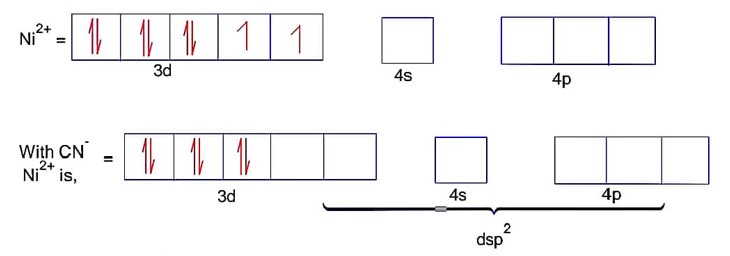
Here; is square planar and diamagnetic.
Ni = 4s23d8Co is strong field ligand.
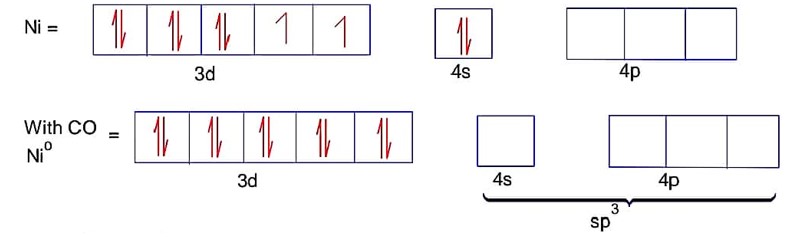
Here ; is tetrahedral and diamagnetic
has 3d8 configuration while has 3d10 configuration.
New answer posted
a year agoContributor-Level 10
Valence shell electronic configuration of Eu in +2 O.S is,
It has half filled f-sub shell and stable.
New answer posted
a year agoContributor-Level 10
Pentavalent oxides of group – 15 elements, E2O5 is more acidic than trivalent oxides, E2O3 of the same element.
Acidic strength of trivalent oxides decreases down the group as metallic strength increases.
New answer posted
a year agoContributor-Level 10
Below 1350° C, Mg can reduce Al2O3 and above 1350°C, Al can reduce MgO (from Ellingham diagram).
Melting and boiling point of Mg are lower than that of Al.
New answer posted
a year agoContributor-Level 10
General valence shell electronic configuration of group 16 elements is ns2np4. For 3rd period element which is above element “E” is 3s23p4
New answer posted
a year agoContributor-Level 10
Potential difference between fixed layer and mobile layer of lyophobic colloid is called zeta potential or electro kinetic potential.
This potential difference is related to charge on the surface of colloidal particles.
New answer posted
a year agoContributor-Level 10
· Density of solid decreases in Schottky defect and vacancy defect.
· Density of solid increases in interstitial defect.
· Density of solid remain unchanged in Frenkel defect.
Taking an Exam? Selecting a College?
Get authentic answers from experts, students and alumni that you won't find anywhere else
Sign Up on ShikshaOn Shiksha, get access to
- 67k Colleges
- 1.2k Exams
- 718k Reviews
- 1850k Answers