Education: Search Trends In India, An Online Perspective
 Call 8585951111Got Doubts?
By Siddharth Raman Singh (Marketing)

According to Greek myths, there was once a king named Sisyphus who was punished for his arrogance and deceitfulness in a very novel manner. Sisyphus was made to roll a large boulder up a steep hill, the truly maddening nature of the punishment was the fact that as soon as he was about to reach the top of the hill, the boulder would slip away and roll back down thus endlessly extending his frustration and misery.
Being an online marketer can often feel just as frustrating. By the nature of our work, we have to be aware of consumer sentiments, needs and opinions. However, trying to accurately determine these constantly changing attributes in a vast, heterogeneous country like India with more than 300 million people online can often feel frustrating and an endless journey – not unlike the unfortunate Sisyphus whom we met a few sentences earlier.
Fortunately for us, unlike our tragic Greek king, we have a few tools at our disposal which can simplify the job, perhaps even make it fun and insightful in the process – the good old Google. Most people know Google as the search empire which was built atop the ground breaking product Google Search which did (and continues to do) an absolutely stellar job of providing relevant results to a seemingly endless variety of queries.

What many don’t realize is Google often publishes data around searches being done by the online population and a careful study of these searches reveals as much about user’s need and opinions (perhaps far more given the anonymity that the internet provides) than any offline survey or questionnaire ever could. The whole universe of Google searches is far too big to be analysed meaningfully by a business like ours. Thankfully, we were able to filter out some data around education oriented searches in India and were able to derive a number of interesting insights which we can delve into now.
1. Popular Careers – Perhaps not so popular after all!
All of us growing up would have run into the ever present Indian fascination of becoming doctors or engineers. Merely getting admitted to a top grade engineering or medical colleges was supposed to open the gates of heaven while mere mortals studying Eco(Hons) would watch in envy as the doctors and engineers laughed their way to the bank. (PS: No offence intended to my Eco Hons comrades)
However, the internet begs to differ. While engineering and medical continue to be popular career choices, data suggests that other streams have taken the lead. The opening up of the economy and consequently new career options, the proliferation of quality colleges around the country and movement of companies beyond the established metropolitans means that a fair number of students are interested in non-engineering and non-medical courses as well. We explored the search volumes for some popular study courses and came up with some surprising results:
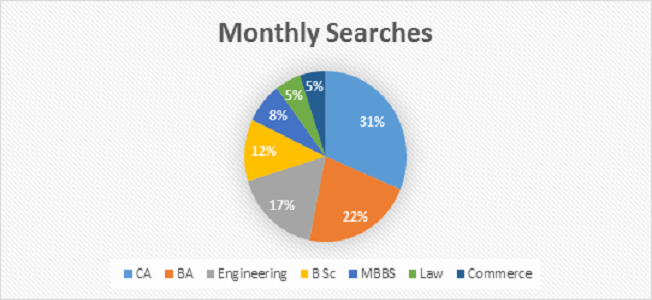
Strangely enough, Indian students seem to have discovered chartered accountancy with a vengeance! With a pass percentage hovering between 10-12%, India’s CA exam is one of the toughest on the planet and very few make it through the finals but that obviously does not stop it from forming the single largest pool in our study. Engineering only managed to make it to the 3rd slot while medical got relegated to the 5th spot, the once lowly BA and BSc courses make up 33% of online searches in this category indicating their ascendency. So remember parents, if your kid says that he/she wants to become an accountant or study (shudder) Eco (Hons), perhaps they are onto something good!
2. The pull of the University
During our study, we assumed that students would have clarity on the streams and courses they would like to study and would start hunting for specific colleges and universities after they had made up their mind. What we found was something totally different. Apparently, universities, specifically well-known ones have a very strong pull on students as was seen in search volumes data:
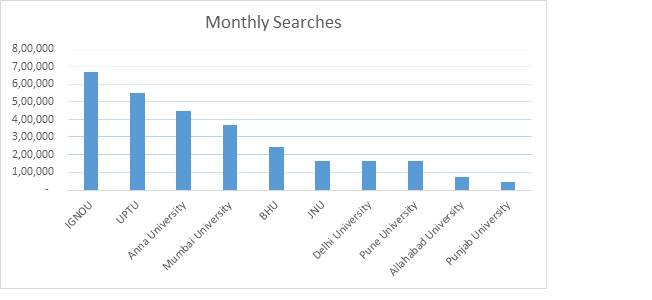
Merely 10 popular universities (not even the top 10 for that matter!) accounted for a staggering 30 lakh searches a month, by conservative estimates. India has almost 700+ universities, by contrast, stream and course specific searches are but a small fraction of this number.
Even private universities seem to be generating a lot of traction, some of the more well-known ones manage to attract well over 20-30,000 searches per month, which is a very healthy benchmark:
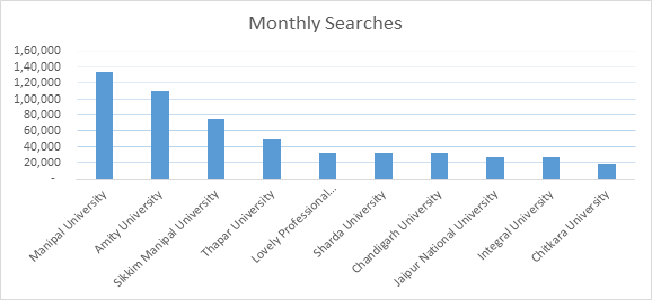
The reason why private universities are seeing this pull is not precisely known, but it’s not too difficult to figure out some of the factors at play. There is only so much infrastructure that state and central governments can build in a country as vast as India and even with a focused push in the last few decades, the quality of education provided by government colleges often leaves a lot to be desired. Coupled with the rising aspirations and income of a rapidly expanding middle class, good quality private education was a niche that was begging to be catered to and now private players seem to have spotted the opportunity of solving a social/infrastructure problem and generating commercial success at the same time.
3. The rise of mobile
These days, no self-respecting marketing treatise can conclude without a section on how mobile is changing the world, so let’s also have a look at this before we reach the end of our journey.
As most of us know, India managed to bypass the entire desktop based internet revolution and jumped straight to the mobile platform. This was driven by multiple factors like most new online users not having a desktop or laptop, highly capable and domestically manufactured smartphones being available at very affordable rates and having some of the cheapest mobile data plans on the planet etc. This trend is especially pronounced in education based searches, which are carried out by young students who took to mobile devices like a duck takes to water.
These trends also reflect in search volume data. We took a sample of 800 odd education related keywords and compared their device specific searches across years 2014 and 2015. We found that in 2014 approximately 32% of searches were made on mobile devices, by 2015, this number had swelled to 43%. For many keywords the contribution of mobile was well over 50% as well.
In absolute terms also, searches done on mobile devices increased by close to 50% – an astounding number in the time when desktop searches are either stagnant or even slowing down in some cases.
These were just some of the more interesting discoveries we made as part of our research. Are there other more profound insights hidden in the data? Absolutely! With time and more experimentation, a smart marketer would undoubtedly discover more and more information about how users/students are behaving online and be able to design and implement increasingly sophisticated marketing strategies. Gone are the days when marketers had to rely on intuition and the ever so inefficient “spray and pray” technique, to misquote Aldous Huxley – it’s a brave new world out there – let data be our guiding light in this new environment!
Sources:
- Google Adwords Keyword Planner
- https://en.wikipedia.org/wiki/List_of_universities_in_India
[First Published on October 28, 2015]
