
Moment of Inertia
Get insights from 22 questions on Moment of Inertia, answered by students, alumni, and experts. You may also ask and answer any question you like about Moment of Inertia
- 22
Questions
- 0
Discussions
- 0
Active Users
- 0
Followers
Have a question about Moment of Inertia? Ask our experts
Keep it short & simple. Type complete word. Avoid abusive language.
For a uniform rectangular sheet shown in the figure, the ratio of moments of inertia about the axes perpendicular to the sheet and passing through O (the centre of mass) and O’ (corner point) is:
<!-- [if !supportLineBreakNewLine]-->
<!--[endif]-->
For a uniform rectangular sheet shown in the figure, the ratio of moments of inertia about the axes perpendicular to the sheet and passing through O (the centre of mass) and O’ (corner point) is:
<!-- [if !supportLineBreakNewLine]-->
<!--[endif]-->
l? = 0.6M
l? = 0.8M
√l? ² + l? ² = 1
MI about 0 = M/12 (l? ² + l? ²)
I? = M/12
MI about O' = M/12 (l? ² + l? ²) + M (l? ²+l? ²)/4
I? = M/12 + M/4 = (4m)/12; I? /I? = 1/4
 Upvote

Consider two uniform discs of the same thickness and different radii R₁ = R and R₂ = aR made of the same material. If the ratio of their moments of inertia I₁ and I₂, respectively, about their axes is I₁:I₂ = 1:16 then the value of a is:
Consider two uniform discs of the same thickness and different radii R₁ = R and R₂ = aR made of the same material. If the ratio of their moments of inertia I₁ and I₂, respectively, about their axes is I₁:I₂ = 1:16 then the value of a is:
I? ∝ R? ² & I? ∝ R? ²
I? /I? = (R? /R? ) ² = 1/α² = 1/16
α = 4
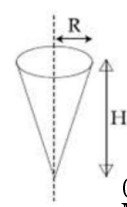
Upvote Shown in the figure is a hollow icecream cone (it is open at the top). If its mass is M, radius of its top, R and height, H, then its moment of inertia about its axis is:
<!-- [if !supportLineBreakNewLine]-->
<!--[endif]-->
Shown in the figure is a hollow icecream cone (it is open at the top). If its mass is M, radius of its top, R and height, H, then its moment of inertia about its axis is:
<!-- [if !supportLineBreakNewLine]-->
<!--[endif]-->
Kindly consider the following figure
Upvote Mass per unit are of a circular disc of radius a depends on the distance from its centre as . The moment of inertia of the disc about the axis, perpendicular to the plane and passing through its centre is:
<!-- [if !supportLineBreakNewLine]-->
<!--[endif]-->
Mass per unit are of a circular disc of radius a depends on the distance from its centre as . The moment of inertia of the disc about the axis, perpendicular to the plane and passing through its centre is:
<!-- [if !supportLineBreakNewLine]-->
<!--[endif]-->
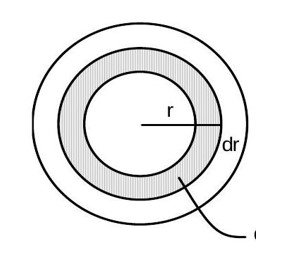
Moment of inertia of ring
Upvote 

The figure shows two solid discs with radius R and r respectively. If mass per unit area is same for both, what is the ratio of MI of bigger disc around axis AB (which is ⊥ to the plane of the disc and passing through its centre) to MI of smaller disc around one of its diameters lying on its plane? Given 'M' is the mass of the larger disc. (MI stands for moment of inertia)
The figure shows two solid discs with radius R and r respectively. If mass per unit area is same for both, what is the ratio of MI of bigger disc around axis AB (which is ⊥ to the plane of the disc and passing through its centre) to MI of smaller disc around one of its diameters lying on its plane? Given 'M' is the mass of the larger disc. (MI stands for moment of inertia)
I? / I? = (MR²/2) / (mr²/4)
[ M = σπR², m = σπr² ]
= 2 (M/m) (R²/r²)
= 2 (σπR²/σπr²) (R²/r²)
= 2 (R²/r²)² = 2R? /r?
Upvote 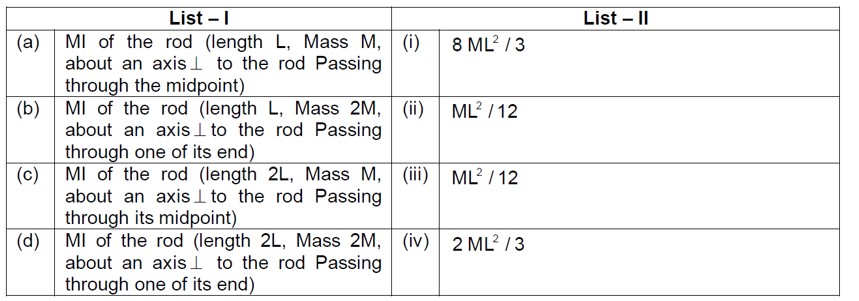
(a) I = ML²/12
(b) I = (2M)L²/3
(c) I = M (2L)²/12 = ML²/3
(d) I = (2M) (2L)²/3 = 8ML²/3
Upvote A uniform thin bar of mass 6kg and length 24 meter is bent to make an equilateral hexagon. The moment of inertia about an axis passing through the centre of mass and perpendicular to the plane hexagon is………….× 10-1 kg m2.
A uniform thin bar of mass 6kg and length 24 meter is bent to make an equilateral hexagon. The moment of inertia about an axis passing through the centre of mass and perpendicular to the plane hexagon is………….× 10-1 kg m2.
Let mAB = m = 1 kg
AB = 0.4 m =
d = OM =
= 0.08 + 0.72 = 0.8 kgm2 = 8 × 10⁻¹ kgm2
Upvote A system consists of two identical spheres each of mass 1.5 kg and radius 50cm at the end of light rod. The distance between the centres of the two spheres is 5m. What will be the moment of inertia of the system about an axis perpendicular to the rod passing through its midpoint?
A system consists of two identical spheres each of mass 1.5 kg and radius 50cm at the end of light rod. The distance between the centres of the two spheres is 5m. What will be the moment of inertia of the system about an axis perpendicular to the rod passing through its midpoint?
Using parallel axis theorem:
l = 19.05 kgm2
Upvote