Ncert Solutions Maths class 12th

Get insights from 2.5k questions on Ncert Solutions Maths class 12th, answered by students, alumni, and experts. You may also ask and answer any question you like about Ncert Solutions Maths class 12th

  • 2.5k

    Questions

  • 0

    Discussions

  • 0

    Active Users

  • 65

    Followers

Have a question about Ncert Solutions Maths class 12th? Ask our experts

Ask Your Question

Keep it short & simple. Type complete word. Avoid abusive language.

New answer posted•a year ago
S
a year ago

Let, I=∫sin−1 (2x1+x2)dx

Putting x = tanθ tan-1x = θ dx = sec2θdθ we get,
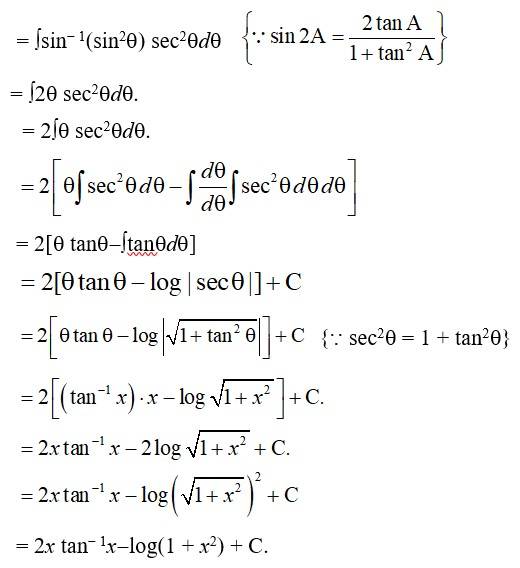
I=∫sin−1 [2tanθ1+tan2θ]⋅sec2θ  dθ

Thumbs Up IconUpvote Thumbs Down Icon
New answer posted•a year ago
S
a year ago

Let, I=∫e2xsinx dx.=sinx∫e2x−∫ddxsinx∫e2xdx dx=sinx⋅e2x2−∫cos x⋅e2x2dx=e2x2sinx−12∫cosx⋅× e2xdx=e2x2⋅sinx−12{cosx∫e2xdx−∫ddxcosx∫e2xdxdx}=e2x2sinx−12{cosx⋅e2x2+∫sinxe2x2dx}=e2x2sinx−e2x4cosx−14I+ C⇒I+I4=e2x2sinx−e2x4cosx+ C⇒5I4=e2x2sinx−e2x4cosx+ C⇒I=45[e2x2sinx−e2x4cosx]+ C=e2x5[2sinx−cosx]+ C

Thumbs Up IconUpvote Thumbs Down Icon
New answer posted•a year ago
S
a year ago

Let, I =∫x−3(x−1)3exdx.=∫(x−1)−2(x−1)3exdx.=∫ex[x−1(x−1)3−2(x−1)3]dx=∫ex[1(x−1)2+(−2)(x−1)3]dx,whichisinfore∫ex[f(x)+f′(x)]dx,Wheref(x)=1(x−1)2f′(x)=ddx(x−1)−2=−2(x−1)3.∴I=exf(x)+c=ex1(x−1)2+c=ex(x−1)2+ C

Thumbs Up IconUpvote Thumbs Down Icon
New answer posted•a year ago
S
a year ago

Let, I=∫ex (1x−1x2)dx∫ex [f (x)+f (x)] dxWhere, f (x)=1xf (x)=dxdx=−1x−2=−1x2

So, I = exf (x) + C

=ex1x+ c=exx+ c

Thumbs Up IconUpvote Thumbs Down Icon
New answer posted•a year ago
S
a year ago

Let,=∫ex(1+sinx1+cosx)dx.,

=∫ex1+2sinx2cosx22cos2x2dx. {∴ sin 2x = 2sin x cos x. cos 2x = cos- 2x- 1 1 + cos 2x = 2cos2x.

=∫ex[12cos2x2+2sinx2cosx22cos2x2]dx]=∫ex[12sec2x2+cosx⋅sinx2cosx2]dx

=∫ex[tanx2+12sin2x2]dx is in the form

  ex [f(x) + f(x)].dx where

f(x)=tanx2f′(x)=ddrtanx2=sec2x2ddx(x2)=12sec2x2=exf(x)+c=extanx2+ C

Thumbs Up IconUpvote Thumbs Down Icon
New answer posted•a year ago
S
a year ago

Let,I=∫xex(x+1)2 dx=∫x+1−1(x+1)2exdx

=∫ex[(x+1)(x+1)2+(−1)(x+1)2]dx. is of the form

ex [f(x) + f(x)] dx

Where,f(x)=x+1(x+1)2=1x+1So,f′(x)=d(x+1)−1dx=(−1)(x+1)2.∴∫x⋅⋅ex(1+x2)dx=ex[1x+1]+ C

Thumbs Up IconUpvote Thumbs Down Icon
New answer posted•a year ago
S
a year ago

∴f (x) = sin x

f (x) = cos x.

ex [f (x) + f (x)] dx = exf (x) + C

∫ex (sinx+cosx)dx=exsinx+c

Thumbs Up IconUpvote Thumbs Down Icon
New answer posted•a year ago
S
a year ago

∫(x2+1)logx  dx=logx∫(x2+1)dx−∫(x2+1)dx−∫ddxlogx∫(x2+1)dx  dx=logx⋅[x33+x]−∫1x×[x33+x]dx=[x33+x]logx−∫[x23+1]dx=[x33+x]logx−x33×3−x+ C=[x33+x]logx−x39−x+ C

Thumbs Up IconUpvote Thumbs Down Icon
New answer posted•a year ago
S
a year ago

∫x(logx)2=⋅(logx)2∫x dx−∫ddx(logx)2⋅∫x dx dx=(logx)2×x22−∫2logx×12×x22dx=x22(logx)2−∫logx⋅x  dx

=x22(logx)2−[logx∫x dx−∫ddxlogx∫x dx dx]=x22(logx)2−x22logx+∫x2dx=x22(logx)2−x22logx+x24+ C

Thumbs Up IconUpvote Thumbs Down Icon
New answer posted•a year ago
S
a year ago

∫tan−1x dx=∫ (tan−1x)1⋅dx.=tan−1x∫dx−∫ddxtan−1x∫dx dx=xtan−1x−∫11+x2⋅x  dx.=xtan−1x−12∫2x1+x2dx=xtan−1x−12⋅log|1+x2|+ C

Thumbs Up IconUpvote Thumbs Down Icon