
Ncert Solutions Maths class 12th
Get insights from 2.5k questions on Ncert Solutions Maths class 12th, answered by students, alumni, and experts. You may also ask and answer any question you like about Ncert Solutions Maths class 12th
- 2.5k
Questions
- 0
Discussions
- 0
Active Users
- 65
Followers
Have a question about Ncert Solutions Maths class 12th? Ask our experts
Keep it short & simple. Type complete word. Avoid abusive language.
Let be the binary operation defined on . Find which of the following binary operations are commutative:
(i)
(ii)
(iii)
(iv) .
Let be the binary operation defined on . Find which of the following binary operations are commutative:
(i)
(ii)
(iii)
(iv) .
This is a Long Answer Type Question as classified in NCERT Exemplar
Sol:
 Upvote

Functions are defined, respectively, by , , find
(i)
(ii)
(iii)
(iv)
Functions are defined, respectively, by , , find
(i)
(ii)
(iii)
(iv)
This is a Long Answer Type Question as classified in NCERT Exemplar
Sol:
Upvote Using the definition, prove that the function is invertible if and only if is both one-one and onto.
Using the definition, prove that the function is invertible if and only if is both one-one and onto.
This is a Long Answer Type Question as classified in NCERT Exemplar
Sol:
Upvote Let and be the relation in defined by if for . Prove that is an equivalence relation and also obtain the equivalent class .
Let and be the relation in defined by if for . Prove that is an equivalence relation and also obtain the equivalent class .
This is a Long Answer Type Question as classified in NCERT Exemplar
Sol:
Upvote Each of the following defines a relation on :
(i) is greater than
(ii)
(iii)
(iv) .
Determine which of the above relations are reflexive, symmetric, and transitive.
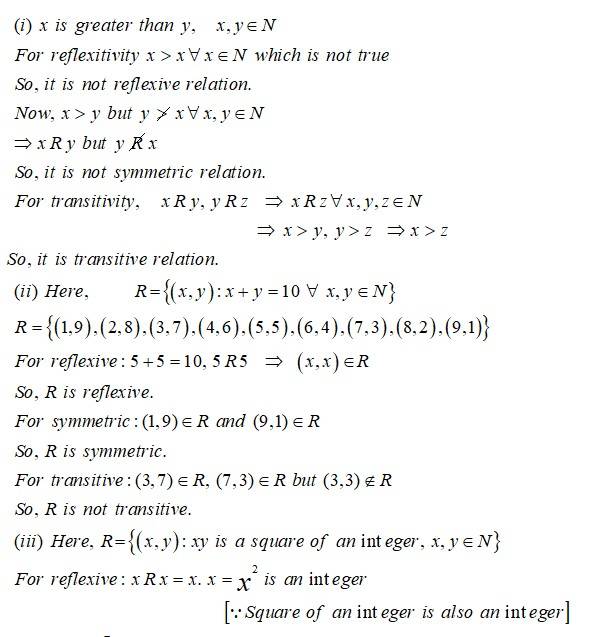
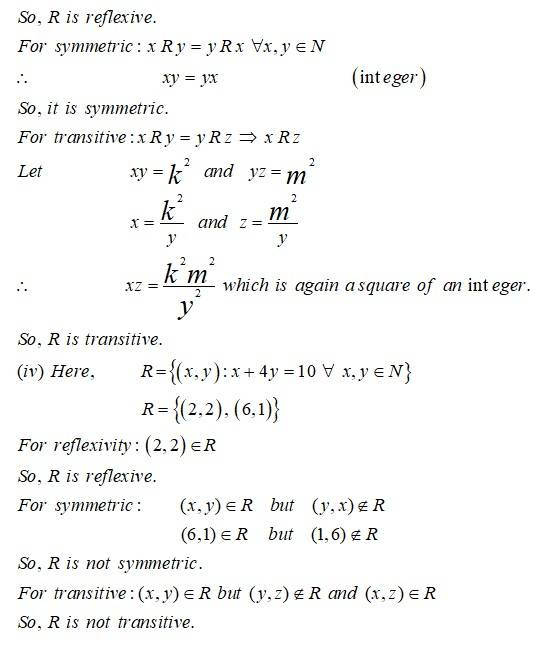
Each of the following defines a relation on :
(i) is greater than
(ii)
(iii)
(iv) .
Determine which of the above relations are reflexive, symmetric, and transitive.
This is a Long Answer Type Question as classified in NCERT Exemplar
Sol:
Upvote Let , Then, discuss whether the following functions defined on are one-one, onto, or bijective:
(i)
(ii)
(iii)
(iv) .
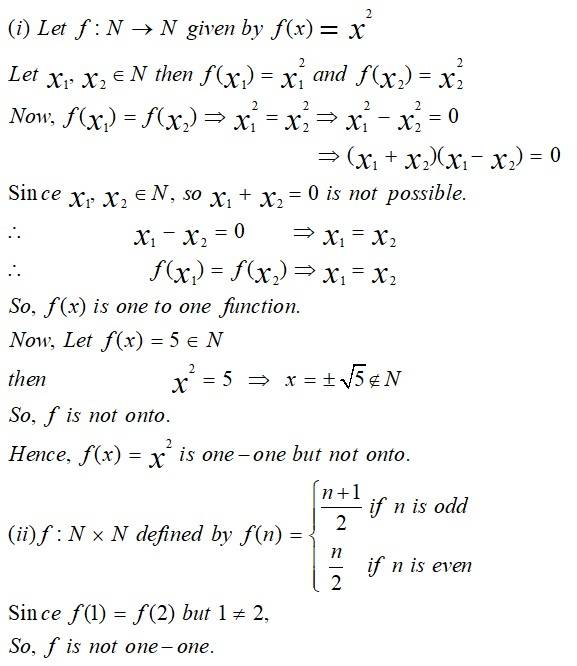
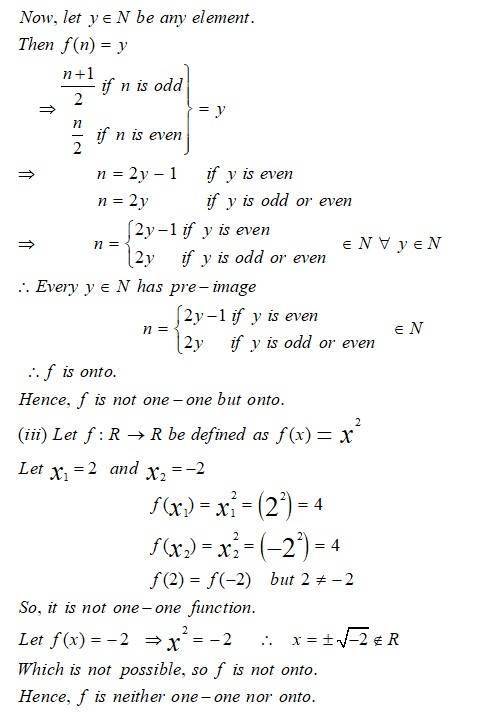
Let , Then, discuss whether the following functions defined on are one-one, onto, or bijective:
(i)
(ii)
(iii)
(iv) .
This is a Long Answer Type Question as classified in NCERT Exemplar
Sol:
Upvote Let . Let be defined by . Then Show that is bijective.
Let . Let be defined by . Then Show that is bijective.
This is a Long Answer Type Question as classified in NCERT Exemplar
Sol:
Upvote Give an example of a map:
(i) which is one-one but not onto
(ii) which is not one-one but onto
(iii) which is neither one-one nor onto.
Give an example of a map:
(i) which is one-one but not onto
(ii) which is not one-one but onto
(iii) which is neither one-one nor onto.
This is a Long Answer Type Question as classified in NCERT Exemplar
Sol:
Upvote Given , construct an example of each of the following:
(a) An injective mapping from to
(b) A mapping from to which is not injective
(c) A mapping from to .
Given , construct an example of each of the following:
(a) An injective mapping from to
(b) A mapping from to which is not injective
(c) A mapping from to .
This is a Long Answer Type Question as classified in NCERT Exemplar
Sol:
Upvote Let be a relation defined on the set of natural numbers N as follows:
. Find the domain and range of the relation . Also, verify whether is reflexive, symmetric, and transitive.
Let be a relation defined on the set of natural numbers N as follows:
. Find the domain and range of the relation . Also, verify whether is reflexive, symmetric, and transitive.
This is a Long Answer Type Question as classified in NCERT Exemplar
Sol:
Upvote