
Binomial Theorem
Get insights from 31 questions on Binomial Theorem, answered by students, alumni, and experts. You may also ask and answer any question you like about Binomial Theorem
- 31
Questions
- 0
Discussions
- 0
Active Users
- 0
Followers
Have a question about Binomial Theorem? Ask our experts
Keep it short & simple. Type complete word. Avoid abusive language.
If the sum of the coefficients of all the positive powers of x, in the Binomial expansion of is 939, then the sum of all the possible integral values of n is.
If the sum of the coefficients of all the positive powers of x, in the Binomial expansion of is 939, then the sum of all the possible integral values of n is.
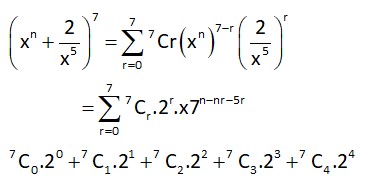
= 939
And r = 4 then
And r should not be 5
possible values of n are 7, 8, 9, 10, 11, 12
Sum of integral value of n = 57
 Upvote

<p><strong>Using binomial theorem, evaluate each of the following:</strong></p>
<p><strong>3. (102)<sup>5</sup></strong></p>
15. Find the expansion of (3x2– 2ax + 3a2)3 using binomial theorem.
15. Find the expansion of (3x2– 2ax + 3a2)3 using binomial theorem.
15.
=
We know that by binomial theorem,
=
=
Then,
= (3x2)3 + + +
= 27x6 + + +
= 27x6 + + + [ ]
= 27x6 + [ ] + [ ] + [ ]
= 27x6 +
= 27x6– 54ax5
Upvote 14. If a and b are distinct integers, prove that a – b is a factor of an– bn, whenever n is a positive integer.
[Hint: write an= (a – b + b)n and expand]
14. If a and b are distinct integers, prove that a – b is a factor of an– bn, whenever n is a positive integer.
[Hint: write an= (a – b + b)n and expand]
14. For (a – b) to be a factor of an – b nwe need to show (an – bn) = (a – b)k as k is a natural number.
We have, for positive n
an = =
=>an = nC0(a – b)n + nC1(a – b)n -1b + nC2(a – b)n – 2b2 + ………… +nCn-1 + nCnbn
=>an= + nC1 + nC2 + …………….…+ nCn-1 + [Since, nC0 = 1 and
Upvote 13. Find a if the coefficients of x2and x3in the expansion of (3 + ax)9are equal.
13. Find a if the coefficients of x2and x3in the expansion of (3 + ax)9are equal.
13. The general term of the expansion is
Tr+1 = 9Cr
= 9Cr
At r = 2,
T2+1 = 9C2
= 37a2x2
= / 37a2x2
= 36 ×37a2x2
At r = 3,
T3+1 = 9C3
= 36a3x3
= 9'8'7'6!/3'2'1'6! 36a3x3
= 84 ×36a3x3
Given that,
Co-efficient of = co-efficient of
=> 36 × = 84 ×
Upvote 12. Find a, b and n in the expansion of (a + b)n if the first three terms of the expansion are 729, 7290 and 30375, respectively.
12. Find a, b and n in the expansion of (a + b)n if the first three terms of the expansion are 729, 7290 and 30375, respectively.
1.The general term of the expansion (a + b)n is given by
Tr +1 = nCran–rbr
So, T1 = nC0an = an
T2 = nC1an-1b = an-1 b = an-1b = nan-1b
T3 = nC2an-2b2 = an-2b2 = an-2b2 = an-2b2
Given,
T1 = 729
=>an = 729 ------------------ (1)
T2 = 7290
=>nan–1b = 7290 ------------- (2)
T3 = 30375
=> an–2b2 = 30375
Upvote 11. Find a positive value of m for which the coefficient of x2in the expansion (1 + x)m is 6.
11. Find a positive value of m for which the coefficient of x2in the expansion (1 + x)m is 6.
11. The general term of the expansion is given by,
Tr+1 = mCr
= mCrxr
At r = 2,
T2+1 = mC2x2
Given that, co-efficient of x2 = 6
=>mC2 = 6
=> = 6
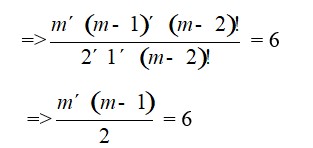
=>m2 – m = 12
=>m2 – m – 12 = 0
=>m2 + 3m – 4m – 12 = 0
=>m (m + 3) – 4 (m+ 3) = 0
=> (m – 4) (m + 3) = 0
=>m = 4 and m = –3
Since, we need a po
Upvote 10. Prove that the coefficient of xn in the expansion of (1 + x)2n is twice the coefficientof xn in the expansion of (1 + x)2n-1.
10. Prove that the coefficient of xn in the expansion of (1 + x)2n is twice the coefficientof xn in the expansion of (1 + x)2n-1.
10. General term of the expansion (1 + x)2n is
Tr+1 = 2nCr (1)2n-r(x)r
So, co-efficient of xn (i.e. r = n) is 2nCn
Similarly general term of the expansion (1 + x)2n–1 is
Tr+1 = 2n-1Cr (1)2n–1–rxr
And co-efficient of xn i.e. when r = n is 2n-1Cn
Therefore,
= 
= ÷
= ×
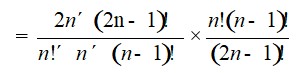
=
=
Upvote 9. The coefficients of the (r – 1)th, rthand (r + 1)thterms in the expansion of (x + 1)n are in the ratio 1 : 3 : 5. Find n and r.
9. The coefficients of the (r – 1)th, rthand (r + 1)thterms in the expansion of (x + 1)n are in the ratio 1 : 3 : 5. Find n and r.
9. The general term of the expansion (x +1)n is
Tr+1 = nCrxn–r1r
i.e. co-efficient of term = nCr
So, co-efficient of term =nC(r–1) – 1 = nCr – 2
Similarly, co-efficient of rth term = nCr – 1
Given that, nCr – 2 :nCr – 1 : nCr = 1 : 3 : 5
We have,

=
=> × =
Upvote